
When can you start c section scar massage safely?
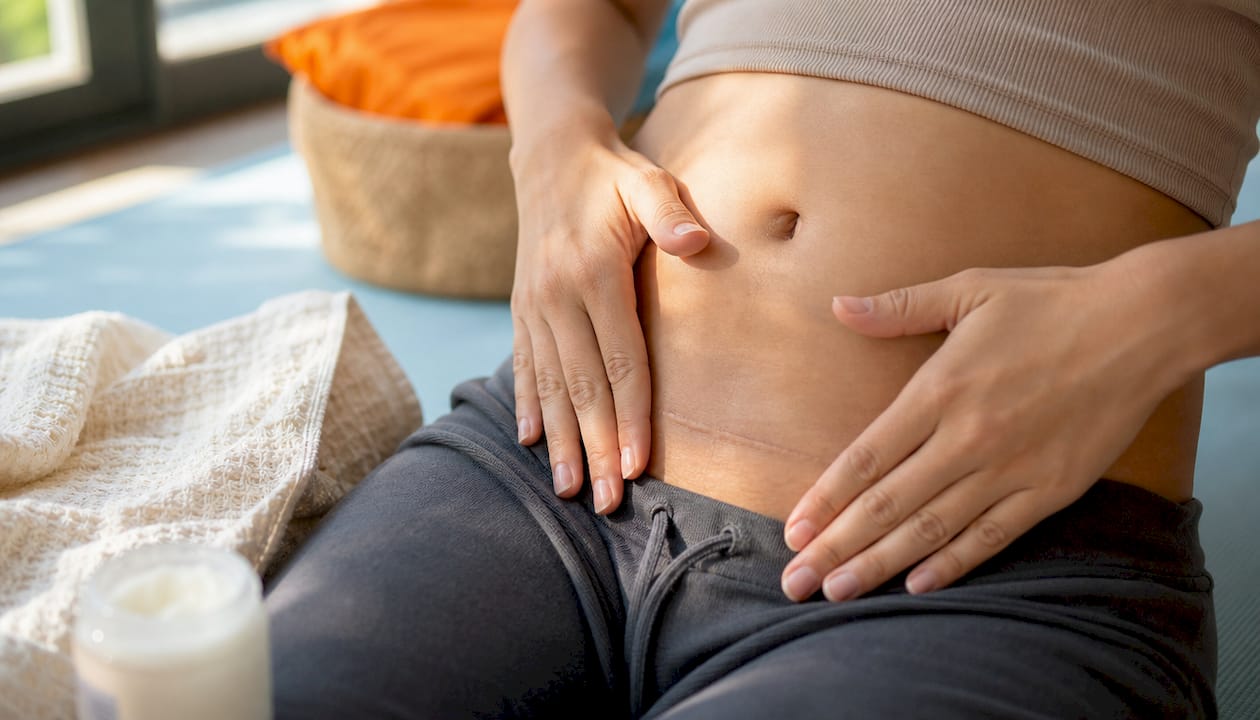
You can start c section scar massage once your incision has fully healed, typically 6 to 8 weeks after birth, and a GP, midwife, or physiotherapist has confirmed it is safe to begin. Done correctly, scar massage reduces tightness, calms itching, and gradually improves how the scar moves against the layers beneath it. The technique progresses in stages: gentle desensitisation first, then skin mobility work, then deeper mobilisation once the tissue tolerates more pressure.
Before you touch the scar, check the basics:
No scabs, oozing, or open areas anywhere along the incision
No redness, warmth, or swelling that looks worse than usual
Clearance from your GP, midwife or physiotherapist, usually confirmed at the 6 week postnatal check
No signs of infection or unusual discharge
Roughly 6 to 8 weeks is the standard healing window quoted in NHS physiotherapy guidance, and starting direct massage earlier risks reopening the wound.
Key Takeaways
Effective c section scar massage depends on correct timing, staged technique, and consistent short sessions rather than sporadic, heavy-handed effort.
Point | Details |
Wait for clearance | Start only once the incision is fully closed, typically 6 to 8 weeks, with sign off from a GP, midwife or physiotherapist. |
Follow the stages | Progress from desensitisation to skin mobility to deeper mobilisation rather than starting with firm pressure. |
Keep sessions short and regular | Five to ten minutes most days works better than occasional long sessions. |
Watch for red flags | Stop and seek review for increasing redness, swelling, discharge, or worsening pain. |
Escalate when needed | Parks Therapy Centre offers hands-on scar assessment and pelvic health physiotherapy when home massage plateaus or the scar feels tethered. |
Table of Contents
Why c section scar massage actually helps
Scar tissue does not form like the skin around it. When your body repairs the incision, it lays down collagen fibres in a disorganised, criss-crossed pattern rather than the neat, parallel alignment found in undamaged skin. That randomness is what makes a fresh scar feel tight, raised, or oddly numb. Massage encourages those collagen fibres to realign more uniformly and helps free up adhesions where the scar has stuck to the tissue layers underneath, which is why mobility often improves before appearance does.
Scar mobilisation techniques such as circular, vertical, horizontal, and skin-rolling movements are widely recommended by NHS physiotherapy teams to soften scars and restore movement, even though the research base behind specific protocols remains limited.
What you can realistically expect with consistent practice:
Reduced pulling or tightness when you bend, stretch, or stand tall
Less itching and altered sensation around the scar line
Better mobility of the abdominal skin and underlying tissue
Some softening and flattening of raised or thickened areas
Possible, though not guaranteed, cosmetic improvement over time
Here is the part most women are not told: scar tissue keeps remodelling for a prolonged period after surgery. That means a scar you consider “finished” at four months can still respond to massage a year later, and it is one reason older scars can still improve with regular, targeted manual therapy. Consistency matters more than intensity. Ten focused minutes most days will do more than one heavy-handed session a week.
When is it safe to start massaging your scar?
Timing is the single most important safety factor in this entire process. Massaging too soon, before the incision has properly closed, risks reopening tissue that is still fragile underneath a deceptively normal-looking surface.
The general rule clinicians use:
Wait until the scar is fully closed, with no scabbing, oozing, or broken skin anywhere along the line.
Confirm there is no redness, warmth, or swelling beyond what is normal for a healing scar.
Get clearance from your GP, midwife or physiotherapist, ideally at your 6 to 8 week postnatal check.
Start gently and build up. Day one should feel more like exploration than deep treatment.
If you had a wound infection, delayed healing, or any complication during recovery, wait for specific sign-off rather than following the standard timeline. Women with a personal or family history of keloid scarring should also flag this at the postnatal check, since keloid-prone tissue can respond differently to manual pressure and may need a modified approach or dermatology input.
Pro Tip: If you’re not sure whether your scar has healed enough, run a clean finger very lightly along the line. If it stings, looks fragile, or you can see any break in the skin, it is too early. Healed scar tissue should feel intact, even if it is still numb or tight.
Getting ready for a scar massage session
A few minutes of preparation makes the difference between a session that feels uncomfortable and one that feels genuinely soothing.
Warm the area first. A warm bath, shower, or a warm compress held over the scar for a few minutes relaxes the surrounding tissue and makes it more receptive to touch.
Wash your hands thoroughly before you start, and keep nails short to avoid catching the skin.
Use a lubricant. A plain massage oil or an emollient such as E45 reduces friction and lets your fingers glide rather than drag, unless your physiotherapist has advised against it for a specific reason.
Get comfortable. Lie down with your knees bent and supported by a pillow, which relaxes the abdominal muscles and gives you easier access to the scar.
Keep sessions short. Five to ten minutes is genuinely enough. This is not a task that rewards marathon effort.
Pick a time when you are not rushed. Many women find it easiest to combine scar massage with an existing routine, straight after a shower works well, so it becomes automatic rather than another thing to remember.
How to massage your c section scar step by step
This is where most guides skip detail, and where detail actually matters. Scar massage works best as a staged progression rather than a single technique repeated blindly. Each stage builds tolerance for the next, and rushing ahead before the tissue is ready tends to cause more discomfort, not faster results.
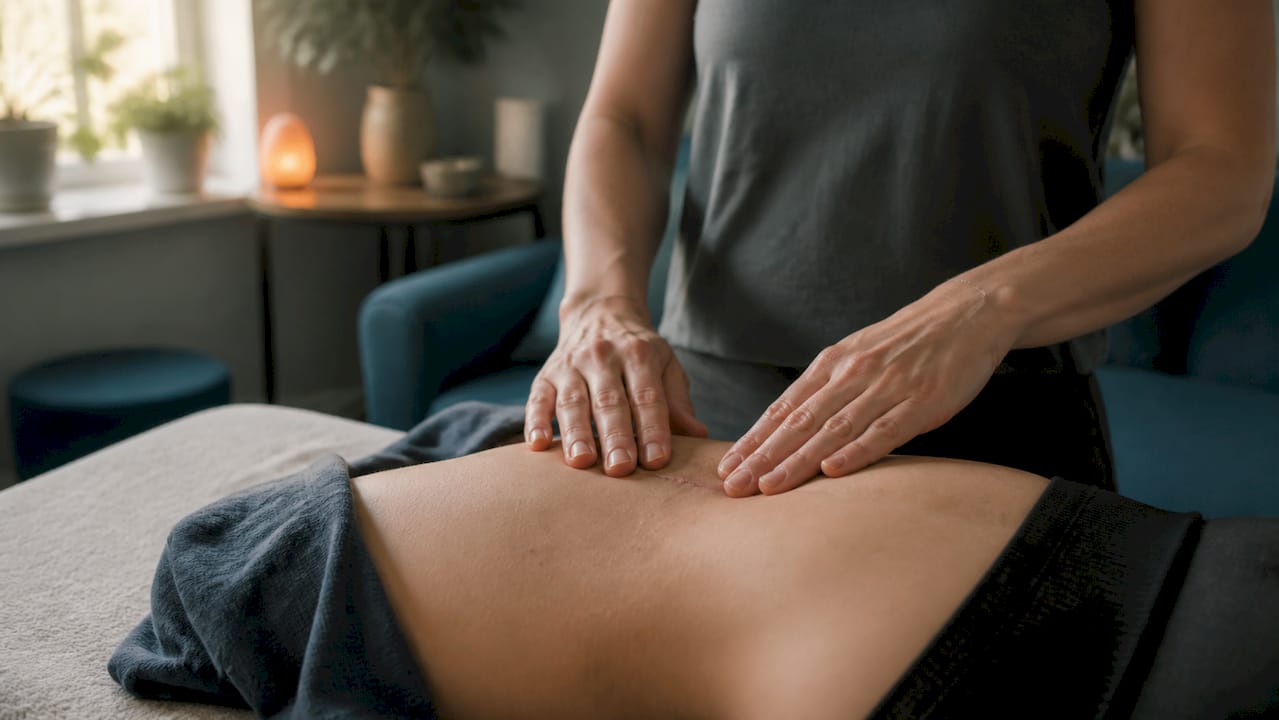
Stage 1: desensitisation
If the area around your scar feels numb, oddly sensitive, or you flinch at the thought of touching it, start here rather than skipping straight to firmer techniques.
Use a soft cloth, cotton wool, or simply your fingertips to stroke the skin around the scar, not directly on it yet.
Vary the pressure and texture: light strokes, then slightly firmer ones, moving in different directions.
Spend one to two minutes on this before moving closer to the scar line itself.
Progress once the area tolerates touch without excessive discomfort or a strong urge to pull away.
This stage matters more than it sounds. Nerve endings around a caesarean scar are often disrupted during surgery, and reintroducing normal sensory input gradually helps recalibrate how the area feels touch, rather than leaving it permanently oversensitive or numb.
Stage 2: skin mobility
Once desensitisation feels manageable, move on to mobilising the skin itself, working the tissue rather than just the surface.
Circular motions: small circles directly over and around the scar, using one or two fingers, moving slowly.
Up-and-down strokes: gentle vertical movements along the length of the scar line.
Side-to-side motions: horizontal strokes across the scar, which help address tightness that runs perpendicular to the incision.
Pressure at this stage should feel firm but never sharp or painful. A useful way to judge it: press until you feel resistance in the tissue, similar to pressing into slightly stiff dough, then hold or move within that range rather than pushing through it.
Stage 3: scar line and deeper mobilisation
Once the skin moves reasonably freely, staged techniques that work deeper layers become appropriate.
Pinch and roll: gently pinch the scar and surrounding tissue between thumb and forefinger, rolling it slightly as you move along the length of the scar. This targets adhesions between the skin and the layers beneath.
Vertical mobilisation: using flat fingers, push the tissue on one side of the scar upward while the other hand stabilises, then reverse.
Horizontal mobilisation: the same principle applied side to side, encouraging the scar to move independently of the tissue around it.
Some pulling or mild discomfort is normal here. Sharp pain is not, and is your signal to ease off immediately rather than push through it.
Pro Tip: Breathe deeply into your abdomen while working on deeper layers. Relaxed breathing softens the rectus muscles and reduces the instinctive guarding that makes deeper mobilisation feel harder than it needs to.
How often should you massage a c section scar?
Frequency matters as much as technique, and the pattern that works best changes as the scar matures. Early consistency drives most of the improvement; later sessions are largely maintenance.
Phase | Frequency and duration |
First few weeks after clearance | 5 to 10 minutes daily |
Months 2 to 4 | 5 to 10 minutes daily |
Beyond month 4 | 2 to 3 times weekly, as tolerated |
Long term (if tightness persists) | Occasional sessions, guided by symptoms |
Physiotherapy guidance generally recommends, daily sessions in the early weeks, tapering as mobility and comfort improve. Track progress loosely rather than obsessively: note whether bending feels easier, whether itching has settled, and whether the scar line looks less raised. Improvement tends to arrive in small increments over months, not a single dramatic shift, so judge success over a six-week window rather than session to session.
When to stop massaging and see a clinician
Certain signs mean you should stop scar massage immediately and get it checked, rather than pushing through in the hope it settles.
Increasing redness, warmth, or swelling around the scar
Any bleeding, new discharge, or an unusual smell
Pain that gets worse rather than better with massage
A fever, or feeling generally unwell alongside scar symptoms
The scar reopening, even slightly
These red flags point towards possible infection or a healing complication, and warrant a call to your GP, midwife or physiotherapist rather than a wait-and-see approach. Beyond acute warning signs, some women find home massage plateaus, mobility stays restricted, deep pulling continues, or pain persists despite weeks of consistent effort. That is a reasonable point to ask for referral to pelvic health physiotherapy, particularly if the scar seems tethered to deeper layers or is affecting how you move day to day.
What can a physiotherapist do that home massage cannot?
Home massage has real limits, and knowing where they sit helps you decide when to seek hands-on help rather than persisting alone.
A pelvic health or scar physiotherapist can assess the scar’s depth of restriction with hands-on testing that is difficult to judge on yourself.
They can apply deeper release techniques, including instrument-assisted soft tissue mobilisation, that go beyond what self-massage typically achieves.
They can combine manual therapy with adjuncts such as silicone gel or strips for cosmetic management, or taping to reduce mechanical load across the healing area.
They can identify when a scar issue needs surgical review rather than manual therapy.
A recent biomechanical review frames scar rehabilitation around three tiers: reducing load transfer across the scar, providing passive stabilisation, and mitigating external mechanical forces. Manual therapy, silicone, and taping are reasonably well supported for superficial abdominal scars, but the same review is clear that external mechanotherapy for a uterine niche remains unproven and should not be presented as an established treatment.
That distinction matters if you have read claims online about massage resolving deeper surgical issues. Superficial scar work is genuinely supported. Anything involving suspected uterine niche or persistent internal symptoms needs proper clinical assessment, not a massage protocol. At Parks Therapy Centre, our physiotherapists assess scars against exactly this kind of framework, distinguishing what manual therapy can reasonably achieve from what needs onward referral.
A note on patience and realistic progress
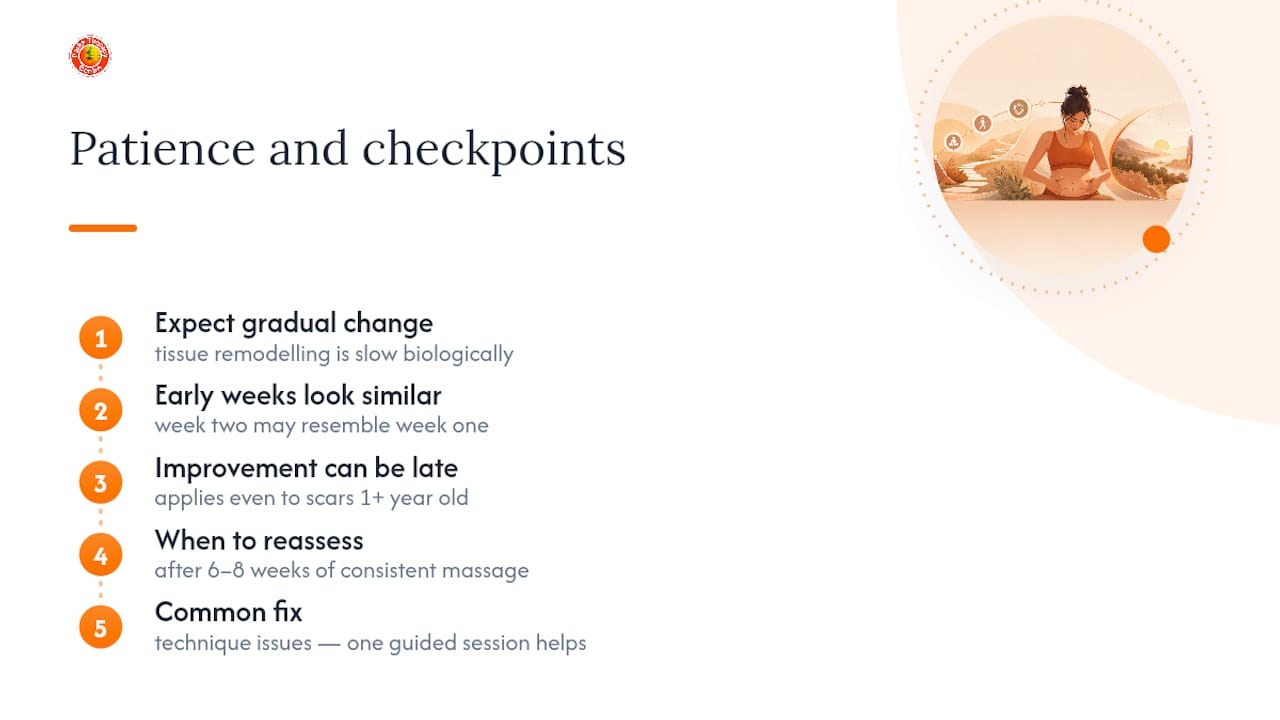
Scar healing rewards patience more than intensity. Many women expect visible change within days and feel discouraged when week two looks much like week one, but tissue remodelling is a slow biological process, not a switch that flips.
What I would want any woman reading this to hold onto: gradual improvement is the norm, not the exception, and it applies even to scars that are a year or more old. If you have been consistent for six to eight weeks and still feel stuck, that is not failure. It is a reasonable point to ask for hands-on assessment rather than assuming massage alone should have fixed things by now. Sometimes the missing piece is technique, not effort, and a single guided session can correct that.
— Ivan
Book a scar assessment with Parks Therapy Centre
If home massage has plateaued or you would rather have your technique checked from the start, Parks Therapy Centre offers hands-on scar assessment that a self-taught routine simply cannot replicate, direct manual testing of how your scar moves against the layers beneath it, not just guidance from a leaflet.
Our physiotherapists combine scar mobilisation with broader postnatal rehabilitation, including core and pelvic floor assessment, so you are not treating the scar in isolation from the rest of your recovery. At a first appointment, expect a discussion of your surgery and healing so far, a physical assessment of scar mobility and any tethering, and a personalised plan covering technique, frequency, and whether adjuncts such as taping or silicone might help. We accept a wide range of insurance providers and see patients across our Bedfordshire and Buckinghamshire clinics, so ongoing care fits around your schedule rather than the other way round. If your scar still pulls, itches, or feels restricted, book a physiotherapy assessment and get a clear, hands-on plan for what comes next.
Sources
This article is general information, not a substitute for advice from a qualified doctor. Consult a qualified healthcare professional about your own circumstances before acting on anything here.
Recommended