
Cervical radiculopathy exercises: a 6-week home programme

Deep cervical flexor training, neural glides, targeted stretching, scapular strengthening and, in some cases, intermittent traction form the backbone of effective cervical radiculopathy exercises. Most people respond well to this combination when it is progressed gradually and paired with physiotherapy supervision.
Before starting anything, know the warning signs that mean stop and seek urgent assessment: worsening arm weakness, an unsteady walk, any change in bladder or bowel control, or severe pain that will not settle. None of these are things to work through with exercise.
Start gently. Let pain guide your range of movement in the early days, then build towards endurance and strength as your neck tolerates more load. This is the order that clinical guidance and physiotherapy practice both support, and it is what the rest of this guide walks through, stage by stage.
Key Takeaways
Cervical radiculopathy responds best to a staged combination of motor control training, neural mobilisation, targeted stretching and scapular strengthening, progressed gradually under symptom guidance.
Point | Details |
Start with motor control | Chin tucks in supine, sitting and standing build the deep neck flexor control that unloads the irritated nerve root. |
Progress gradually | Increase reps or hold time every one to two weeks rather than adding resistance too soon. |
Watch for red flags | Progressive arm weakness, gait changes or bladder/bowel disturbance need urgent assessment, not more exercise. |
Most cases improve conservatively | Good to excellent recovery is typical with consistent nonsurgical care over weeks to months. |
Get supervised when stuck | Parkstherapycentre offers physiotherapy assessment, manual therapy and supervised progression when home exercise plateaus. |
This article is general information, not a substitute for advice from a qualified doctor. Consult a qualified healthcare professional about your own circumstances before acting on anything here.
Table of Contents
How cervical radiculopathy exercises actually work
Cervical radiculopathy happens when a nerve root in your neck gets compressed or irritated, usually from a disc bulge or bony narrowing pressing on the space it needs. Exercise addresses this from several angles at once, not just one.
Mobility work opens up the space the nerve travels through. Motor control training, particularly of the deep neck flexors, reduces strain on the segment that is irritated. Neural mobilisation techniques calm an oversensitised nerve without stretching it aggressively. Scapular and thoracic conditioning shifts load away from the neck and onto stronger, larger muscle groups that were never designed to sit idle.
The categories covered below work together rather than in isolation:
Motor control and strengthening – chin tucks and scapular stabiliser work to unload the affected segment
Neural mobilisation – gentle nerve glides to reduce irritability
Stretching – scalene, upper trapezius and pectoral release to ease mechanical compression
Traction – used selectively, when symptoms suggest compression relief will help
None of this replaces good daily habits. Adjusting your desk setup, applying heat before stretching or ice after a flare, and staying generally active rather than resting completely all support the exercise programme rather than compete with it.
Building neck strength and motor control safely
Deep cervical flexor training is usually the first thing a physiotherapist teaches, because a weak, poorly controlled neck struggles to protect an irritated nerve root under any load.
Lie on your back, knees bent, head in neutral. Gently nod your chin as if saying “yes” in a very small, slow movement, lengthening the back of your neck without lifting your head off the surface. Hold for 5 to 10 seconds, then release.
Progress to sitting, spine tall, and repeat the same small nod. A useful cue is to imagine flattening a soft roll under your chin rather than jutting it forward or down.
Progress to standing, ideally against a wall, then away from support once the movement feels controlled.
The most common error is substituting a big head-bobbing motion or bracing the jaw. The nod should be small and almost invisible to someone watching. Aim for 5 to 10 repetitions, 3 to 5 times a day initially, and add hold time or light manual resistance every one to two weeks as tolerance improves, in line with standard physiotherapy dosage guidance.
Scapular stabiliser work follows the same logic. Scapular retractions (squeezing shoulder blades gently together and holding), wall slides, and resistance band rows all build the shoulder girdle’s capacity to share load with the neck. Start with 10 repetitions, two to three sets, most days of the week.
Pro Tip: Film yourself doing a chin tuck from the side once a week. Most people cannot feel the difference between a correct small nod and a forward-jutting movement, but the camera never lies.
Do nerve glides and traction help radiculopathy pain?
Neural mobilisation, often called nerve gliding or flossing, moves the nerve gently through its surrounding tissue rather than stretching it. Done correctly, it can settle nerve sensitivity rather than provoke it.
Sit tall, arm out to the side, elbow bent, palm facing your ear.
Slowly straighten your elbow while gently tilting your head away from that arm, moving only until you feel a mild pull, never sharp pain.
Return to the start position slowly and repeat.
Keep the rhythm slow and stay well within a comfortable range. Aim for 10 repetitions, 2 to 3 times a day, and increase range before you increase speed.
Intermittent traction, whether applied manually by a physiotherapist or through a mechanical device, can relieve symptoms for some people by briefly opening the space around the nerve root. Mechanical traction has shown better outcomes than manual traction in limited comparative research, though evidence overall remains modest, which is why it is usually offered as an adjunct rather than a standalone fix.
Stop any nerve glide or traction immediately if you notice:
Increasing numbness, tingling or weakness down the arm
Sharp, shooting pain during the movement
Symptoms that spread further than before you started
Stretching for neck and shoulder tightness
Tight scalene, upper trapezius, levator scapulae and pectoral muscles can all narrow the space a nerve root needs, so releasing them is not just about comfort.
Upper trapezius stretch: tilt your ear towards your shoulder, gently assist with your hand, hold 20 to 30 seconds.
Levator scapulae stretch: turn your head about 45 degrees, then look down towards your armpit, hold 20 to 30 seconds.
Scalene stretch: tilt your head back slightly and to one side, holding lightly, 15 to 20 seconds.
Pectoral stretch: stand in a doorway, forearm on the frame, gently lean forward, hold 20 to 30 seconds.
Thoracic extension over a foam roller or rolled towel, plus seated thoracic rotations, to restore mid-back movement that often compensates poorly when the neck is guarded.
If a stretch increases arm symptoms rather than local tightness, ease off the range or skip it that day.
Pro Tip: Stretch after strengthening work, not before. Warmed, activated muscles release more readily, and you are less likely to overstretch a joint that still needs stability.

How much should you do, and when should you stop?
Progression should follow your symptoms, not a fixed calendar. Build repetitions and hold times before you add resistance, and increase load only once the previous stage feels easy rather than merely tolerable.
Exercise Phase | Typical Reps/Sets | Frequency | Progression Cue |
Early (motor control) | 5 to 10 reps, short holds | 3 to 5 times daily | Comfortable, pain-free small movement |
Mid (endurance) | 10 reps, longer holds | 2 to 3 times daily | Hold time increases without symptom flare |
Late (strengthening) | 10 to 15 reps, 2 to 3 sets | Most days | Light resistance added without arm symptoms |
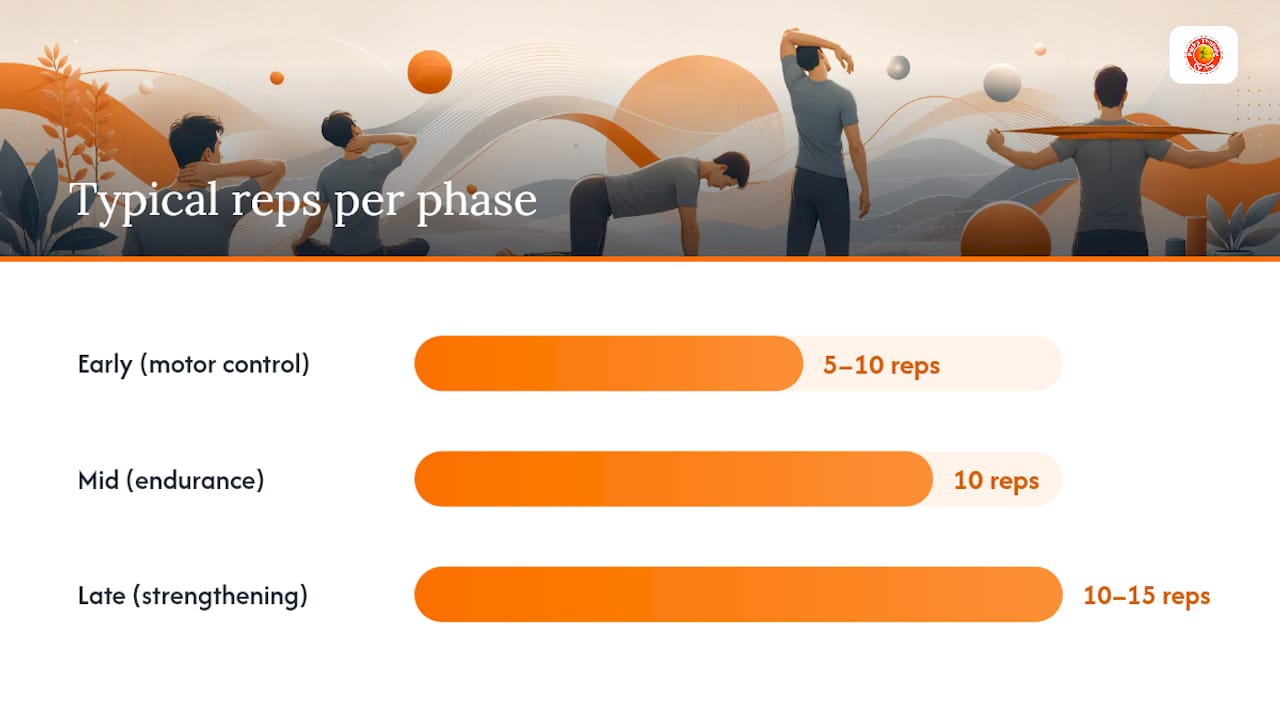
This staged approach reflects recommended practical dosage for neck rehabilitation, where repetitions or hold times typically increase every one to two weeks.
Seek urgent medical review if you notice any of the following, rather than continuing to exercise through them:
Progressive weakness in the arm or hand
Changes in walking, balance or coordination
New bladder or bowel disturbance
Severe, unremitting pain that does not ease with rest or position change
If pain persists despite consistent conservative care, surgery is generally only considered after 6 to 12 weeks of nonsurgical treatment, or sooner if neurological deficits are severe or worsening. A short period in a soft collar can ease an acute flare, but wearing one for weeks tends to weaken the muscles you are trying to retrain, so treat it as a brief measure, not a long-term aid.
A 6-week home programme for cervical radiculopathy
This programme assumes symptoms are manageable and there are no red flags present. Work with a physiotherapist if you are unsure whether you fit that description.
Weeks 1 to 2 (early): Chin tucks in supine and sitting, gentle nerve glides, light scalene and upper trapezius stretching. Keep sessions short and frequent, 3 to 5 times daily.
Weeks 3 to 4 (mid): Progress chin tucks to standing, add scapular retractions and wall slides, introduce thoracic extension drills. Reduce frequency slightly but increase hold times.
Weeks 5 to 6 (late): Add light resistance band rows, progress nerve glides through fuller range, continue stretching as maintenance. Aim to tolerate 10 holds of 10 seconds on chin tucks before adding any resistance work.
Milestones matter more than the calendar. If week 3 still feels like week 1, stay there rather than pushing forward on schedule alone.
For anyone with higher pain levels, drop repetitions rather than skipping sessions entirely, and favour shorter, more frequent bouts. Adding a daily walk supports general recovery, and small ergonomic changes, screen height, chair support, phone position, reduce the load your neck carries between exercise sessions. Similar principles apply to managing desk-related neck strain day to day.
Adherence beats intensity here. Most people notice gradual change over weeks rather than days, and consistency with a modest programme outperforms sporadic bursts of ambitious exercise.
What does the evidence say about recovery?
Most people diagnosed with cervical radiculopathy see good to excellent recovery through nonsurgical treatment, typically improving over several weeks to a few months of consistent conservative care.
Clinical guidance from the North American Spine Society supports imaging before surgical decompression when the diagnosis or affected level isn’t clear, reinforcing that surgery follows a structured decision process rather than an early default. Recovery still varies by individual: severity at diagnosis, how quickly treatment starts, and adherence to the programme all shape the timeline. Evidence is strong on the overall direction of conservative care but less precise on predicting any one person’s exact recovery speed.
When to see a physiotherapist for cervical radiculopathy treatment
A physiotherapy assessment for cervical radiculopathy typically covers your symptom history, a neurological screen of strength, reflexes and sensation in the arm, and movement testing to identify which positions ease or provoke your symptoms. From there, your programme is built around what your neck actually needs, not a generic template.
Clinic-based care can offer things a home programme cannot: hands-on manual therapy, supervised progression of resistance and range, intermittent mechanical traction where appropriate, and referral into wider multidisciplinary care if your case needs it.
Book an assessment if home exercise hasn’t shifted your symptoms after a few weeks, or sooner if you notice any progressive neurological signs. Understanding what a physiotherapy assessment involves beforehand can make that first appointment feel far less daunting.
History taking and symptom mapping
Neurological screening (strength, reflexes, sensation)
Movement and posture assessment
Tailored exercise progression with hands-on treatment where needed
A clinician’s view on staying consistent
Patients who do best tend to keep moving within sensible limits rather than waiting for pain to disappear before starting. Most cases genuinely improve with guided conservative care. Escalation is the exception, not the rule, but it matters that you know the signs.
Book supervised physiotherapy for cervical radiculopathy
Home exercises get most people moving in the right direction, but a supervised programme catches the small technique errors, like a chin tuck that has quietly turned into a head bob, that keep symptoms lingering longer than they need to. Parkstherapycentre has been treating musculoskeletal and nerve-related neck conditions since 1986, across clinics in Bedfordshire and Buckinghamshire, with physiotherapists who can adjust your programme week to week rather than leave you guessing.

A typical pathway includes a full physiotherapy assessment, manual therapy alongside your exercise programme, supervised progression of resistance and range, clinic-supported traction where it’s appropriate, and referral into other services such as acupuncture if your case calls for it. If you notice progressive arm weakness, changes in walking, or any bladder or bowel disturbance, seek urgent medical care promptly.
Book a physiotherapy assessment to get a programme built around your specific symptoms and progress, checked and adjusted by someone qualified to catch what you can’t see yourself.
Sources
Recommended