
Desk neck pain: quick fixes and a clinician-backed plan
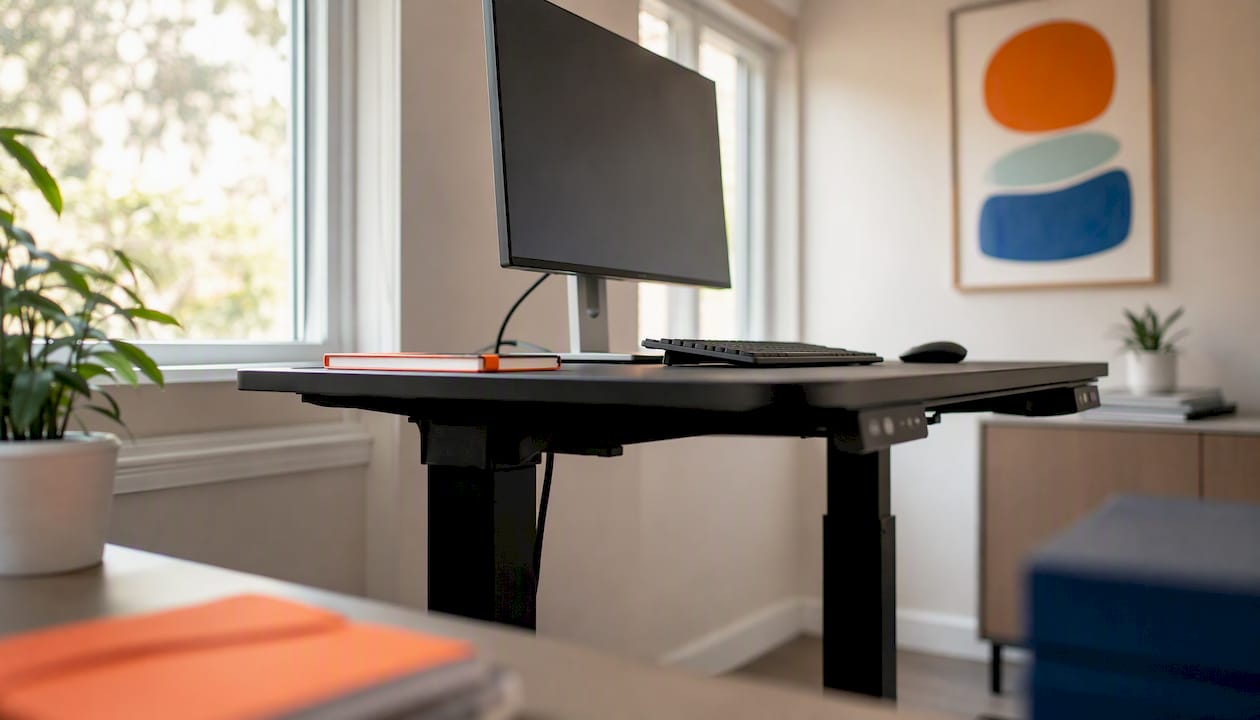
You can reduce most desk-related neck pain today by raising your screen to eye level, resetting your head to a neutral position, and taking a two-minute movement break every half hour or so. These three changes address the most common mechanical drivers before anything else.
Do these in the next five minutes:
Raise your monitor so the top of the screen sits at or just below eye level, about an arm’s length away.
Perform a chin tuck: gently draw your chin straight back (not down) until you feel a light stretch at the base of your skull. Hold for five seconds.
Stand up, roll your shoulders back five times, and walk for two minutes.
If you experience numbness or tingling down one arm, sudden weakness in your hands, dizziness, or any loss of bladder or bowel control alongside neck pain, seek urgent medical assessment rather than self-managing.
Key takeaways
Consistent ergonomic correction combined with a daily stretch-and-strengthen routine addresses the two root causes of desk neck pain and produces measurable improvement for most people within four to eight weeks.
Point | Details |
Fix the workstation first | Raise your monitor to eye level and set keyboard at elbow height before adding any exercises. |
Stretch and strengthen together | Pairing scapular strengthening with chest and neck stretching restores muscle balance; strength alone can worsen posture. |
Move every 30–45 minutes | Short position changes throughout the day reduce cumulative spinal load more effectively than exercise volume alone. |
Expect improvement in 4–8 weeks | Daily routines typically reduce tension within 1–2 weeks; measurable postural change takes 4–8 weeks of consistency. |
Parkstherapycentre for assessment | For persistent or neurological symptoms, Parkstherapycentre offers directional physiotherapy assessment across Bedfordshire and Buckinghamshire. |
Table of Contents
Why does desk work cause neck pain?
The clinical term for desk-related neck discomfort is postural syndrome, a temporary mechanical deformation of soft tissues caused by sustained loading rather than structural damage. Poor posture and prolonged static positions are among the most common causes of neck pain, with symptoms typically worsening the longer the head is held in one position.
Forward head posture is the central problem. For every inch the head moves forward of the shoulders, the effective load on the cervical spine increases substantially. At a neutral position the head weighs roughly 10–12 lbs; at a 60-degree forward tilt, that load can feel equivalent to 60 lbs on the cervical structures. Bending the head forward to view screens increases mechanical load on the neck, and long combined screen time fatigues both the neck and upper back.
Two secondary problems compound the issue. Tight anterior chest muscles (pectorals and anterior scalenes) pull the shoulders forward and reinforce the rounded posture. Simultaneously, the deep cervical flexors and scapular stabilisers weaken from disuse, removing the muscular support the cervical spine depends on. The result is a self-reinforcing cycle: poor posture weakens the muscles that would correct it.
Pro Tip: Strengthening the upper back without actively stretching the chest and anterior neck tissues can actually entrench forward head posture rather than correct it. Physiotherapists recommend pairing upper-back strengthening with active chest and neck stretching to restore genuine muscle balance.
How to fix your desk setup in minutes
Small workstation adjustments produce immediate reductions in cervical load. Work through these in order.
Monitor height and distance. Position the top of your screen at or slightly below eye level. Place the screen about an arm’s length away so you are not craning forward to read. A monitor that sits too low forces sustained downward gaze, the primary driver of forward head posture at a desktop.
Chair height and lumbar support. Adjust your chair so your feet rest flat on the floor (or on a footrest) and your hips sit at roughly 90–100 degrees. Engage the lumbar support so your lower back is gently supported; this naturally encourages the thoracic spine to extend, which in turn reduces cervical flexion.
Keyboard and mouse position. Keep both at elbow height with your elbows close to your sides. Reaching forward for a mouse elevates and protracts the shoulder, loading the upper trapezius and levator scapulae directly.
Phone and headset. Never cradle a handset between your ear and shoulder. Use a headset or speakerphone for calls longer than a minute. Shoulder-cradling a phone is one of the fastest ways to accumulate unilateral neck strain during the working day.
Lighting and glare. Position your screen perpendicular to windows rather than facing them. Glare on the screen causes you to lean forward or tilt your head to reduce reflection, both of which increase cervical load. Adjust screen brightness to match ambient light so you are not squinting.
Pro Tip: Laptop users face a structural problem: the screen is always too low when the keyboard is at the right height. Use an external keyboard and mouse with a laptop stand or monitor riser. This single change removes the most common source of sustained neck flexion for home and hybrid workers. For ergonomic tips for home-working setups, a structured checklist can help you verify each adjustment.
Is your workstation actually set up correctly?
Use this checklist to verify your setup in under two minutes. Tick each item; any unchecked row is a priority adjustment.
Workstation item | What to check | Quick verification |
Screen height | Top of screen at or just below eye level | Sit back in your chair and look straight ahead — your gaze should land on the top third of the screen |
Viewing distance | Roughly an arm’s length | Extend your arm; fingertips should nearly touch the screen |
Chair height | Feet flat, hips at 90–100 degrees | Thighs roughly parallel to the floor, no pressure behind the knees |
Lumbar support | Lower back gently supported | Slide a hand behind your lower back — there should be light contact with the support |
Keyboard and mouse | At elbow height, close to body | Elbows bent at roughly 90 degrees, shoulders relaxed |
Foot support | Feet fully supported | No dangling feet; use a footrest if the chair cannot go low enough |
Document holder | Source documents at screen height | No repeated downward glancing at papers flat on the desk |
Headset | Used for calls over one minute | Handset not cradled between ear and shoulder |
For a broader view of how ergonomics supports injury prevention across different working environments, the principles extend well beyond the neck.
Workstation format comparison
Format | Postural load | Movement frequency | Best suited for |
Seated desktop with external monitor | Low when correctly set up | Moderate — requires deliberate breaks | Full-day office or home-office workers |
Laptop with stand and external keyboard | Low when stand is used; high without | Moderate | Hybrid workers and those moving between locations |
Sit–stand desk | Variable — reduced when alternating | High — standing naturally prompts more movement | Anyone with persistent postural symptoms or sedentary roles |
Safe stretches and strengthening exercises for desk neck
A focused daily routine targeting the deep cervical flexors, scapular stabilisers and thoracic spine can reduce neck tension within 1–2 weeks and show measurable postural improvement over 4–8 weeks for many people. Perform these in order; they progress from mobility to stability.
Chin tuck. Sit tall. Draw your chin straight back without tilting your head down. Hold for 5 seconds. Repeat 10 times. This activates the deep cervical flexors and directly counters forward head posture.
Upper trapezius stretch. Sit upright, hold the underside of your chair with one hand, and gently tilt your head away from that side until you feel a stretch along the side of your neck. Hold 20–30 seconds each side. Repeat twice.
Levator scapulae stretch. Turn your head 45 degrees to one side, then tuck your chin toward your armpit. Hold 20–30 seconds. This targets the muscle most commonly overloaded by sustained forward head posture.
Scapular retractions. Sit or stand. Squeeze your shoulder blades together and slightly downward, as if trying to hold a pencil between them. Hold 5 seconds, release fully. Repeat 15 times. This reactivates the mid-trapezius and rhomboids.
Wall angels. Stand with your back, head, and arms against a wall. Slowly slide your arms upward into a Y shape, keeping contact throughout. Perform 10 slow repetitions. This combines thoracic extension with scapular control.
Thoracic extension over a foam roller. Place a foam roller horizontally across your mid-back. Support your head with your hands and gently extend over the roller for 30–60 seconds, moving it up one vertebral level at a time. This directly addresses the thoracic stiffness that drives compensatory cervical flexion.
Safety cautions. Stop and seek clinical assessment if any exercise produces pain radiating down your arm, numbness or tingling in the hands, dizziness, or a significant increase in headache. These may indicate a directional sensitivity that requires individual assessment rather than a generic programme.
Pro Tip: Pair this daily routine with your workstation adjustments from day one. The exercises correct muscle imbalance; the ergonomic changes stop the imbalance from being recreated eight hours a day. One without the other produces slower, less durable results.
Building movement habits that protect your neck at work
The primary driver of desk-related neck pain is not insufficient exercise volume; it is sustained static loading. Changing position every 20–60 minutes resets muscle tension and restores blood flow, reducing the cumulative strain that builds across a working day.

A practical rhythm that works for most desk workers: a two-minute micro-reset every 30–45 minutes (stand, shoulder rolls, chin tuck, brief walk to the printer or kitchen), and a five-minute fuller break every 90 minutes that includes two or three of the stretches above. You do not need to leave your desk for the micro-reset; standing and rolling your shoulders for 90 seconds is sufficient.
Practical ways to make this stick:
Set a repeating timer on your phone or computer for 35 minutes. When it sounds, stand before you dismiss it.
Use natural workflow transitions (end of a document, a phone call, a video meeting) as movement cues rather than relying solely on timers.
Keep a full water bottle on your desk. Hydration supports muscle recovery, and refilling it creates a natural movement prompt every hour or so.
Sleep and stress matter more than most desk workers realise. Poor sleep reduces the body’s ability to clear inflammatory mediators from overloaded tissues, and sustained psychological stress increases resting muscle tension in the upper trapezius and suboccipital muscles. A short mindfulness or breathing practice at the end of the working day (even five minutes of diaphragmatic breathing) can measurably reduce this resting tension. Stress management is not a soft add-on; it is a genuine component of pain management for musculoskeletal conditions.
When should you see a GP or physiotherapist?
Most desk-related neck pain responds to consistent self-management within four to six weeks. Seek clinical assessment sooner if any of the following apply:
Numbness, tingling or weakness in one or both hands or arms
Pain that radiates from the neck into the shoulder blade or down the arm
Dizziness, balance problems, or visual disturbance associated with neck movement
Headaches that are new, severe, or worsening
Any bowel or bladder changes alongside neck symptoms
Pain that is rapidly worsening despite rest and self-care
For symptoms that are uncomfortable but not neurological, the NHS advises that persistent pain lasting more than a few weeks warrants professional review. A physiotherapist can assess whether your symptoms have a directional preference, which guides a more targeted exercise programme than a generic routine.
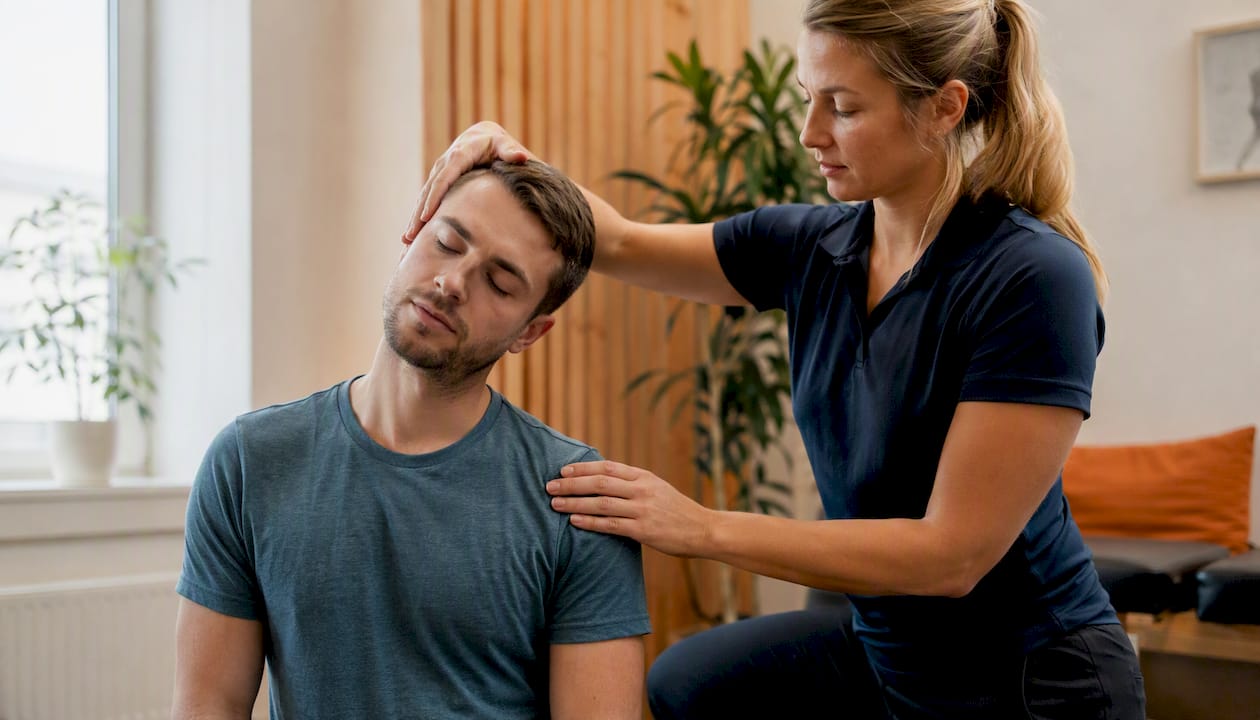
At an initial physiotherapy appointment, you can expect a structured movement assessment, range-of-motion testing, and a discussion of your work setup and symptom pattern. Many clinicians use McKenzie-style directional preference testing to identify which movements relieve your symptoms and design a high-frequency, patient-specific programme around them. This approach tends to produce faster resolution than generic stretching because it works with your individual mechanical response rather than against it.
What physiotherapy does for desk-related neck pain
Physiotherapy for neck pain is not simply a series of passive treatments. A well-structured programme combines movement classification, targeted exercise, and self-management education so that patients leave with tools they can use independently.

The assessment phase typically involves identifying whether the neck pain has a directional preference: a movement direction (usually extension or retraction) that consistently reduces symptoms. McKenzie Method principles allow therapists to design high-frequency programmes tailored to each patient’s mechanical response, which is why two people with superficially similar desk neck pain may receive quite different exercise prescriptions.
Treatment then combines lengthening tight anterior tissues with progressive strengthening of the scapular stabilisers and deep cervical flexors. Strengthening alone can reinforce poor posture if anterior tightness is not addressed simultaneously; this is why a physiotherapist’s programme differs from a generic gym routine. Manual therapy, including joint mobilisation and soft-tissue work, may be used to restore thoracic and cervical mobility where movement is restricted. For readers interested in how these approaches work in practice, the evidence behind physiotherapy for pain relief covers the clinical rationale in more detail.
For some patients, acupuncture offers a useful adjunct, particularly where muscle tension is a dominant feature. The role of acupuncture for neck pain is covered separately for those considering a multi-modal approach.
Pro Tip: The most durable outcomes come from programmes that transition patients to independent self-management within six to eight weeks. If a treatment plan keeps you dependent on clinic visits indefinitely without building your own capacity to manage symptoms, ask your therapist about a structured home programme.
A clinician’s note on realistic recovery
Desk neck pain is genuinely correctable for the majority of people, but it rarely resolves in a week. The tissues that have adapted to a forward-head position over months or years need consistent, repeated input to remodel. Two weeks of daily chin tucks and scapular work will reduce tension noticeably; eight weeks of consistent effort, combined with workstation changes, produces the kind of postural shift that holds.
What I see most often in clinic is people who do the exercises well for ten days, feel better, and stop. The pain returns within a fortnight. Consistency across six to eight weeks matters more than perfection on any single day. If self-management has not produced meaningful improvement after four to six weeks, a structured physiotherapy assessment is the logical next step, not because the self-care was wrong, but because individual mechanical factors may need a more targeted approach.
Parkstherapycentre has been supporting patients across Bedfordshire and Buckinghamshire since 1986, and the team sees desk-related neck presentations regularly. If you want a personalised assessment rather than a generic programme, booking an appointment is straightforward.
Parkstherapycentre: personalised assessment for neck pain

Parkstherapycentre offers physiotherapy assessment, exercise rehabilitation, acupuncture, and manual therapy across multiple clinic locations in Bedfordshire and Buckinghamshire. For desk workers with persistent neck pain, an initial assessment covers your movement pattern, workstation history, and symptom behaviour, giving you a specific programme rather than a generic one.
The clinic accepts private pay and most major health insurance plans, and online booking is available seven days a week. If your symptoms have not responded to four to six weeks of self-management, or if you want a directional assessment from the outset, book your physiotherapy appointment at a time that suits your working week.
Sources
The sources below were selected for clinical reliability, evidence grounding, and relevance to UK-based readers. They cover the full range of topics in this article, from biomechanical causes to exercise protocols and ergonomic guidance.
This article is general information, not a substitute for advice from a qualified doctor. Consult a qualified healthcare professional about your own circumstances before acting on anything here.
Recommended