
Exercises to improve circulation in feet
TL;DR:
Poor foot circulation causes symptoms like cold feet, swelling, and numbness, which can improve with regular, targeted exercises. Incorporating brief movements every 30 minutes, elevating the feet, and self-massage enhances venous return and vascular health effectively. Consistent practice over weeks, combined with professional assessment if symptoms worsen, leads to better circulation and foot health.
Cold feet, tingling toes, persistent swelling at the end of the day. These are the calling cards of poor foot circulation, and they are far more common than most people realise. Exercises to improve circulation in feet are not a niche fix reserved for athletes or the elderly. They are practical, evidence-backed movements that anyone can do at home, in a chair, or during a lunch break. This guide walks you through exactly what to do, how often, and why it works.
Table of Contents
Key takeaways
Point | Details |
Muscle movement drives blood flow | Calf and foot contractions act as pumps, pushing blood back towards the heart. |
Little and often beats intensity | Brief movements every 30 minutes are more effective than one long session for desk-bound adults. |
Elevation plus exercise works best | Combining elevation and movement yields better results than either approach alone. |
Preparation prevents injury | Correct footwear, posture, and knowing when to rest protect you while exercising. |
Seek professional help if symptoms persist | Worsening pain, skin changes, or numbness that does not improve with exercise need medical assessment. |
Why poor foot circulation happens and how exercise helps
Your feet sit at the furthest point from your heart. Getting blood all the way down there, and more critically, back up again, is a constant physiological effort. The veins in your lower legs rely heavily on the surrounding muscles contracting to squeeze blood upward. When you sit still for hours, that pumping action stops, and blood pools in your feet and ankles.
“The calf muscle is sometimes called the ‘second heart’ because its contractions are central to venous return from the lower limbs.”
Age-related vascular changes, diabetes, smoking, and prolonged inactivity all reduce the efficiency of this system. The walls of blood vessels lose elasticity over time, and the micro-circulation within foot tissue becomes sluggish. The result is feet that feel cold, numb, or perpetually swollen. Ankle pumps, circles, and seated leg raises performed for just 60 seconds every hour can meaningfully interrupt that pooling cycle.
The good news is that exercise triggers genuine vascular adaptation. Brisk walking at roughly 5 km/h, sustained for 20 to 30 minutes five to seven days a week, improves lower-extremity blood flow and cardiovascular efficiency. Even seated foot circulation workouts produce measurable changes by activating the same muscle-pump mechanism. You do not need to run a 5k. You need consistent, targeted movement.
Preparing for your foot circulation workout
Getting the environment and equipment right before you start means safer sessions and better results. None of this requires specialist kit. Most of it you already own.
Preparation item | Why it matters |
Supportive but non-restrictive footwear | Tight shoes compress superficial veins and reduce blood flow. |
A firm chair or footstool | Supports correct seated posture for floor-based and seated exercises. |
A yoga mat or non-slip surface | Prevents slipping during standing calf raises or marching. |
A foam roller or tennis ball | Useful for self-massage between exercise sets. |
Loose, comfortable clothing | Restricting waistbands or tight leggings impede circulation. |
Before starting any foot health exercises, consider the following:
Remove tight footwear and socks. Bare feet or thin socks allow you to feel the movement properly.
If you have diabetes, peripheral arterial disease, or open wounds on your feet, speak to a healthcare professional before beginning a new exercise routine.
Avoid exercising immediately after a large meal. Give yourself at least 30 to 45 minutes.
Start on a firm, flat surface. Unstable surfaces increase fall risk, particularly for older adults.
Pro Tip: If your feet feel particularly cold before you start, soak them in comfortably warm (not hot) water for five minutes first. Warmth dilates superficial blood vessels and makes the subsequent exercises noticeably more effective.
A step-by-step guide to exercises that improve foot circulation
These are the exercises that actually move the needle. Work through them in order, or pick and combine based on your ability and available time.
Ankle pumps and foot circles
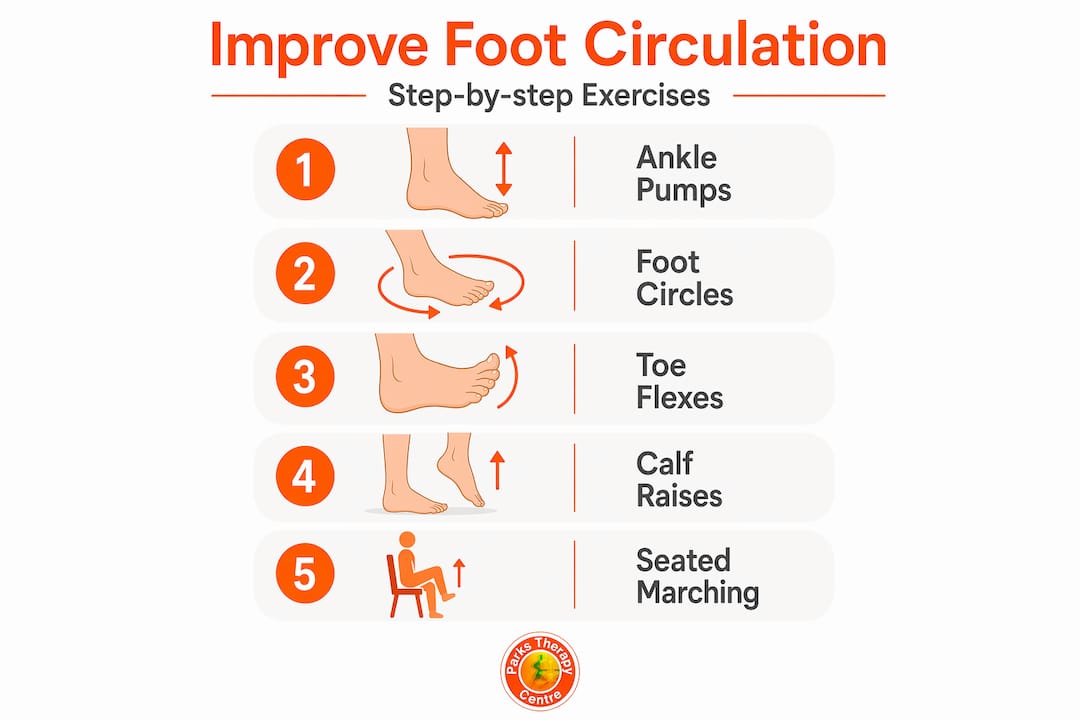
Sit in a firm chair with your feet flat on the floor. Lift one foot slightly and flex it up towards your shin, then point it downward. That is one rep. Aim for 15 to 20 repetitions per foot. Follow immediately with slow clockwise and anticlockwise circles at the ankle, five rotations in each direction. These movements directly activate the ankle joint and engage the muscles that drive venous return. Do this hourly if you are desk-bound.
Toe flexes and extensions
With your feet flat on the floor, curl your toes tightly as if gripping a marble, hold for three seconds, then spread them as wide as possible and hold for three seconds. Do two sets of 10 repetitions on each foot. This stimulates the small intrinsic muscles of the foot that are often completely inactive during prolonged sitting. It sounds minor. It is not.
Heel and calf raises
Stand behind a chair and hold the backrest for balance.
Slowly rise onto your toes, hold for two seconds at the top, then lower your heels back to the floor with control.
Aim for three sets of 12 to 15 repetitions with a 30-second rest between sets.
Progress by slowing the lowering phase to four seconds for greater muscle activation.
Gentle calf raises are the single most effective exercise for activating the calf pump. The calf muscle, when contracting, squeezes the deep veins of the lower leg and pushes a meaningful volume of blood upward with each repetition.
Seated marching
Sit upright in a chair. Lift one knee towards your chest, lower it, then lift the other. Alternate at a comfortable pace for 60 seconds. Add arm swings to increase overall circulation. This mimics walking without any impact on joints, making it ideal for anyone with arthritis or balance concerns.
The nitric oxide dump
This is a 4-minute protocol built around four exercises: squats, alternating arm raises, arm circles, and overhead presses. Perform three rounds of 10 repetitions for each movement with minimal rest between exercises. The protocol works by activating large muscle groups rapidly, which triggers nitric oxide release. Nitric oxide signals blood vessel walls to relax and dilate, producing a whole-body circulation boost in under five minutes.
Pro Tip: Breathe through your nose throughout the nitric oxide dump. Nasal breathing is linked to greater nitric oxide production in the sinus passages, which amplifies the vascular effect.
Exercise | Primary benefit | Difficulty | Seated option |
Ankle pumps | Reduces blood pooling | Easy | Yes |
Toe flexes | Activates intrinsic foot muscles | Easy | Yes |
Calf raises | Engages the calf pump | Moderate | Yes (reduced) |
Seated marching | Improves overall lower limb flow | Easy | Yes |
Nitric oxide dump | Rapid whole-body vessel dilation | Moderate | Partial |
Elevation and self-massage to support your exercises
Exercise does the heavy lifting, but elevation and massage amplify the results, particularly on days when symptoms are more pronounced.
Elevating your feet above the level of your heart allows gravity to assist venous return rather than work against it. Elevating your legs for 10 to 15 minutes, once or twice daily, reduces ankle swelling and gives the venous system a period of assisted drainage. Lie on a sofa or bed, prop your legs against the wall or on a stack of pillows, and let gravity do the work. Combine this with slow ankle pumps during the final few minutes for a noticeably better result.
For self-massage, follow these guidelines:
Use a light, unscented oil or lotion to reduce friction.
Begin at the ankle and use long, firm strokes moving upward towards the knee. Never massage downward. Upward strokes from ankle to knee follow the direction of venous blood flow and support the return journey towards the heart.
Spend five to ten minutes per leg.
Use the heel of your hand for larger surfaces and your thumbs for the sole of the foot.
Avoid deep pressure directly over visible varicose veins. Light pressure and upward strokes are the rule here. Circular or downward motions do not assist venous return and can aggravate fragile vein walls.
Pro Tip: A tennis ball rolled slowly under the sole of your foot for two to three minutes before your exercise session loosens the plantar fascia and warms up the intrinsic foot muscles. It is an underused preparation technique that takes almost no time.
Compression tools and foot massagers offer temporary symptom relief and work well alongside exercise, but they do not replace it. Think of them as complementary support, not the main event.
Tracking progress and knowing when to adjust
Improvement in foot circulation is not always dramatic or immediate. Knowing what to look for prevents discouragement and helps you make sensible adjustments.
Expect to notice these positive changes within two to four weeks of consistent practice:
Feet that feel warmer for longer periods after exercise.
Reduced swelling in the ankles by early evening.
Less tingling or numbness during periods of sitting.
Improved ability to perform calf raises without fatigue.
Common mistakes that stall progress include:
Doing exercises once and then skipping days. Consistency is the determining factor. Brief movement every 30 minutes while sitting consistently outperforms an occasional long session.
Overexerting during the first week. Sore calves from overdoing calf raises lead to rest days that break the habit chain.
Relying entirely on compression socks or a foot massager without building a safe exercise routine.
Seek medical advice promptly if you notice skin that becomes discoloured or shiny, wounds on your feet that are slow to heal, sudden worsening of pain at rest, or significant swelling in one leg only. These signs can indicate conditions that require clinical assessment, not just more exercise.
My honest take on foot circulation exercises
I have worked with a lot of people who arrive frustrated. They have read that walking is good for circulation, they have walked, and they still have cold, aching feet at the end of the day. The missing piece is almost never the exercise itself. It is the frequency.
What I have seen consistently is that patients who perform short bouts of circulation exercises at home, spread across the whole day, improve faster than those who do a single 30-minute session and then sit still for the rest of it. The calf pump needs repeated activation, not one heroic effort. That shift in thinking, from “how long” to “how often”, changes everything.
I also think people underestimate the value of combining approaches. Integrating morning elevation, midday foot exercises, and an evening self-massage is not excessive. It is the kind of multi-faceted daily routine that the evidence consistently supports. None of those three things takes more than ten minutes. The barrier is habit, not time.
My practical advice: start with ankle pumps during your morning coffee, add calf raises before lunch, and do two minutes of upward leg massage while watching television in the evening. Build from there.
— Ivan
How Parkstherapycentre can support your foot health
If you have been working through these circulation exercises at home and still find that symptoms are not improving as you hoped, professional support can make a significant difference.
At Parkstherapycentre, our physiotherapists and podiatrists assess not just your symptoms but the underlying factors driving them. Whether that is gait mechanics, postural habits, or a specific vascular concern, a professional assessment allows us to tailor a personalised exercise and treatment plan that goes well beyond a generic routine. Established since 1986 and operating across Bedfordshire and Buckinghamshire, we accept most major insurance providers and offer straightforward online booking. If cold, uncomfortable feet are affecting your daily life, the next step is simple. Book an assessment today.
FAQ
What are the best exercises to improve circulation in feet?
Ankle pumps, calf raises, toe flexes, and seated marching are the most effective exercises for improving blood flow to feet. Perform them in short sessions throughout the day rather than one long session.
How often should I do foot circulation exercises?
Brief movements every 30 minutes during prolonged sitting are more effective than a single daily session. Aim for at least three to five dedicated sessions per week of five to ten minutes each.
Can elevation replace foot circulation exercises?
No. Elevating your feet for 10 to 15 minutes assists venous return but does not activate the muscle pump. Elevation and exercise complement each other and produce the best results when combined.
How quickly will I see improvement in foot circulation?
Most people notice warmer feet and reduced evening swelling within two to four weeks of consistent daily practice. Significant structural vascular improvement takes longer and depends on overall lifestyle factors.
When should poor foot circulation prompt a visit to a professional?
See a healthcare professional if you notice skin discolouration, slow-healing wounds on the feet, sudden increases in pain at rest, or swelling confined to one leg. These symptoms may indicate a condition that needs clinical assessment.
Recommended