
Stage by Stage Frozen Shoulder: When to Use Injections or Physio

Frozen shoulder progresses through three recognised stages: freezing (painful), frozen (stiff), and thawing (recovery). Most people move through all three within one to three years. Each stage calls for a different approach to treatment, and getting that timing right, particularly with physiotherapy and pain relief, makes a measurable difference to how well and how quickly movement returns.
TL;DR:
The freezing stage lasts 2 to 9 months and involves diffuse pain that worsens at night, with limited active and passive movement.
During the frozen stage, pain eases but stiffness dominates, making daily tasks like reaching behind the back difficult, with progression favoring gentle stretching and isometric exercises.
Recovery can take 5 to 24 months overall, especially for patients with diabetes or thyroid issues, who often experience a longer, more stubborn course.
Early treatment should focus on pain control with analgesics or corticosteroid injections, while later stages prioritize mobilisation, strengthening, and functional exercises.
Patience and stage-appropriate care are crucial, with progress measured in weeks rather than days, and ineffective pain or movement should prompt a clinical review.
Table of Contents
The three frozen shoulder stages at a glance
Each stage has its own personality, and knowing which one you’re in shapes what you should actually do about it.
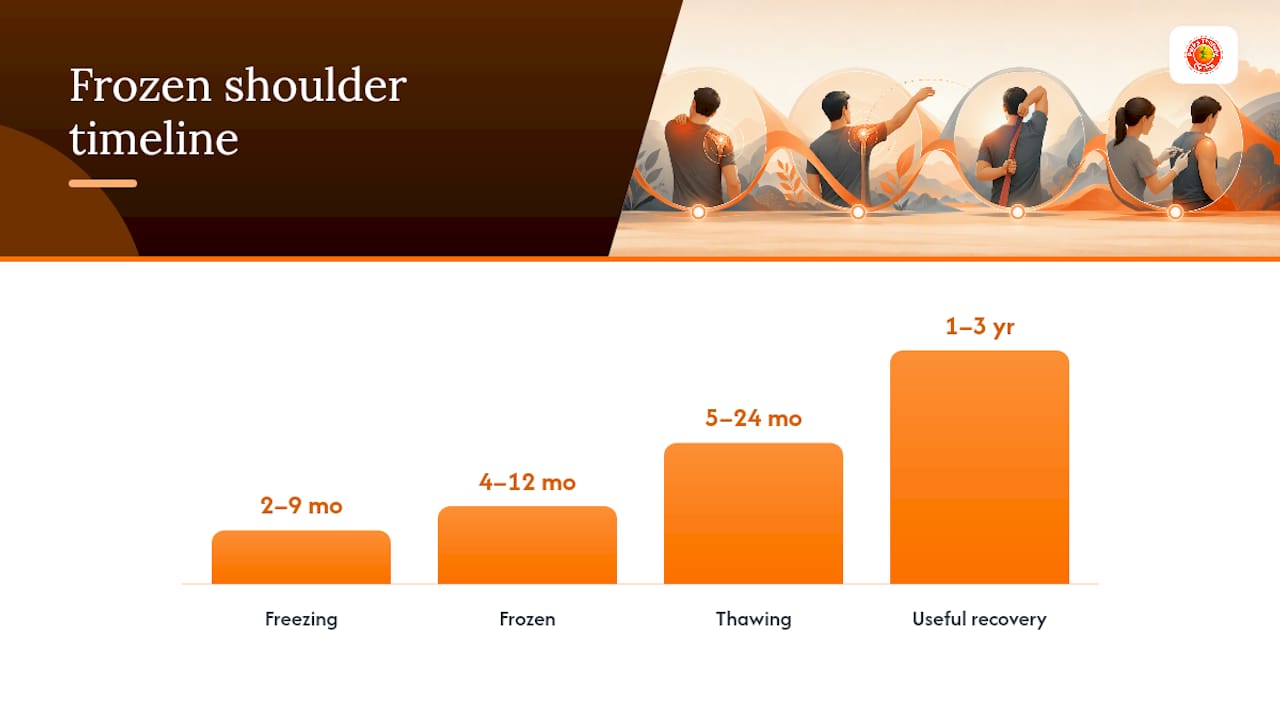
Freezing (painful) stage: pain builds gradually and worsens at night, while the shoulder becomes progressively harder to move. This stage typically lasts 2 to 9 months.
Frozen (stiff) stage: pain often eases, but stiffness settles in and dominates daily life. Expect this to run for roughly 4 to 12 months.
Thawing (recovery) stage: movement returns slowly but steadily, usually over 5 to 24 months.
These windows are guides, not guarantees. Clinical reviews of adhesive capsulitis staging note that the phases regularly overlap, and some people carry symptoms of one stage into what looks like the next. Two patients diagnosed on the same day can end up on very different timelines, so treat these figures as a rough map rather than a countdown clock.
What does each frozen shoulder stage actually feel like?
The symptoms tell a fairly clear story once you know what to look for, and the shift between stages usually shows up as a change in what bothers you most, not just how much it bothers you.
Freezing stage. Pain is diffuse, aching, and often worse lying on the affected side at night. Both active movement (what you can do yourself) and passive movement (what someone else can move your arm through) become restricted, and the loss creeps in over weeks rather than appearing overnight. This is the phase where forceful stretching does more harm than good, because the joint capsule is inflamed rather than simply tight.
Frozen stage. Night pain typically settles, but stiffness now runs the show. Reaching behind your back to fasten a bra, pulling on a jacket, or turning to check a blind spot while driving becomes genuinely difficult. This is where gentle, sustained range-of-motion work and isometric exercises, holding a muscle contraction without moving the joint, tend to be introduced.
Thawing stage. Range of motion starts returning in a fairly linear way, week on week. This is the point to shift towards progressive strengthening and rebuilding the movements you need for work, sport, or simply sleeping comfortably again.
The underlying biology explains why the symptom pattern flips. Early on, the joint capsule is inflamed and gaining new blood vessels; later, that inflammation resolves into capsular fibrosis, scar-like thickening of the tissue, which is why pain fades but stiffness lingers.
Red flags that aren’t typical frozen shoulder: sudden, severe worsening of pain or swelling; fever, redness, or warmth around the joint (possible infection); numbness, tingling, or marked weakness down the arm (possible nerve involvement); or a shoulder that gives way or feels unstable. Any of these warrants prompt medical review rather than a “wait and see” approach.
How is frozen shoulder diagnosed?
Diagnosis is largely clinical. A physiotherapist or GP will take a history and check how far the shoulder moves both actively and passively across several directions, forward, out to the side, and rotation. Restriction in more than one plane, especially with a normal-looking X-ray, is the hallmark finding.
Imaging isn’t always necessary, but an X-ray or MRI may be used to rule out other causes of shoulder pain, such as a rotator cuff tear or osteoarthritis, particularly if symptoms don’t fit the expected pattern.
Book an assessment early if you notice:
Severe pain that disturbs sleep most nights
Real difficulty using the arm for everyday tasks
A history of diabetes or thyroid disease, both linked to a higher risk of frozen shoulder
No improvement after a few weeks of trying to manage it yourself
A first assessment typically involves measuring pain and range of motion, discussing how symptoms are affecting daily life, and talking through whether an injection alongside physiotherapy makes sense at this point.
Which frozen shoulder treatments work at each stage?
Treatment timing matters more with this condition than with most shoulder problems, because what helps in one stage can be pointless, or even counterproductive, in another.
Freezing stage. The priority is pain control. Simple analgesia helps you tolerate the movement you do attempt, and a corticosteroid injection given early can meaningfully reduce pain and create the window needed to start physiotherapy properly. Clinical guidance from NICE/CKS specifically recommends considering an early injection if conservative measures alone aren’t allowing progress. Gentle, pain-limited range-of-motion exercises begin here, but nothing forced.
Frozen stage. The focus shifts to mobilisation, stretching, and gradually progressive exercise. Steroid injections are less useful now, since the problem has moved from inflammation to stiffness, and injections don’t loosen fibrous tissue.
Thawing stage. This is strengthening territory. Progressive loading and functional rehabilitation, practising the actual movements you need for work or sport, take over. For the small number of people whose stiffness doesn’t budge despite consistent physiotherapy, referral for hydrodilatation (a fluid injection to stretch the joint capsule) or, rarely, surgical release may be considered.
Physiotherapy courses commonly run for at least six weeks before review, then get adjusted based on progress.
Steroid injections offer short-term relief best suited to the painful phase, not the stiff one.
Hydrodilatation and surgery are reserved for cases that don’t respond to conservative care.
Pro Tip: If a steroid injection is offered, ask specifically whether it’s aimed at reducing pain to help you exercise, not at “fixing” stiffness. Setting that expectation avoids disappointment later in the frozen stage.
Safe self-care and exercises by frozen shoulder phase
You can do a lot at home, provided the exercises match the stage you’re actually in rather than the stage you wish you were in.
Freezing stage: pendulum exercises (letting the arm hang and swing gently from the shoulder) and assisted flexion, using your other arm or a stick to guide movement without forcing it.
Frozen stage: sustained, gentle stretching held for 20 to 30 seconds, plus isometric holds to maintain muscle strength without loading the stiff joint.
Thawing stage: resistance band work, wall slides, and functional reaching tasks that mirror what you need for daily life or sport.
Keep sessions short and frequent rather than long and occasional. Stop immediately if you feel sharp pain, as opposed to the dull ache of normal stretching. Heat before exercise tends to ease stiffness; ice afterwards helps if a flare feels inflamed. The most common mistake is aggressive, forced stretching in the freezing stage, which tends to provoke more pain without buying extra range of motion. The second most common mistake is ignoring persistent night pain instead of flagging it for a clinician review.
Pro Tip: Track range of motion with something concrete, like how high up a wall you can walk your fingers, rather than relying on how the shoulder “feels” that day. Feelings vary daily; measurements don’t lie.
For structured exercise progressions matched to your stage, a full shoulder pain treatment guide can help you sequence the movements correctly. Some patients also find gentle therapeutic movement practices, such as yoga approaches for chronic pain, useful as a supplementary, low-load way to stay active between physiotherapy sessions.
How long does frozen shoulder recovery really take?
Most people regain useful, functional movement within one to three years of symptoms starting, with freezing lasting 2 to 9 months, frozen 4 to 12 months, and thawing 5 to 24 months.
Diabetes and thyroid disease both predict a longer, more stubborn course, and patients with diabetes in particular often need earlier, more proactive escalation of care when function stays severely limited. Prolonged immobilisation, avoiding the arm entirely out of fear of pain, tends to extend recovery further rather than protect the joint.
Most people regain the range they need for daily life, though some retain mild residual stiffness. Starting stage-appropriate rehabilitation early consistently improves how that story ends.
What happens during physiotherapy for frozen shoulder?
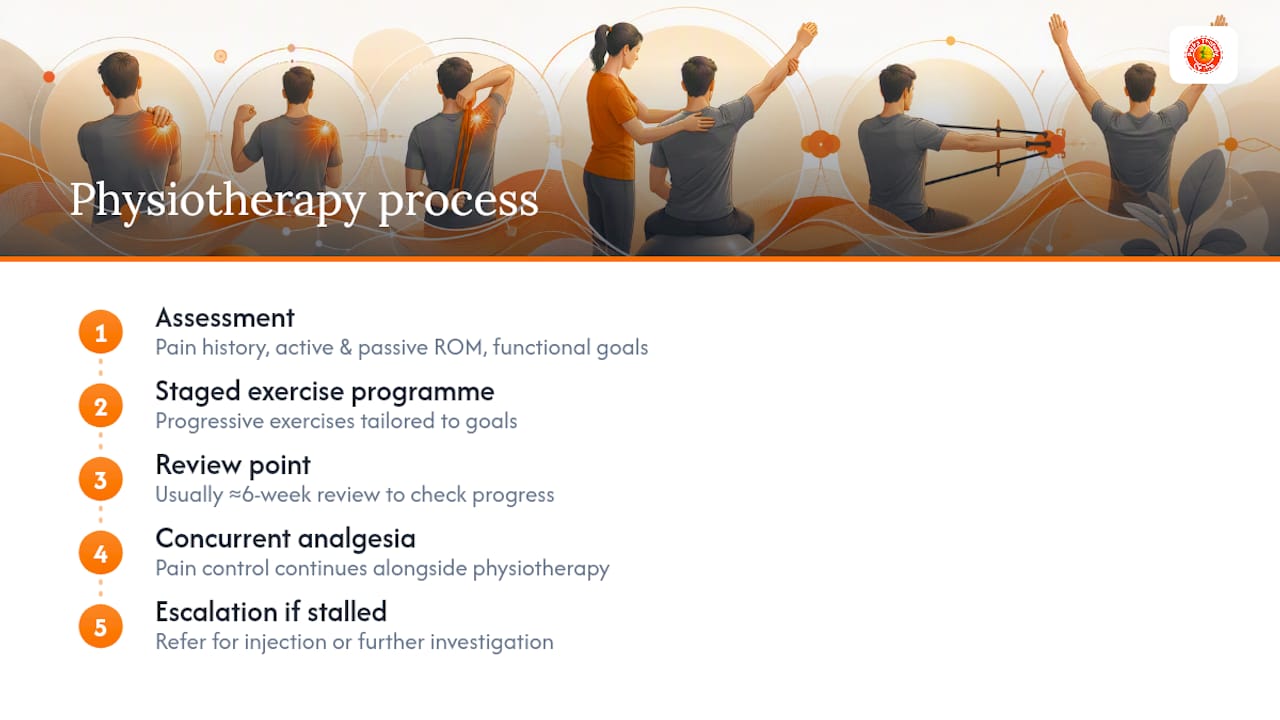
A typical assessment covers your pain history, measures how far the shoulder moves actively and passively, and sets functional goals, dressing, driving, sleeping, that matter to your daily life. From there, you get a staged exercise programme with a review point, usually around six weeks, to check progress. Physiotherapy works alongside analgesia throughout, and referral for an injection or further investigation happens when progress stalls rather than as a default first step.
Why patience matters more than intensity in frozen shoulder recovery
The hardest part of frozen shoulder isn’t the pain, it’s the pace. Progress is measured in weeks, not days, and pushing harder rarely speeds things up. Set small, measurable targets: reaching a shelf, fastening a seatbelt, sleeping through the night, rather than chasing full symmetry too soon. Keep working where possible, adapting tasks rather than avoiding the arm entirely. If two or three weeks pass without any shift in pain or movement, that’s the signal to ask for a review rather than push on alone.
— Ivan
Book a shoulder assessment with Parkstherapycentre
Specialist therapy centres offer a more direct route to stage-appropriate care than working through generic exercise videos and hoping you’ve matched them to the right phase. A team with expertise can assess exactly which stage your shoulder is in and build a programme around it, rather than a one-size-fits-all routine that ignores where you actually are in the timeline.

A first appointment typically includes a full assessment of pain, range of motion, and functional goals, followed by an initial staged exercise plan and a discussion of whether analgesia or injection referral fits your case. Both private payment and insurance are accepted. If night pain, stiffness, or a shoulder that simply won’t loosen up is disrupting your daily life, book an appointment with Parkstherapycentre to get a clear plan rather than another guess.
This article is general information, not a substitute for advice from a qualified doctor. Consult a qualified healthcare professional about your own circumstances before acting on anything here.
Sources
Recommended