
Hypnotherapy for Insomnia: Evidence and a 3–5 Session UK Clinic Guide

Hypnotherapy can genuinely help many adults with insomnia sleep better, but the evidence is modest, not miraculous. Most positive results come from short, structured programmes of three to five sessions combined with home audio practice, rather than a single dramatic session. It is not a guaranteed fix, works best for people who respond well to suggestion, and should sit alongside your GP’s advice or a course of cognitive behavioural therapy for insomnia when your sleep problems are complex or long-standing.
TL;DR:
Hypnotherapy generally requires three to five structured sessions, often delivered via telephone or with audio recordings, for meaningful sleep benefits.
Effectiveness varies widely because of inconsistent techniques and measurement methods used in studies, with about 58.3% of research showing real improvements.
The therapy mainly targets anxiety, physiological arousal, and conditioned wakefulness, helping the nervous system relax on cue rather than forcing sleep.
Hypnotherapy works best for suggestible individuals responding actively to practice, especially postmenopausal women and those with anxiety-driven insomnia.
It should be part of a broader treatment plan and not used as a standalone cure for serious or complex sleep disorders.
Table of Contents
Hypnotherapy for insomnia: what the research evidence shows
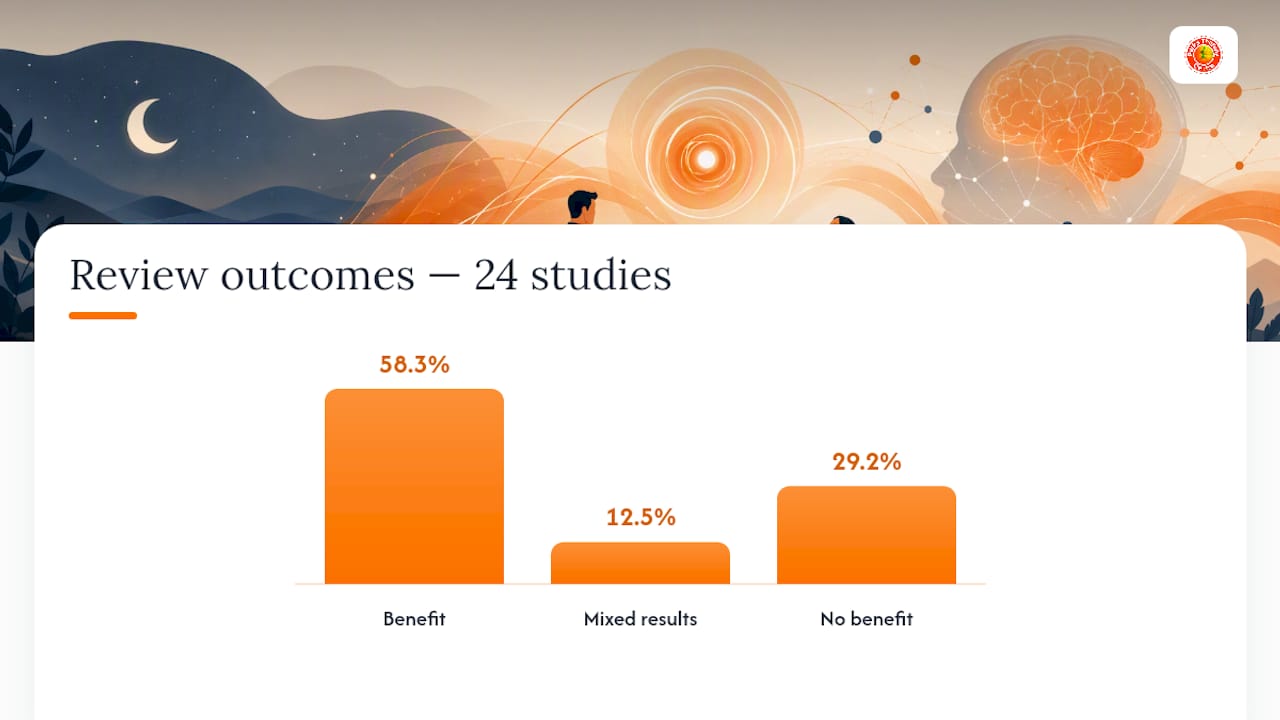
The strongest available evidence on hypnotherapy for insomnia comes from a 2018 systematic review that pooled 24 published studies. It found that 58.3% reported a genuine benefit on sleep outcomes, 12.5% produced mixed results, and 29.2% showed no benefit at all, according to the systematic review of hypnosis intervention effects on sleep outcomes. That is a meaningfully positive signal, but it is not the kind of overwhelming consensus you get with, say, statins and cholesterol. The reviewers were explicit about the limitations: many of the included trials had small samples and inconsistent methods, which means the true effect size for any individual sleeper is harder to pin down than the headline percentage suggests.
What tends to get lost in summary is why the numbers vary so much between studies. A narrative review of the hypnotherapy and insomnia literature found wide variation in the techniques used, the number of sessions delivered, and even how “improvement” was measured from one trial to the next, according to a review of the hypnotherapy and insomnia literature. One trial might rely on a therapist’s own bespoke script; another might use a fully scripted, manualised programme. One might measure sleep onset latency with a diary; another might use a validated sleep-quality questionnaire. That inconsistency is precisely why researchers keep calling for more standardised protocols, rather than because hypnotherapy itself is inherently unreliable.
Statistic Callout: In the largest systematic review to date, 58.3% of studies found hypnosis benefited sleep outcomes, 12.5% found mixed results, and 29.2% found no benefit, out of 24 studies reviewed.
Dose and delivery matter more than most people assume. A randomised trial built around a manualised hypnosis programme found clinically meaningful improvements after just three to five sessions, and importantly, the benefits held up when the programme was delivered by telephone with audio recordings for home practice, according to research on optimal dose and delivery of hypnosis for sleep disturbance. That is a useful finding for anyone worried that hypnotherapy demands weeks of in-person sessions before it does anything.
A few practical points fall out of this body of evidence:
Positive results cluster around short courses (three to five sessions), not indefinite ongoing therapy.
Telephone and audio-supported delivery produced comparable results to face-to-face sessions in at least one controlled trial.
Sample sizes across the literature remain small, so individual results vary more than a single percentage figure implies.
Hypnotherapy is generally studied as one tool within a broader insomnia treatment plan, not a standalone cure.
None of this means hypnotherapy is unproven nonsense, nor does it mean it is a sure thing. It sits where a lot of legitimate but still-maturing therapies sit: a coherent, plausible treatment with real trial support and real gaps in the data.
How hypnotherapy might improve sleep: mechanisms and targets
Clinically, hypnosis is a state of focused attention combined with heightened responsiveness to suggestion. You are not unconscious and you are not “under someone’s control.” You are simply absorbed enough that suggestions aimed at relaxing your body and quieting your thoughts land more effectively than they would during ordinary waking distraction.
For insomnia specifically, hypnotherapy tends to target three things that keep people awake:
Anxiety and rumination — the racing, circular thoughts that arrive the moment your head hits the pillow.
Physiological arousal — the raised heart rate, muscle tension, and shallow breathing that come with a stressed nervous system.
Conditioned arousal around the bed itself — where the bedroom has become associated with frustration and wakefulness rather than rest, a pattern that builds up over months of bad nights.
A hypnotherapist working on sleep might use imagery such as picturing yourself sinking heavily into a warm, supportive surface, or walking down a staircase where each step corresponds to a deeper level of physical relaxation. The suggestion itself is less important than the principle behind it: giving your nervous system a repeatable, low-effort route out of hyperarousal, rather than trying to force sleep through willpower, which almost always backfires. This is sometimes described as training the nervous system to relax on cue, according to insights from the Institute of Applied Psychology on hypnotherapy for sleep, rather than sedating the mind into submission.
Pro Tip: If a session leaves you feeling calm but not necessarily “hypnotised” in the dramatic sense you might expect, that is normal. Most people experience hypnosis as focused relaxation rather than anything theatrical.
Cognitive behavioural therapy for insomnia, or CBT-I, remains the established first-line non-drug treatment for chronic insomnia. It works on sleep-related beliefs, stimulus control, and sleep restriction. Hypnotherapy is not a replacement for CBT-I’s structured approach, but the two can complement each other well: CBT-I reshapes the behaviours and beliefs around sleep, while hypnotherapy directly addresses the physiological tension that often makes those behavioural changes harder to sustain. Reputable sleep resources note that hypnosis appears most effective when used alongside, not instead of, established approaches, according to the Sleep Foundation’s review of hypnosis for sleep.
Who benefits most from hypnotherapy sleep sessions?
Response to hypnotherapy varies a great deal, and the single biggest factor is suggestibility, your natural capacity to become absorbed in imagery and respond to suggestion. Some people are highly responsive; others find the process does very little for them regardless of how skilled the therapist is. Motivation and active participation matter almost as much: hypnotherapy is not a passive treatment you simply receive. Practising the audio recordings between sessions consistently predicts who improves and who does not.
Certain groups show particularly promising results in the trial data. Postmenopausal women with sleep disturbance were the focus of one of the better-designed randomised trials, which found clinically meaningful improvement from a manualised programme delivered flexibly by phone or in person, according to the dose and delivery trial for postmenopausal sleep disturbance. People whose insomnia is driven mainly by anxiety, rather than a physical condition like chronic pain or sleep apnoea, also tend to respond well, since anxiety reduction sits at the centre of what hypnotherapy actually does.
There are clear situations where hypnotherapy is not the right first step, or should only proceed with medical oversight:
Active psychosis or uncontrolled bipolar disorder are contraindications without prior psychiatric review.
Insomnia caused primarily by an undiagnosed physical condition (sleep apnoea, restless legs, chronic pain) needs that condition addressed first or alongside.
People who feel resistant to or sceptical about the process rarely get much from it, since active engagement matters.
Severe, treatment-resistant insomnia with a long psychiatric history usually warrants a GP or specialist referral before trying hypnotherapy alone.
For genuinely complex cases, where anxiety, chronic pain, and poor sleep all feed into each other, hypnotherapy often works best as one part of a wider plan that might include CBT-I, physiotherapy for pain-related sleep disruption, or ongoing GP support. Effectiveness depends heavily on individual suggestibility and willingness to engage with the process, according to Healthline’s overview of hypnotherapy for insomnia.
What happens in a hypnotherapy session, and how many will you need?
A typical hypnotherapy session for insomnia follows a fairly predictable shape. Expect an initial assessment where the therapist asks about your sleep pattern, stress levels, and what a bad night actually looks like for you. Then comes the induction, a guided process of settling your attention and body into a relaxed, focused state. From there, the therapist delivers suggestions tailored to your specific sleep difficulty, whether that is racing thoughts, physical tension, or clock-watching anxiety. The session closes with a debrief, a short conversation about what you noticed and how you felt.
Here is what a typical course looks like, based on the trial evidence available:
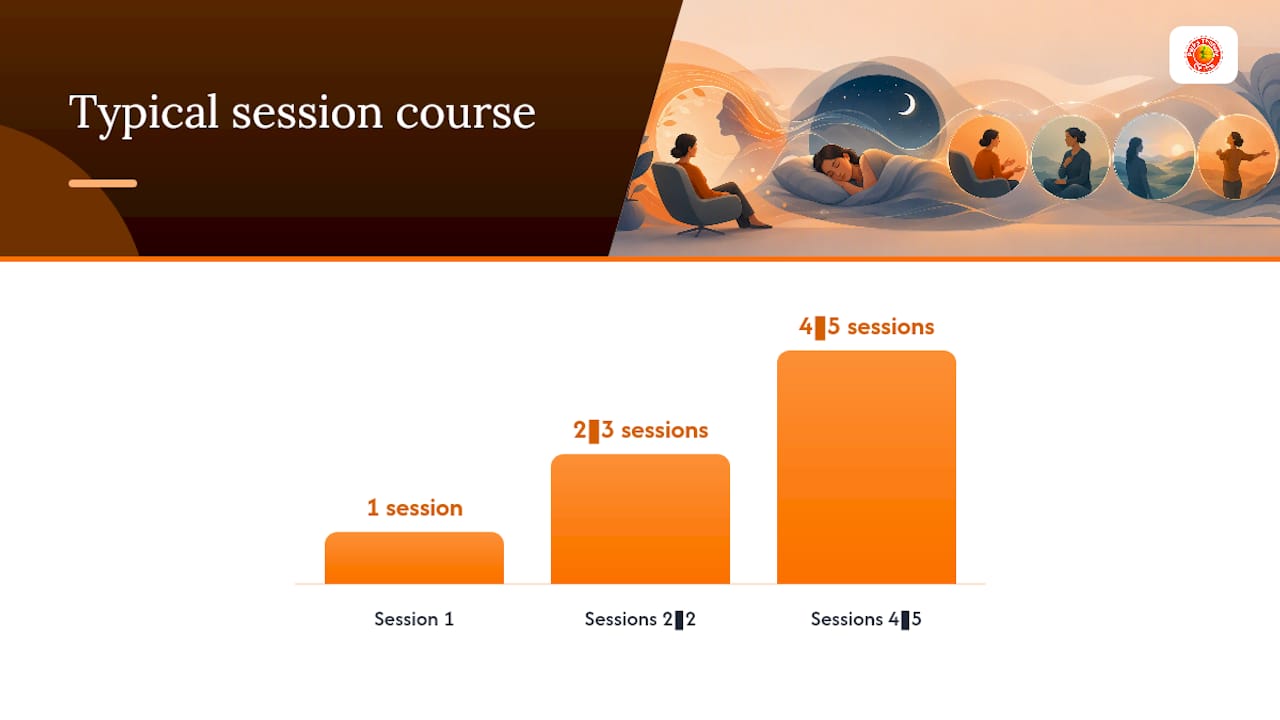
Session 1: assessment and first induction, usually with an audio recording provided for home practice.
Sessions 2 to 3: refinement of suggestions based on how your sleep has responded, plus continued home practice most nights.
Sessions 4 to 5: consolidation, with many manualised programmes designed to run their full course within this range.
Ongoing: occasional top-up sessions if sleep difficulty returns during a stressful period, rather than indefinite weekly therapy.
Programmes modelled on this three-to-five session structure have shown clinically meaningful improvement in trial settings, according to research on hypnosis dose and delivery for sleep disturbance. Encouragingly, the same research found that telephone-delivered sessions, combined with audio recordings for home practice, produced results comparable to in-person delivery in some trials. That matters if travelling to a clinic every week is not realistic for you.
Tracking progress does not need to be complicated. A basic sleep diary noting the time you went to bed, roughly how long it took to fall asleep, and how many times you woke, gives you and your therapist something concrete to review after each session. Subjective sleep quality ratings on a simple one-to-ten scale, tracked weekly, often reveal a trend well before you feel like anything has changed.
Practising self-hypnosis safely between sessions
Home practice is not an optional extra. It is often the single biggest predictor of whether hypnotherapy actually improves your sleep, since consistent audio practice between sessions correlates with better outcomes than clinic time alone.
A useful starting point is what some therapists call a short psychological landing strip: roughly ten minutes, ideally an hour or two before bed, spent settling your attention on slow breathing and a simple relaxation image. This is not the same as trying to force sleep. It is a deliberate wind-down that signals to your nervous system that the day’s demands are finished.
A few safety points are worth taking seriously:
Never listen to a hypnosis recording while driving or operating machinery.
Practise somewhere you can safely rest afterwards, such as a bed or comfortable chair, not somewhere you need to stay alert.
Keep sessions short and consistent rather than long and irregular; five to ten minutes most nights beats an occasional thirty-minute session.
If a recording brings up distressing memories or strong emotional reactions, stop and speak to your therapist rather than pushing through alone.
Pro Tip: Try a brief daytime “reset” of two or three minutes whenever you notice stress building, rather than saving all your relaxation practice for bedtime. This prevents the late-night pile-up of unprocessed tension that so often turns into racing thoughts once the lights go off.
Self-hypnosis works well as ongoing maintenance once you have learned the technique from a qualified therapist. It is less suitable as a starting point if your insomnia is severe, long-standing, or tangled up with anxiety or depression that has not been assessed, in which case working with a therapist directly, at least initially, gives you a much better foundation.
Safety, side effects and when to stop and seek help
Hypnotherapy is widely considered a low-risk intervention, and serious adverse events are rare in the clinical trial literature. Most people describe the experience as simply relaxing, occasionally uneventful, and rarely unpleasant.
That said, a small number of situations deserve genuine caution:
Rare reports of temporary disorientation, headache, or emotional sensitivity following a session.
Active psychosis or uncontrolled bipolar disorder are contraindications, and hypnotherapy should not proceed without psychiatric review in these cases.
If you take sedative or psychiatric medication, mention this to your therapist and your GP, since sleep-related suggestions can interact with how you experience medication effects.
Insomnia that coexists with depression, chronic pain, or a diagnosed sleep disorder such as sleep apnoea needs medical input alongside any hypnotherapy, not instead of it.
Before booking with any practitioner, check their professional registration and relevant healthcare training. A therapist working within a clinical or multidisciplinary setting, rather than purely as a standalone hypnotist, gives you an added layer of safety, since concerns can be flagged to other practitioners such as GPs or physiotherapists working under the same roof. If your insomnia has lasted more than a few weeks, or sits alongside another health condition, loop your GP in before or alongside starting hypnotherapy sessions. Effectiveness and safety both depend on that context being properly understood from the outset, according to Healthline’s guidance on hypnotherapy for insomnia.
How to choose a hypnotherapist and what to ask first
Not all hypnotherapy training is equal, and the difference matters more for sleep than for lighter applications like confidence coaching. Look for a practitioner with recognised clinical training, ideally working within a healthcare setting rather than purely a wellness or entertainment context. Registration with a recognised professional body, and a clear explanation of their qualifications when asked, are reasonable minimum expectations.
Before booking, a short first-contact conversation should answer a few practical questions:
What specific approach do they use for insomnia, and is it based on a structured programme or an improvised script?
How many sessions do they typically recommend, and what happens if progress stalls after that?
Will you receive audio recordings or other home practice materials, and how are they meant to be used?
What is their cancellation policy, and is pricing transparent per session or sold as a fixed package?
Reasonable pricing for hypnotherapy sits closer to a standard therapy session than a one-off luxury treatment. At Parkstherapycentre, a hypnotherapy therapy session is priced at £75, with an initial hypnotherapy consultation available to discuss suitability before you commit to a course. If you are unsure whether hypnotherapy or a related approach fits your situation, this clinic guide to hypnotherapy benefits and practice covers suitability and mental health considerations in more depth.
What to check | Why it matters |
Recognised clinical training and registration | Confirms the therapist meets a professional standard, not just informal experience |
Structured programme (roughly 3 to 5 sessions) | Matches what trial evidence actually supports, rather than open-ended sessions |
Audio recordings for home practice | Consistent home practice is strongly linked to better outcomes |
Clear pricing per session | Avoids ambiguity around packages and cancellation terms |
Willingness to loop in your GP for complex cases | Signals a practitioner working safely within your wider care |
A clinician’s view on when hypnotherapy earns its place
Hypnotherapy for insomnia works best when it is treated as a tool, not a rescue remedy. The clearest results come from patients who engage properly with home practice and who do not expect one session to undo months of poor sleep. Where sleep problems sit alongside pain, anxiety, or a medical condition, we tend to measure progress through simple sleep diaries and honest conversation about what has actually changed, not just whether someone “felt hypnotised.” If you are unsure whether hypnotherapy fits your situation, a short suitability discussion before committing to a full course is worth having.
— Ivan
Book a hypnotherapy consultation with Parkstherapycentre
Parkstherapycentre gives you something most standalone hypnotherapists cannot: a hypnotherapy service sitting inside a multidisciplinary clinic, so if your insomnia turns out to be tangled up with chronic pain, anxiety, or another physical condition, you have physiotherapy, acupuncture, and other relevant support in the same building rather than a separate referral chain to chase.

The clinic offers a Hypnotherapy Consultation to assess suitability, followed by Hypnotherapy Therapy Sessions priced at £75 each, alongside its full range of physiotherapy, podiatry, and pain management services. Parkstherapycentre accepts major health insurance plans and has operated across Bedfordshire and Buckinghamshire since 1986, which means your hypnotherapy sessions can sit alongside other treatment, such as evidence-based physiotherapy, if your sleep issues are linked to pain or injury recovery. If you are ready to explore whether hypnotherapy suits your sleep problem, check current hypnotherapy session pricing and book a consultation directly through the clinic’s prices page.
This article is general information, not a substitute for advice from a qualified doctor. Consult a qualified healthcare professional about your own circumstances before acting on anything here.
Sources
FAQ
Does hypnosis really work for insomnia?
For many people, yes, to a meaningful degree. A systematic review found 58.3% of studies reported a genuine benefit on sleep outcomes, though effects vary with individual suggestibility and how consistently you practise between sessions.
What is the 30/30 rule for insomnia?
The 30/30 rule is a common piece of behavioural advice suggesting that if you have not fallen asleep within roughly 30 minutes, or are awake for 30 minutes during the night, you should get up, do something calm in low light, and return to bed once you feel sleepy. It is a stimulus control technique often used alongside CBT-I rather than a formally validated clinical standard.
What is my body lacking if I have insomnia?
Insomnia is rarely caused by a single missing nutrient or substance. It usually reflects a mix of factors, including stress hormones staying elevated at bedtime, disrupted circadian signalling, or an anxious or overactive mind that has not learned to switch off, which is exactly what hypnotherapy targets.
Why is my anxiety keeping me up at night?
Anxiety raises physiological arousal, the racing heart and shallow breathing your body associates with alertness rather than rest, and it fuels rumination that keeps your mind too active to drift off. Hypnotherapy directly targets both, using relaxation-focused suggestion to counter the hyperarousal that anxiety creates around bedtime.
How much does a hypnotherapy session cost at Parkstherapycentre?
A hypnotherapy therapy session at Parkstherapycentre costs £75. An initial hypnotherapy consultation is also available to assess suitability before starting a full course.
Recommended