
NHS physio waiting times: how to get seen sooner

Many people referred for NHS physiotherapy in England typically wait several weeks for a routine appointment, though local figures vary considerably. Healthwatch England has documented how the absence of national minimum standards means waits can be far shorter or far longer depending on where you live. Here is what to do right now:
Check your local trust or board dashboard for the current published average wait in your area.
Ask your GP about First Contact Physiotherapist (FCP) access or a one-off assessment clinic, both of which can reduce the time to your first appointment.
Consider private physiotherapy if your symptoms are worsening and waiting is causing deterioration.
Pro Tip: Save your local trust’s waiting-times page as a bookmark and check it monthly. Published figures are typically one month behind, so the most recently posted data reflects the previous month’s activity.
Key takeaways
NHS physio waiting times in England often involve multiple weeks for routine referrals, but local variation is significant and faster NHS routes exist alongside private options.
Point | Details |
Typical routine wait | Most trusts report routine NHS physiotherapy waits generally spanning several weeks, with local variation. |
Averages are guides, not guarantees | Published figures reflect the previous month’s data; your individual wait may be shorter or longer. |
Faster NHS routes exist | Ask your GP about First Contact Physiotherapist access or a one-off assessment clinic to reduce your wait. |
Private care offers faster access | Private physiotherapy is typically available within days; check your insurance cover before booking. |
Parkstherapycentre | Offers private physiotherapy across Bedfordshire and Buckinghamshire with online booking and insurance acceptance. |
Table of Contents
What do NHS physiotherapy waiting times look like across the UK?
How trusts calculate ‘average’ waiting times and what the numbers mean for you
Private physiotherapy: what to expect compared to NHS access
Red flags: when you need urgent help rather than a waiting list
Why acting early matters more than waiting to see what happens
Parkstherapycentre: private physiotherapy with faster access in Bedfordshire and Buckinghamshire
What do NHS physiotherapy waiting times look like across the UK?
Routine NHS physio waiting times vary by trust, service model, and region. As a published example, East Sussex MSK reports routine physiotherapy average waits of 10–12 weeks, while urgent appointments are scheduled considerably sooner. Not every trust publishes figures in the same format, which makes direct comparison difficult.
Routine vs urgent categories
Routine referrals cover the majority of MSK presentations: back pain, joint problems, post-injury rehabilitation. These carry the longest waits.
Urgent referrals are reserved for clinically time-sensitive presentations and are typically seen within days to a few weeks.
Scotland operates differently: Public Health Scotland publishes an Allied Health Professionals MSK waiting-times dataset covering all Scottish health boards on a quarterly basis, with national maximum waiting-time targets tracked within it.
Statistic note: The 10–12 week figure from East Sussex MSK is an average calculated from all patients seen in the previous month. Your individual wait may be shorter or longer.
How trusts calculate ‘average’ waiting times and what the numbers mean for you
When a trust publishes an average wait, it combines the waiting times of every patient seen during the previous month and calculates a mean. That single number represents hundreds of individual journeys, and yours may sit well above or below it.
East Sussex MSK states plainly that the reported average is a guide, not a guaranteed wait. Common reasons your wait may differ:
Your referral arrives during a period of high demand or staff absence.
A cancellation creates an earlier slot that you are offered.
Your referral does not meet the service’s criteria and is returned to your GP.
You are placed on a different pathway (urgent, FCP, one-off clinic) that carries a different queue.
Publication lag matters. Most trusts update their waiting-times pages monthly, meaning the figure you read today reflects appointments from the previous month. In Scotland, the AHP MSK dataset is published quarterly with an approximate seven-week lag after the reference period closes.
NHS Greater Glasgow & Clyde notes that waiting lists are centrally managed and patients are contacted when a slot becomes available. Calling the clinic directly rarely speeds things up and can create confusion in centralised systems.
Why do waiting times differ so much between areas?
Several structural factors drive the variation you see between trusts and boards.
Demand and workforce capacity. Some areas have fewer physiotherapists relative to the local population, longer clinic hours, or higher referral volumes from GP practices.
Referral eligibility rules. GHC NHS Trust advises that referrals not meeting clinical criteria are rejected, which can redirect patients back to self-help or GP review before they re-enter the queue.
Service model differences. Trusts with FCP physiotherapists embedded in GP practices, or with active one-off assessment clinics, tend to manage demand more efficiently than those relying solely on traditional outpatient referrals.
Self-referral availability. NHS guidance confirms that self-referral routes exist in many areas but are not universal, and eligibility criteria apply.
How to check your local NHS physiotherapy waiting times
Search your NHS trust or health board by name alongside the phrase “physiotherapy waiting times” or “MSK waiting times.” Most trust websites have a dedicated page or a link within their physiotherapy service section.
Look for the routine and urgent categories separately. The figure you need for planning is the routine average, not the urgent figure.
In Scotland, visit the Public Health Scotland AHP MSK dataset and filter by your health board. Data is published quarterly.
Ask your GP practice. Reception staff often know the current approximate wait for the local service and can tell you whether self-referral is available in your area.
Check NHS England’s published waiting-times data via the NHS England statistics pages for broader context, though trust-level pages are more specific.
Pro Tip: Once you find your trust’s waiting-times page, bookmark it and note the date of the most recent update. Return monthly to track any changes, particularly if you are deciding between NHS and private care.
What you can safely do while you wait for physiotherapy
Managing your condition actively during the wait reduces the risk of deterioration and gives your physiotherapist better information when you are eventually seen.
Keep moving within your pain tolerance. For most MSK conditions, gentle activity is preferable to complete rest. Walking, swimming, or low-impact movement maintains joint mobility and muscle strength.
Follow NHS self-help guidance for your specific condition. The NHS website provides condition-specific exercise advice for common presentations including back pain and knee pain.
Use analgesia appropriately. Over-the-counter options such as paracetamol or ibuprofen (where suitable for you) can support activity levels. Consult your pharmacist if you are unsure.
Document your symptoms. Keep a brief daily log of pain levels, what aggravates or eases symptoms, and the impact on sleep, work, and daily activities. This record supports clinical prioritisation when you are assessed.
Prepare for your appointment by reviewing what to expect from physiotherapy sessions so you can give a clear history quickly.
Pro Tip: A written symptom diary is one of the most practical things you can bring to your first appointment. It shortens the assessment time and helps the physiotherapist identify patterns you may not have noticed.
Stop self-managing and seek urgent review if you experience: sudden loss of bladder or bowel control, progressive neurological weakness, severe unremitting pain unresponsive to analgesia, signs of infection (fever, redness, swelling), or any symptom that is rapidly worsening. These are red flags requiring same-day GP contact or A&E attendance.
NHS routes that can get you seen sooner
First Contact Physiotherapist (FCP)
The Chartered Society of Physiotherapy describes the FCP model as one where physiotherapists assess MSK patients directly in primary care, at the point of first contact. This bypasses the traditional GP referral to an outpatient waiting list entirely. Not all GP practices have an FCP, but where one is available, you can often be seen within days rather than weeks.

One-off assessment clinics
GHC NHS Trust notes that some services offer one-off assessment and advice appointments for patients who opt for a single session rather than a full treatment course. These slots are sometimes available sooner than routine appointments. If your GP is completing a referral form, ask whether a one-off clinic option exists.
Requesting faster access: what to say to your GP
Bring your symptom diary. Concrete evidence of functional impact on work, sleep, and daily activities supports a case for clinical prioritisation.
Private physiotherapy: what to expect compared to NHS access
Private physiotherapy typically means a first appointment within days rather than weeks, your choice of clinician, and continuity of care with the same therapist throughout your treatment. For people whose symptoms are affecting work or daily function, that speed difference is clinically meaningful.
Trade-offs to consider:
Cost is met directly by you or your insurer. Sessions are not free at the point of use.
NHS records are not automatically shared with private providers, so bring any relevant imaging reports or GP letters.
Insurance cover varies. Check your policy before booking to confirm physiotherapy is included and whether a GP referral letter is required.
Parkstherapycentre has operated since 1986 across multiple clinics in Bedfordshire and Buckinghamshire, offering physiotherapy, sports injury treatment, acupuncture, and podiatry. The centre accepts most private health insurance policies and offers online booking for faster access.
Typical private physiotherapy costs and session timelines
Private physiotherapy costs in the UK vary by location, clinician experience, and session type. The figures below reflect typical ranges for private MSK physiotherapy in England.
Common care pathway estimates for typical MSK presentations:
Acute soft-tissue injury (sprain/strain): 3–6 sessions over 4–8 weeks.
Chronic back or neck pain: 6–10 sessions, sometimes more depending on chronicity.
Post-operative rehabilitation: 8–16 sessions or more, guided by surgical protocol.
Before booking with your insurer, check:
Whether physiotherapy is included in your policy and any session limits.
Whether a GP referral letter is required to validate the claim.
Whether you need to use an insurer-approved provider list.
Your excess amount and whether it applies per condition or per year.
Red flags: when you need urgent help rather than a waiting list
Some symptoms require immediate medical attention. Do not wait for a physiotherapy appointment if you experience any of the following.
Cauda equina symptoms: saddle anaesthesia, sudden loss of bladder or bowel control, or progressive bilateral leg weakness. Call 999 or attend A&E immediately.
Suspected fracture: following trauma with severe localised pain and inability to weight-bear. Attend A&E.
Signs of infection: fever, redness, heat, and swelling around a joint or the spine. Contact your GP same day.
Sudden severe neurological change: rapid onset of weakness, numbness, or loss of coordination. Call 999.
Unexplained severe night pain or unremitting rest pain: contact your GP same day for urgent review.
What to say to your GP to request faster assessment
Ask directly about the current wait: “What is the current expected wait for routine physiotherapy at the local service?”
Request FCP access: “Does this practice have a First Contact Physiotherapist I could see for my MSK problem?”
Ask about one-off clinics: “Is there a one-off assessment clinic option that might be available sooner?”
Request clinical prioritisation if appropriate: “My symptoms are affecting my ability to work and sleep. Could my referral be flagged for earlier review?”
Confirm self-referral eligibility: “Am I eligible to self-refer to physiotherapy in this area, and what are the criteria?”
Pro Tip: Bring a written summary of how your symptoms affect daily activities, work, and sleep. Specific functional impact is more persuasive than a pain score alone and gives your GP concrete grounds to support prioritisation.
Why acting early matters more than waiting to see what happens
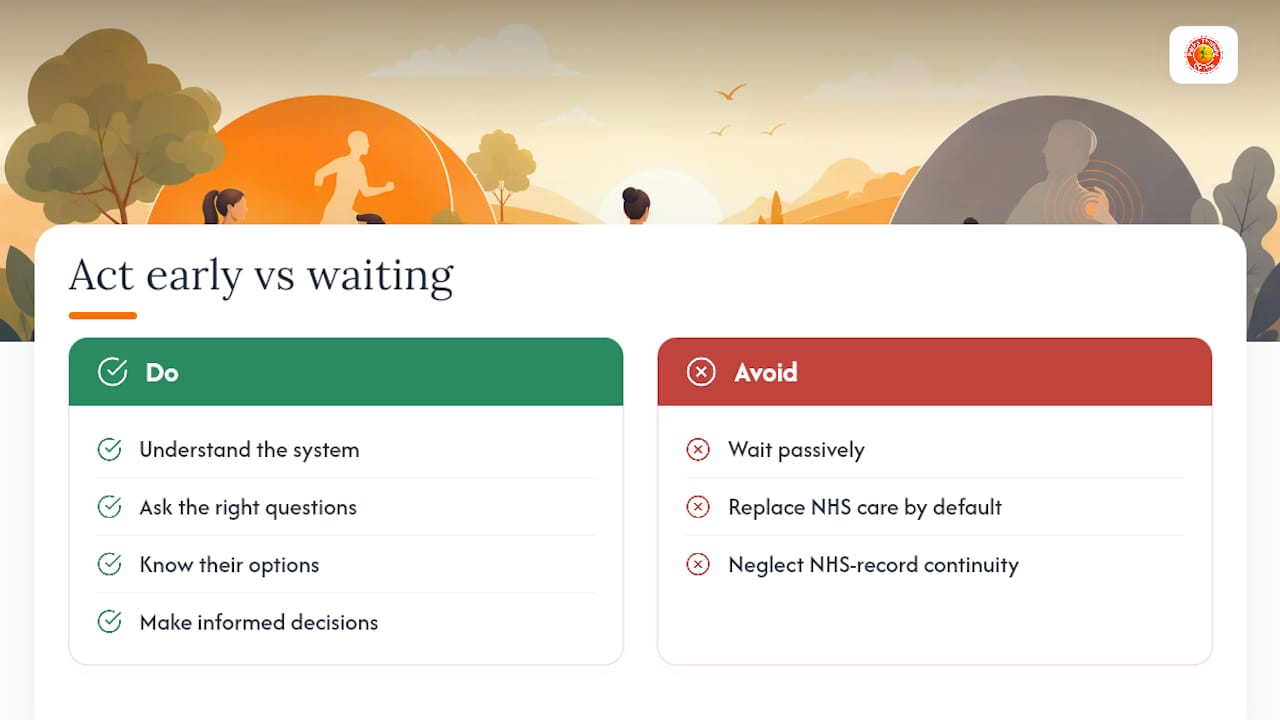
The evidence from Healthwatch England is clear: without national minimum standards, the system places the burden of navigation on patients. That is not a criticism of NHS physiotherapists, who are skilled and committed. It is a structural reality. Patients who understand the system, ask the right questions, and know their options consistently access care sooner than those who wait passively.
Private physiotherapy is not the right choice for everyone, and Parkstherapycentre does not suggest it should replace NHS care. What it does offer is a genuine alternative when waiting is causing harm. The centre’s approach is to support patients in making informed decisions, provide continuity with NHS records where possible, and deliver care that meets the same professional standards as any NHS service. For some patients, a private initial assessment provides the diagnosis and exercise programme they need to self-manage effectively while remaining on an NHS list. That is a legitimate, clinically sensible use of private care.
Parkstherapycentre: private physiotherapy with faster access in Bedfordshire and Buckinghamshire
For people whose NHS physio waiting times are causing deterioration, Parkstherapycentre offers a direct alternative. Established in 1986, the centre provides physiotherapy, sports injury treatment, acupuncture, and podiatry across multiple clinics in Bedfordshire and Buckinghamshire, with most private health insurance policies accepted.

First appointments are typically available within days. Online booking is available directly through the Parkstherapycentre website, with no GP referral required for private patients. The multidisciplinary team covers the full range of MSK presentations, from acute injuries to chronic pain and post-operative rehabilitation. Check your insurance policy for physiotherapy cover before booking, and bring any relevant GP letters or imaging reports to your first session.
Sources
This article provides general information only and is not a substitute for professional medical or clinical advice. Always consult your GP or a qualified healthcare professional regarding your individual circumstances.
Recommended