
Physiotherapist Backed Pelvic Girdle Pain Exercises for Every Trimester
- 11 minutes ago
- 7 min read
Yes, targeted exercises reduce pregnancy-related pelvic girdle pain for most women, and you can start today. Begin with pelvic floor activation, gentle pelvic tilts, and hip and back mobility work, adding bridges and clam exercises as tolerance builds. Stop immediately for sharp pain, and speak to a physiotherapist if symptoms are severe or don’t settle within a few days.
TL;DR:
Pelvic floor activation and pelvic tilts are most effective early in pregnancy, with exercises needing proper technique and gradual progression to avoid pain.
Positioning modifications, such as side-lying or propped positions, are crucial after the halfway point to prevent discomfort and maintain safety.
Consistent practice with pelvic exercises, limited to specific sets and repetition ranges, produces better results than overdoing sessions or rushing progression.
Combining exercises with daily self-care measures like heat, support belts, and proper sleep habits can significantly reduce pelvic girdle pain symptoms.
Physiotherapy assessments help identify personalized movement strategies, focusing on strengthening deep support muscles before adding load or advanced exercises.
Table of Contents
Pelvic girdle pain exercises to try at home
Getting the technique right matters more than pushing through repetitions. Each of these moves can be done in a small space with cushions or a birth ball for support.
Pelvic floor activation. Sit or lie comfortably and imagine stopping yourself passing wind while also lifting away from a tampon string, a cue many women find easier than “squeeze up inside.” Breathe normally throughout; never hold your breath. Build long holds gradually, starting with three breaths and working towards 10 seconds, then add short, sharp holds of one to two seconds, repeated 10 times. Specialist physiotherapy guidance recommends this as a foundation exercise precisely because a well-functioning pelvic floor supports the joints above it.
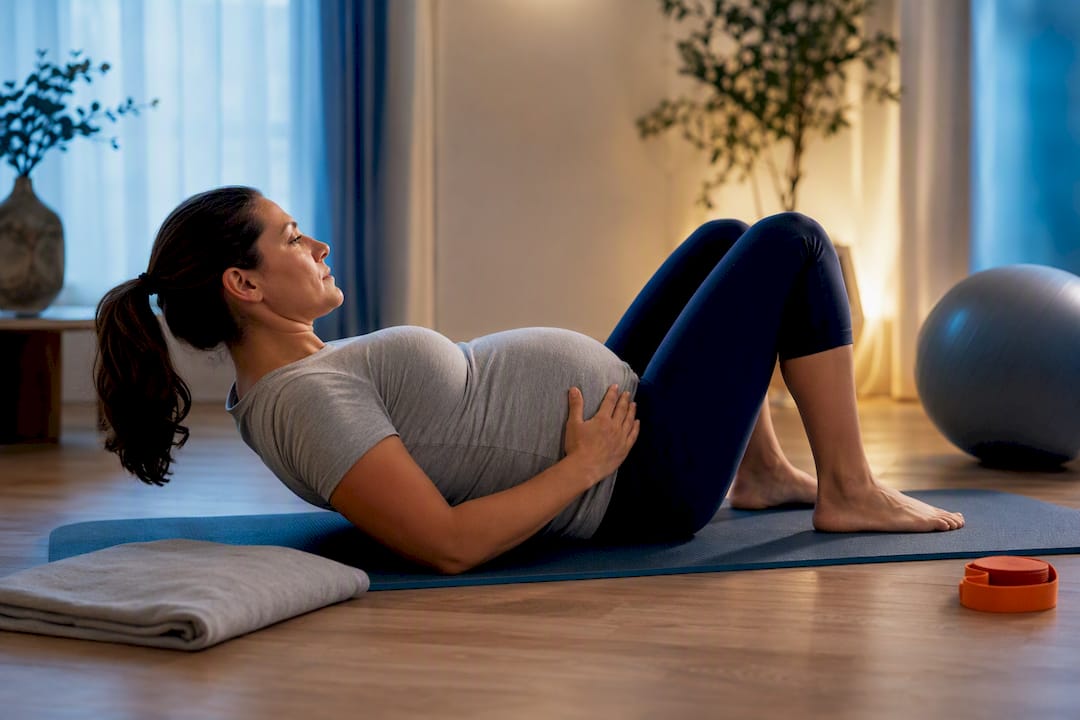
Pelvic tilts. Lie in crook-lying (knees bent, feet flat) and gently flatten your lower back into the floor or bed, then release. The same movement works kneeling on all fours or standing against a wall, tucking your tailbone under before returning to neutral.
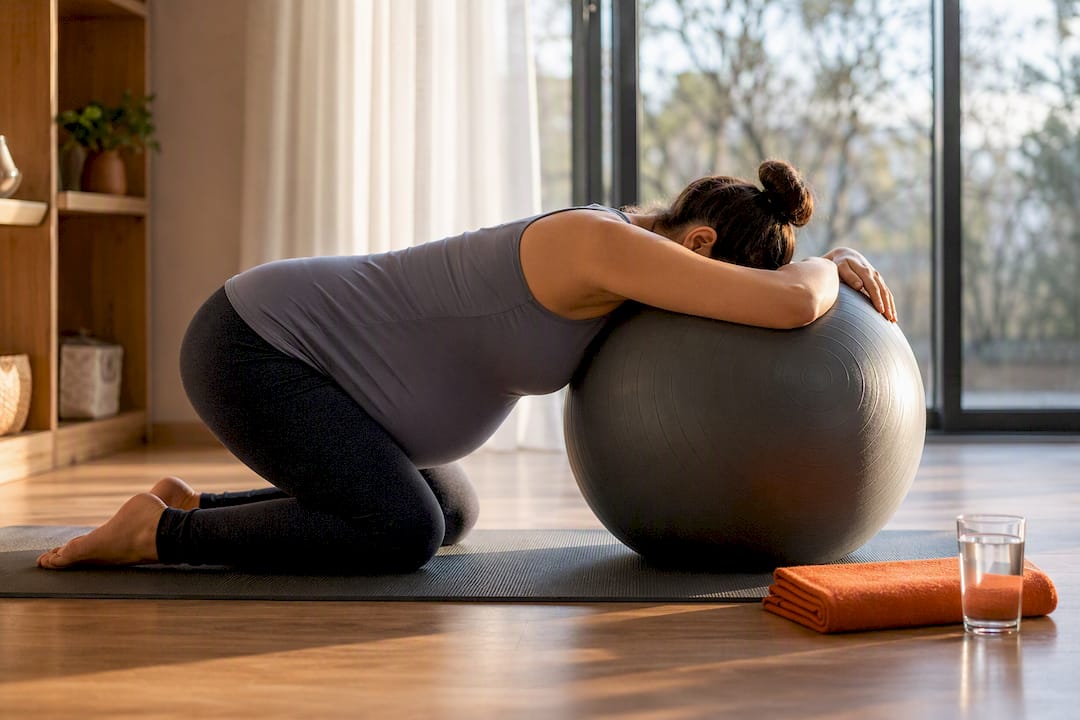
Cat–cow and child’s pose. On hands and knees, arch your back towards the ceiling, then let it dip gently, moving with your breath rather than forcing range. If kneeling forward into child’s pose feels restrictive later in pregnancy, rest your chest on a birth ball instead, which keeps the hips higher than the knees and avoids compressing the bump.
Bridges and staggered bridges. From crook-lying, squeeze your buttocks and lift your hips a few centimetres, keeping knees hip-width apart to protect the joint. A staggered bridge, with one foot slightly forward of the other, challenges stability without adding strain.
Clams and hip stretches. Lying on your side with knees bent and stacked, lift the top knee like an opening shell while keeping your feet together. Follow with a butterfly stretch (soles of the feet together, knees relaxed outward) or a hamstring stretch using a towel or resistance band looped under the foot.
Hold stretches for 5 to 10 seconds, repeated four to five times rather than pushing into a deep, sustained stretch.
Use a pillow between your knees for side-lying positions and a propped-up angle for anything on your back.
On a gym or birthing ball, keep your hips higher than your knees to maintain neutral pelvic alignment.
If your lower back also niggles alongside the pelvic pain, some lower back pain exercise routines complement this pelvic work well.
How do you adapt exercises safely as your bump grows?
Positioning matters more than the exercise itself once you’re past the halfway point of pregnancy. Lying flat on your back becomes uncomfortable and can restrict blood flow, so shift towards side-lying, propped positions, or kneeling with support instead.
Single-leg balance work and anything requiring you to stand on one leg unsupported should be modified or dropped altogether. Hold onto a chair or wall, and take transfers slowly. A useful technique when getting out of bed: straighten the knee on the side you’re turning towards, bend the other, then push through your heel and roll, which keeps your thighs together and reduces shear across the pelvis.
If a movement causes sharp pain, or dull pain that lasts longer than roughly 30 minutes after stopping, avoid that specific movement for a few days.
Rebuild gradually once discomfort settles, rather than jumping straight back to your previous level.
Seek prompt assessment for severe instability, numbness, difficulty walking, or any change in bladder or bowel control.
Pro Tip: Keep your knees together whenever you move from sitting to standing, turning in bed, or getting in and out of a car. This single habit prevents more flare-ups than any single exercise fixes.
Our guide to physiotherapy options during pregnancy covers modality choices in more depth if you want a broader view of safe movement across all trimesters.
How often should you do pelvic girdle pain exercises?
Consistency beats intensity here. Overdoing a session tends to backfire the next day, so build slowly and let your body’s response guide progression.
Pelvic floor work: up to 10 long holds and 10 short holds, two to three times daily.
Mobility and gentle strength exercises (tilts, bridges, clams): three sessions weekly, three sets of eight to 12 repetitions.
Stretches: held 20 to 30 seconds, repeated three times.
Increase repetitions or range of movement before adding any resistance or load. If pain is worse the following day, scale back rather than pushing through. Splitting sessions across the day, doing pelvic tilts while brushing your teeth or clams while watching television, works better than one long block that leaves you sore. Our notes on adapting exercise frequency during pregnancy apply the same pacing principles to broader activity, not just these specific moves.
What self-care measures help alongside exercise?
Exercise does the structural work, but a few simple measures ease symptoms between sessions.
Paracetamol is commonly considered safe in pregnancy for pain relief, though you should always confirm dosage and suitability with your midwife or GP.
Apply heat to sore areas for 10 to 20 minutes, or ice wrapped in a cloth for five to 10 minutes for localised flare-ups.
A pelvic support belt and supportive, low-heeled footwear help when standing for long periods.
Sleep with a pillow between your knees, and keep knees together when turning over.
Hydrotherapy, walking, and gentle prenatal yoga all complement your exercise routine without overloading the joint.
About one in 10 women still have some pelvic girdle pain symptoms after birth, which is exactly why combining exercise with these everyday adjustments, rather than relying on movement alone, tends to produce steadier progress. A tracker or symptom diary, like the one described in this practical pelvic pain tracking guide, can also help you and your physiotherapist spot patterns in what aggravates or eases your symptoms.
Why does physiotherapy help, and what happens at an assessment?
Physiotherapy targets three things: rebuilding muscle support around the pelvis, restoring joint mobility, and reducing the fear of movement that often makes pain worse than the underlying mechanics warrant. NHS guidance is clear that staying active, while avoiding whatever specifically aggravates your pain, works better than rest. A review of functional stability exercises found measurable improvements in mobility and pain when hip and pelvic strengthening was applied consistently.
Most women respond well to physiotherapy-led exercise and lifestyle changes; only a smaller group need further hands-on treatment or extended follow-up.
At Parkstherapycentre, assessment starts with understanding your specific pattern of pain before building a personalised exercise plan, with manual therapy or referral considered where indicated, in line with the practical approach our physiotherapists use across pregnancy-related care.
What actually moves the needle with pelvic girdle pain?
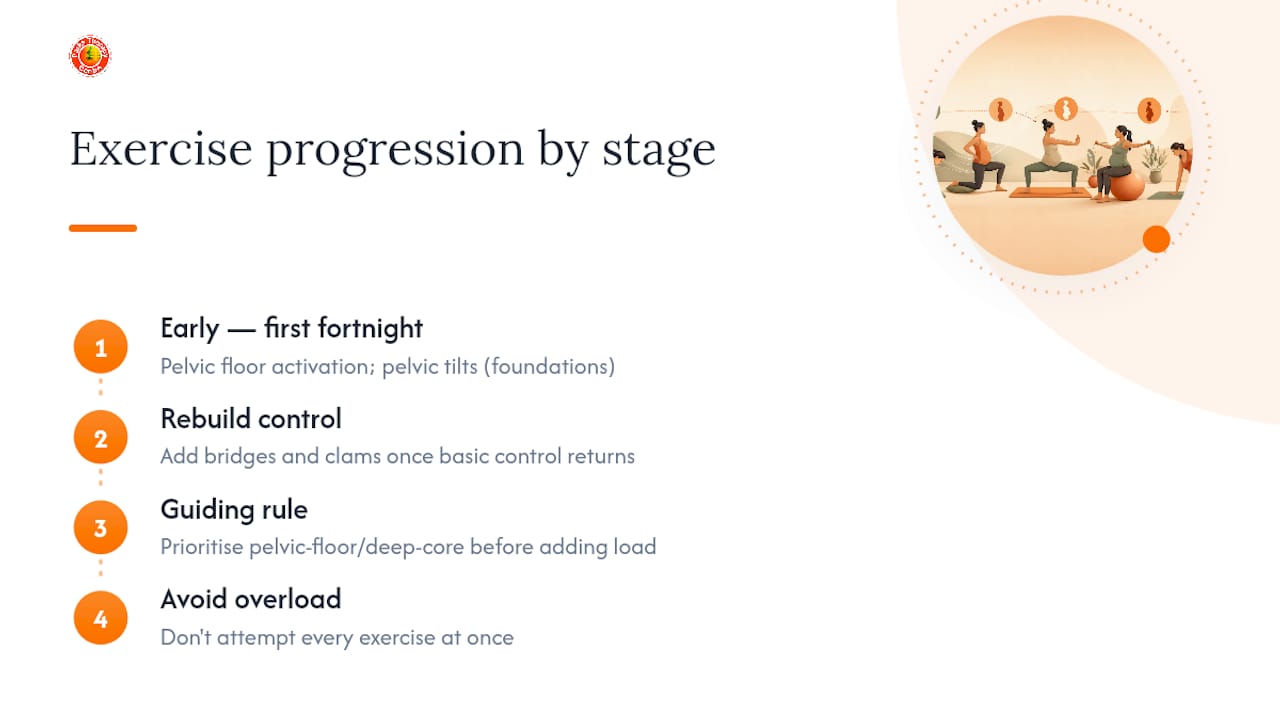
Most advice on this topic treats every exercise as equally valuable, listing 15 moves without saying which ones matter most in the first fortnight. That’s backwards. Pelvic floor activation and pelvic tilts do the heavy lifting early on; bridges and clams matter more once basic control returns. Trying to do everything at once is why so many women give up within a week.
The bigger gap is in expectations. Pregnancy pelvic girdle pain gets framed as something to endure until delivery, when the evidence points the other way: most women improve substantially with the right exercise sequence and pacing, not passive waiting. Where I’d push back hardest on conventional wisdom is the instinct to rest completely after a flare-up. Short, controlled movement almost always beats immobility, because stiff joints and a nervous system braced against movement create their own pain cycle.
If you take one thing from this, prioritise getting your pelvic floor and deep core activation right before adding load. Everything else builds on that foundation, not the other way round.
— Ivan
Ready for a personalised pelvic girdle pain plan?
Generic exercise sheets can only take you so far when your pain pattern is unique to how your pelvis moves and how far along your pregnancy is. A hands-on assessment can identify which muscles may need strengthening and which movements may need modifying, then build a personalised exercise plan around your stage of pregnancy, with follow-up to adjust it as things change.
Sessions may be accessible to many people, depending on individual insurance cover. If pelvic girdle pain is limiting your daily movement or not settling with home exercises, book an assessment with Parkstherapycentre and get a plan built around your body, not a generic printout.
This article is general information, not a substitute for advice from a qualified doctor. Consult a qualified healthcare professional about your own circumstances before acting on anything here.
Sources
Recommended