
Pilates exercises for injury recovery and better wellness
TL;DR:
Choosing the right Pilates exercises depends on individual health status, goals, and available equipment. Mat Pilates offers accessible, low-risk movement suitable for beginners and recovery, while reformer-based and clinical Pilates provide targeted support for injury rehabilitation and advanced training. An assessment by a qualified professional ensures safe, effective exercise tailored to each person’s needs.
Picking the right Pilates exercises feels straightforward until you actually need to do it. When you are managing a sprained knee, navigating the third trimester of pregnancy, or trying to build real functional strength after months of inactivity, the sheer variety of Pilates styles and equipment options can quickly become confusing. Mat, reformer, clinical, therapeutic — each serves a distinct purpose, and choosing the wrong one not only slows your progress but can sometimes cause more harm than good. This guide breaks down every major type of Pilates exercise, matches them to specific goals, and explains when professional input makes all the difference.
Table of Contents
Key Takeaways
Point | Details |
Tailor Pilates to your needs | Select exercise types based on your personal goals, health status, and professional recommendations. |
Mat Pilates is entry-friendly | Mat-based routines are ideal for beginners and those in early recovery, requiring minimal equipment. |
Reformer Pilates enables progression | Equipment-based Pilates provides more resistance for strength building and rehabilitation. |
Clinical Pilates needs expert oversight | Therapist-led Pilates is best for injury recovery, pregnancy, and special populations. |
Consult professionals for safety | Seeking advice from accredited physiotherapists or instructors ensures workouts suit your body and conditions. |
Understanding Pilates: Foundational principles and categories
Pilates was developed by Joseph Pilates in the early twentieth century as a system of controlled movement designed to strengthen the body from the inside out. What makes it different from general fitness training is its underlying philosophy: you do not simply move your limbs, you move with intent.
The six founding principles are:
Centring — every movement originates from the core, or what Pilates called the “powerhouse”
Control — no exercise is performed carelessly; each rep is deliberate
Concentration — full mental focus on the movement being performed
Precision — quality always outweighs quantity
Breath — coordinated breathing supports each movement pattern
Flow — exercises connect smoothly to maintain rhythm and efficiency
These principles matter because they explain why Pilates in rehabilitation works so well across different patient groups. The emphasis on controlled, mindful movement reduces the risk of compensatory patterns — those sneaky habits your body develops when it is trying to protect an injured area.
“Pilates is widely used in rehabilitation and injury prevention due to its focus on core stability and controlled movement.”
In broad terms, Pilates falls into three categories. Mat-based Pilates uses only your bodyweight and a mat. Apparatus Pilates incorporates the reformer, Cadillac, Wunda chair, or tower system. Clinical or therapeutic Pilates is delivered by a qualified physiotherapist and is shaped around a formal health assessment. Clinics across Bedfordshire and Buckinghamshire use all three, often blending them to suit individual needs. The role of injury prevention through physiotherapy underpins how these categories are used in structured care plans.
With the basics of Pilates in mind, let’s break down the major types of exercises you might encounter.
Mat Pilates: Accessible exercise for all levels
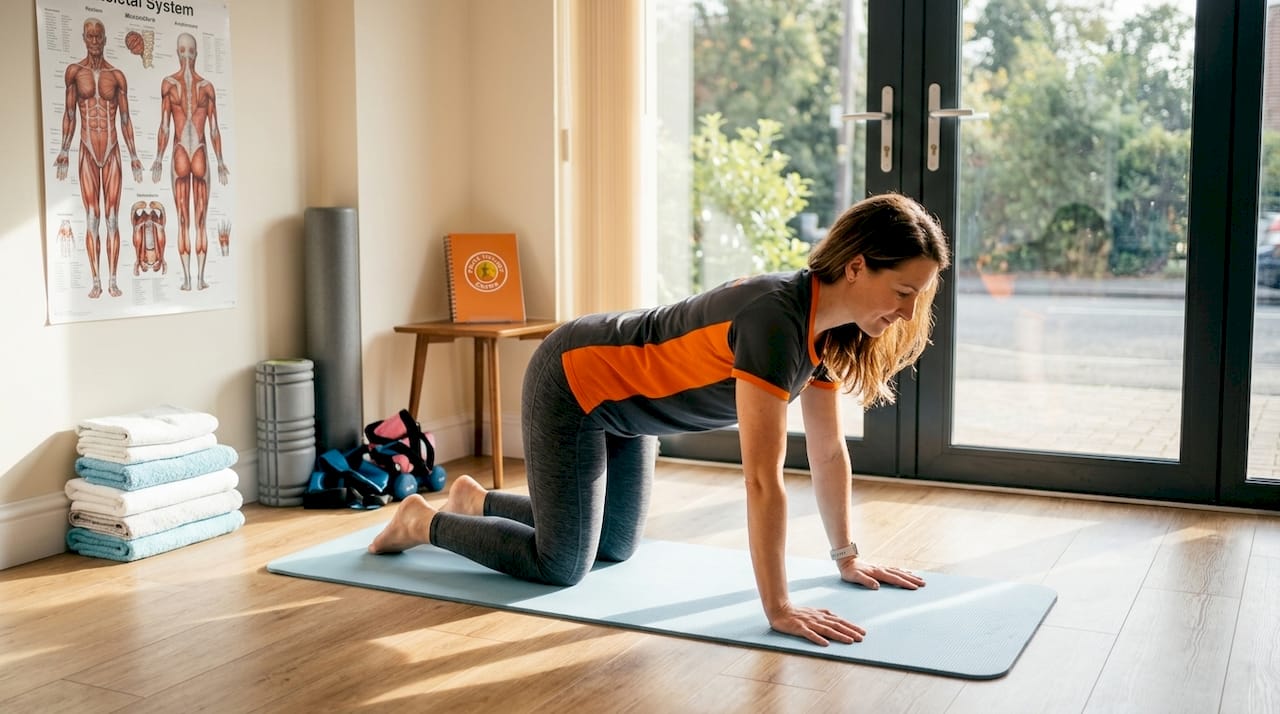
Mat Pilates is exactly what it sounds like: a full system of exercises performed on a mat, using your bodyweight as the primary source of resistance. It is the most accessible form of Pilates, requiring no equipment beyond a firm, non-slip mat. That accessibility makes it a go-to starting point for beginners, people managing early-stage injuries, and individuals who need to exercise at home between clinical appointments.
Common mat Pilates exercises include:
The Hundred — a breathing and core endurance exercise performed supine
Roll-up — a slow spinal articulation that builds abdominal control
Single leg stretch — a dynamic core exercise that challenges coordination
Spine stretch forward — improves spinal mobility and hamstring length
Pelvic tilts and bridges — foundational movements for lower back rehabilitation
Side-lying leg series — targets hip stability and glute strength
Mat Pilates is commonly recommended in rehabilitation programmes and can be adapted to different ability levels, making it an effective tool for those recovering from musculoskeletal problems. If you are working through a hip or back issue, your physiotherapist can modify standard exercises by reducing range of motion, adding prop support (such as a folded blanket under the pelvis), or removing loading from vulnerable areas entirely.
For those with lower back problems, mat Pilates exercises that focus on pelvic stability and deep abdominal activation — particularly the transversus abdominis — are often the first exercises prescribed.
Pro Tip: If you are pregnant or recovering from injury, always tell your instructor or physiotherapist before a session. Even the most “basic” mat exercise can place unexpected load on a healing structure, and a small modification can make the difference between progress and setback.
While mat Pilates is an excellent starting point, many Bedfordshire and Buckinghamshire studios and clinics also recommend equipment-based variations for greater progression.
Reformer and equipment-based Pilates: Enhanced resistance and rehabilitation
The reformer is probably the most well-known piece of Pilates apparatus. It consists of a sliding carriage set within a frame, with a system of springs that provide adjustable resistance. You push or pull the carriage using your arms, legs, or both, performing exercises in a variety of positions: lying, sitting, kneeling, or standing. The spring resistance can be increased as you grow stronger or reduced to support you through an early rehabilitation phase.
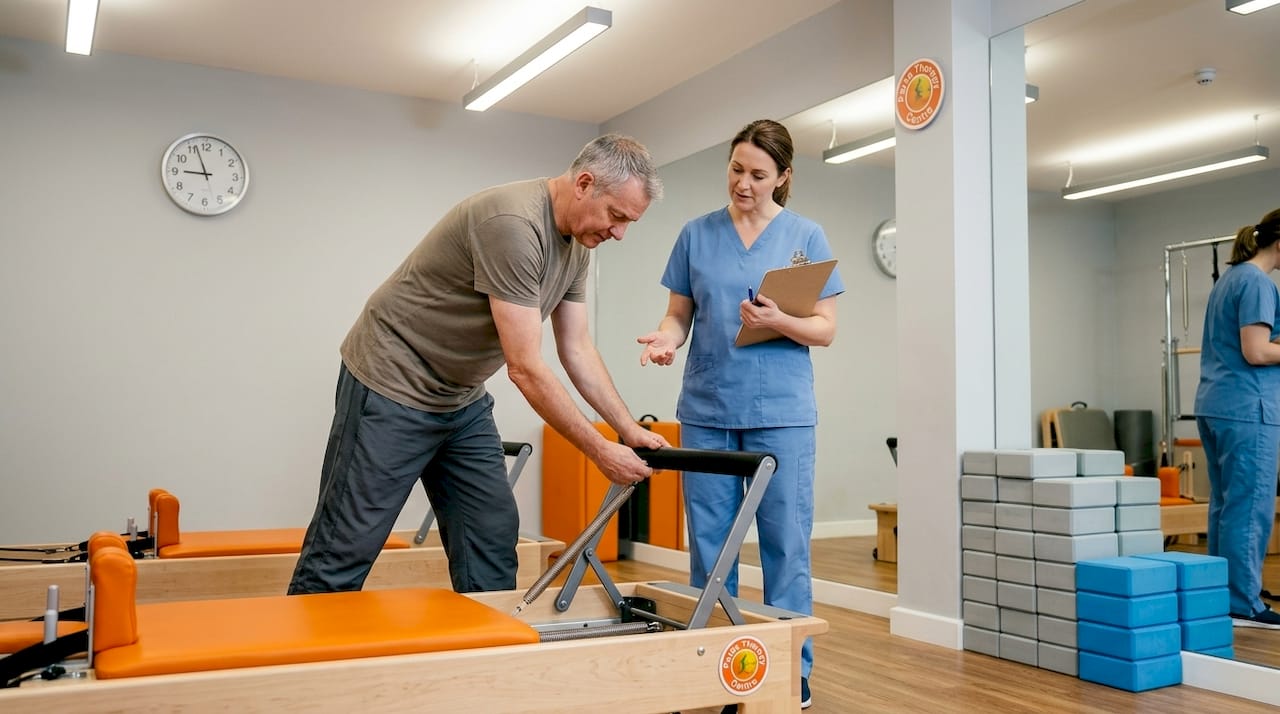
Reformer Pilates offers varied resistance and is popular in physiotherapist-led rehabilitation for its adaptability. The support the carriage provides also reduces the compressive loading on joints, which is particularly useful after knee surgery, a hip replacement, or a lumbar disc injury.
Equipment type | Primary function | Best suited for | Skill level required |
Mat | Bodyweight resistance | Beginners, home rehab, flexibility | All levels |
Reformer | Spring resistance, full-body | Post-injury rehab, strength building | Beginner to advanced |
Wunda chair | Seated and standing stability | Balance rehab, lower limb strengthening | Intermediate to advanced |
Cadillac/tower | Supported full-body work | Post-surgical rehab, neurological conditions | All levels with guidance |
The Wunda chair is excellent for rebuilding balance and lower limb strength, particularly for people who have had ankle or knee surgery. The Cadillac provides a high level of support and is frequently used in early post-surgical rehabilitation or for older adults with limited mobility. These pieces of equipment are rarely found outside specialist studios or physiotherapy clinics, which is one reason professional guidance matters so much when moving beyond the mat.
Pro Tip: Do not choose your Pilates apparatus based on what looks most impressive. The best equipment for you is the one that matches your current health status. A reformer offers tremendous benefit for rehab, but only when you understand how to use it safely. Ask your physiotherapist or Pilates instructor to guide you toward the right starting point when you explore Pilates classes in Bedfordshire and Buckinghamshire.
Some people require even more targeted support — enter clinical and therapeutic Pilates, which is especially relevant for those recovering from injury or managing health conditions.
Clinical and therapeutic Pilates: Tailored for injury and special populations
Clinical Pilates is not simply “Pilates led by someone with a certificate.” It is a structured approach delivered by a qualified physiotherapist who conducts a full assessment before any exercise prescription takes place. The physiotherapist identifies the specific structures involved in your injury or condition, rules out any contraindications (factors that would make an exercise unsafe), and designs a programme around your measurable findings.
This matters enormously for special populations. Therapeutic Pilates forms a core part of many physiotherapy programmes for pregnancy, post-surgery, and chronic musculoskeletal conditions. These groups share one thing in common: a general class cannot reliably keep them safe.
Populations who benefit most from clinical Pilates include:
Post-operative patients recovering from spinal, hip, or knee surgery
Pregnant women managing pelvic girdle pain or diastasis recti
Individuals with chronic pain including fibromyalgia or degenerative disc disease
Older adults working on balance, fall prevention, and joint stability
Those with neuromotor conditions such as multiple sclerosis or Parkinson’s
For people recovering from spinal procedures, clinical Pilates is often integrated into a broader post-back surgery recovery plan, with exercises progressed in line with tissue healing timescales. Frequency and load are carefully managed to avoid overloading healing structures.
Population group | Typical session frequency | Clinical focus | Outcome goal |
Post-surgical rehab | 2 to 3 times per week | Joint stability and load management | Return to daily function |
Pregnancy | 1 to 2 times per week | Pelvic floor, posture, breathing | Comfort and safe delivery prep |
Chronic pain | 2 times per week | Pain desensitisation, motor control | Reduced pain, increased capacity |
Older adults | 1 to 2 times per week | Balance, bone loading, coordination | Fall prevention, independence |
Physiotherapy-led programmes also lend themselves well to supplementation with at-home physio exercises, meaning the benefit of each session is extended into the week without creating risk.
With the main types covered, let’s summarise the key features and help you choose the right format based on your goals.
Choosing the right Pilates type: Goals and situational recommendations
Understanding which Pilates format suits you best comes down to three things: your current health status, your specific goal, and the environment you have access to. The table below gives you a clear starting point.
Exercise type | Best for | Setting | Equipment needed |
Mat Pilates | Beginners, home recovery, flexibility | Home or studio | Mat only |
Reformer Pilates | Strength building, joint rehab | Studio or clinic | Reformer machine |
Clinical Pilates | Injury recovery, post-op, pregnancy | Physiotherapy clinic | Varies, assessed individually |
Apparatus Pilates | Advanced users, complex rehab | Specialist studio | Chair, tower, or Cadillac |
Group Pilates class | General fitness, social motivation | Studio | Mat or reformer |
Once you know your category, follow these steps to get started safely:
Book a health assessment first — before joining any class, see a physiotherapist or certified Pilates instructor for an initial consultation. This is especially important if you have an existing injury, a chronic condition, or are pregnant.
Clarify your primary goal — is your priority pain reduction, strength, flexibility, or general fitness? Be specific, because the answer changes your programme.
Start with what you can control — mat Pilates at home is a low-risk way to begin building body awareness while you arrange professional support.
Progress gradually — adding load, range, or complexity too quickly is the most common reason people plateau or re-injure themselves.
Reassess regularly — clinical goals change as your body heals. A programme that suited you eight weeks post-surgery will likely need updating by week sixteen.
Selecting the appropriate Pilates exercise type enhances recovery and physical wellbeing, and that selection is most accurate when it is informed by a qualified professional who knows your history.
Why a one-size-fits-all Pilates approach rarely works
Here is something the wellness industry rarely says clearly: the majority of public Pilates classes are designed for people without significant health concerns. That is not a criticism; it is just a fact. General group classes cannot account for the individual variation that exists between a healthy thirty-year-old improving their posture and someone managing persistent lower back pain after a prolapsed disc.
We see this play out regularly in Bedfordshire and Buckinghamshire. Patients arrive at clinical sessions having attended general Pilates classes for months with minimal improvement, sometimes having even aggravated their symptoms. Not because Pilates failed them, but because the format they chose was not designed for what they needed.
The uncomfortable truth is that Pilates is only as effective as the assessment that precedes it. Without a proper understanding of your movement patterns, tissue health, and any neurological involvement, even well-intentioned exercise can reinforce dysfunctional patterns rather than correct them.
There is also a psychological dimension here. People who enter a general class and struggle to keep up, or who experience discomfort, often assume Pilates “is not for them.” In reality, they simply needed a different entry point. Clinical Pilates, delivered by a physiotherapist who understands your condition, often reveals that the same exercises which felt impossible in a group class become very achievable when correctly modified.
Our view, informed by decades of clinical practice, is that the single most valuable thing you can do before starting any Pilates programme is to have a professional assessment. Not as a formality, but as the actual starting point of your programme. The evidence-based Pilates approaches used in physiotherapy settings consistently outperform generic class attendance for people with specific health goals because they start with the individual, not the exercise.
Start your tailored Pilates journey with expert support
If anything in this article resonated with you — whether you are managing an injury, supporting a pregnancy, or simply looking to build a stronger, more functional body — the next best step is professional guidance. Generic advice can only take you so far.
At Parks Therapy Centre, our qualified team offers clinical Pilates, physiotherapy, and tailored exercise programmes across multiple locations in Bedfordshire and Buckinghamshire. With experience stretching back to 1986, we work with patients at every stage of recovery and fitness. From one-to-one clinical sessions to small group Pilates classes in Bedfordshire and Buckinghamshire, we match the right approach to your individual needs. Book a consultation through our website and take the first step toward a programme that is built around you, not around a general fitness template.
Frequently asked questions
Which type of Pilates is best for lower back pain?
Clinical Pilates is commonly recommended for individuals managing lower back problems, as it is overseen by a physiotherapist who can assess the cause and tailor exercises accordingly.
Can I do Pilates during pregnancy?
Yes, Pilates can be safely adapted throughout pregnancy, but pregnancy Pilates should be supervised by a qualified physiotherapist or specialist instructor to ensure exercises are appropriate for each trimester.
What equipment do I need for beginner Pilates at home?
Very little. Mat-based Pilates is accessible with minimal equipment — usually just a mat — though resistance bands or a small Pilates ball can add variety as you progress.
How often should I do Pilates for rehabilitation?
For most rehabilitation goals, two to three sessions per week is standard, though Pilates therapy frequency should be adjusted to reflect your individual capacity and the stage of your recovery.
What is the difference between mat and reformer Pilates?
Mat Pilates relies on bodyweight and a mat, while reformer Pilates uses equipment for adjustable spring resistance and physical support, making it particularly effective for rehabilitation and progressive strength work.
Recommended