
Rehabilitation protocols explained: your recovery guide

TL;DR:
A rehabilitation protocol is a structured, phase-based recovery plan tailored to biological healing timelines and functional milestones. Progression depends on objective criteria like strength symmetry and range of motion, not just time or feelings. Early and consistent effort, guided by clinical assessments, significantly improves long-term recovery outcomes.
A rehabilitation protocol is a structured, phase-based plan that guides your recovery after a musculoskeletal injury or surgery, specifying what to do, when to do it, and how to progress safely. These plans are not generic checklists. They are built around biological healing timelines, functional milestones, and objective criteria that tell your physiotherapist when your body is genuinely ready for the next challenge. Understanding rehabilitation protocols explained in plain terms gives you the power to engage actively with your recovery rather than simply following instructions you do not fully understand. Parkstherapycentre has supported patients through this process since 1986, and the single most consistent finding is this: patients who understand their protocol recover better than those who do not.
What are rehabilitation protocols explained in terms of phases?
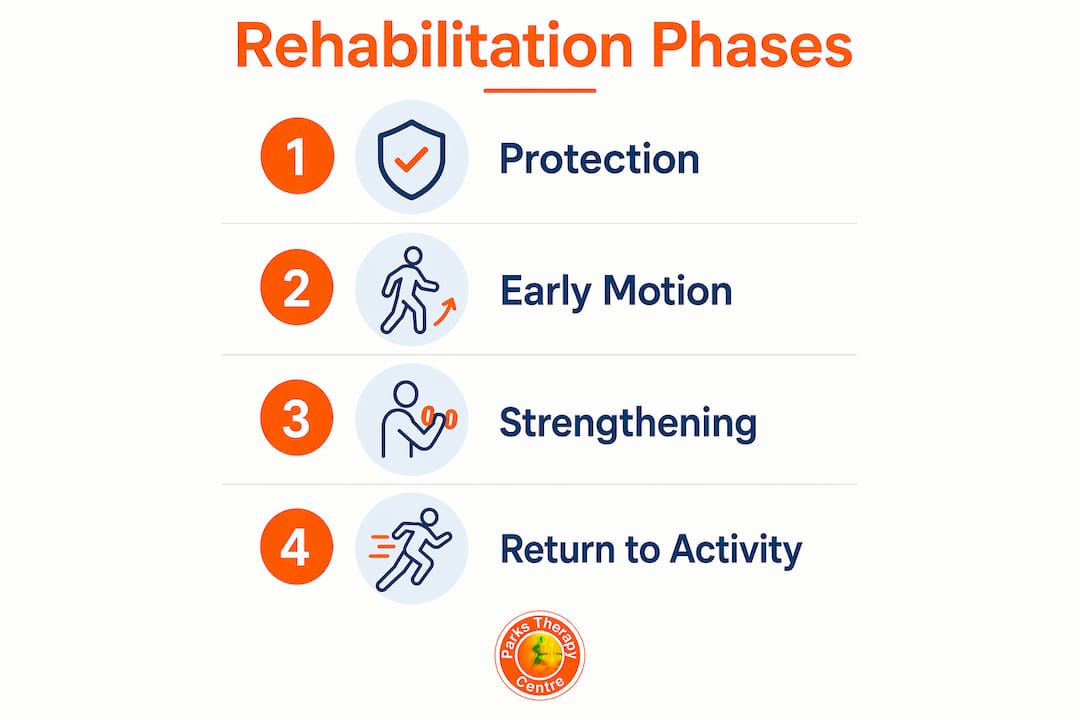
Post-operative rehabilitation protocols follow four biological healing phases, each with distinct goals tied directly to tissue recovery timelines. The phases are not arbitrary time blocks. They reflect what is actually happening inside your body at the cellular and structural level.
Phase 1: Protection (weeks 0–2). Your primary goal is to protect the repair and control swelling. Weight-bearing is restricted or carefully managed. Ice, elevation, and gentle range of motion exercises are standard. Rushing this phase risks disrupting the initial tissue repair.
Phase 2: Early motion (weeks 3–6). Controlled movement begins in earnest. Your physiotherapist introduces exercises that prevent stiffness without overloading healing tissue. Scar tissue formation is still active, so the quality of movement matters more than the quantity.

Phase 3: Strengthening (weeks 6–12). Progressive loading begins. Resistance exercises target the muscles surrounding the injured area. Proprioception work, which trains your body’s positional awareness, is introduced here because neuromuscular control is as important as raw strength.
Phase 4: Return to activity (12+ weeks). Sport-specific or task-specific training replaces general conditioning. Functional tests determine readiness rather than calendar dates.
Phase | Timeframe | Primary goal | Example activities |
Protection | Weeks 0–2 | Protect repair, reduce swelling | Ice, elevation, gentle passive motion |
Early motion | Weeks 3–6 | Restore range of motion | Controlled stretching, low-load movement |
Strengthening | Weeks 6–12 | Build muscle strength and control | Resistance exercises, balance training |
Return to activity | 12+ weeks | Restore full function | Sport-specific drills, functional testing |
Pro Tip: The most common mistake in early recovery is progressing to Phase 2 before swelling has fully settled. Persistent swelling inhibits muscle activation, particularly in the quadriceps, and no amount of exercise compensates for that neurological shutdown.
How do objective criteria determine when you can progress?
Time alone does not determine readiness. Return-to-sport decisions rely on objective criteria such as the quadriceps limb symmetry index, which requires at least 80% strength symmetry between your injured and uninjured leg before high-intensity activity resumes. That threshold exists because strength deficits below 80% significantly increase reinjury risk.
The limb symmetry index is measured using isokinetic dynamometry. Tools like those from Isoforce provide precise strength measurements that remove guesswork from progression decisions. A number on a screen is far more reliable than a patient’s self-reported confidence.
Common objective criteria used in physical therapy protocols include:
Range of motion: Full or near-full passive and active range compared to the uninjured side
Strength symmetry: Quadriceps and hamstring limb symmetry index of at least 80%
Single-leg step-down test: Controlled, pain-free descent without compensatory movement
Hop tests: Single-leg hop for distance, triple hop, and crossover hop, each requiring 90% symmetry
Psychological readiness: Validated questionnaires such as the ACL-RSI scale assess fear of reinjury
Objective return-to-sport assessment involves a battery of tests covering strength, movement quality, agility, and psychological readiness to minimise reinjury risk. Passing one test is not enough. You need to pass the full battery.
Pro Tip: Before each physiotherapy session, write down your current range of motion, any pain scores, and how you performed on any home exercises. Specific numbers give your therapist far more useful information than “it feels a bit better.”
Accelerated versus standard rehabilitation: what does the evidence show?
Accelerated rehabilitation protocols are defined by early weight-bearing, early motion, and faster progression through phases compared to traditional conservative approaches. Many patients and even some clinicians worry that moving faster risks the repair. The evidence does not support that concern.
Accelerated protocols do not increase joint laxity or complication rates compared with standard conservative approaches. Studies consistently show earlier mobility and higher patient satisfaction without compromising structural stability. That finding has shifted clinical practice significantly over the past decade.
The risk runs in the opposite direction. Prolonged immobilisation leads to muscle atrophy and arthrofibrosis, a condition where excessive scar tissue permanently restricts joint movement. Delayed progression can cause range of motion deficits that never fully resolve, regardless of how diligently you train later.
Approach | Typical timeline | Key benefits | Key risks |
Standard conservative | 9–12 months | Cautious tissue protection | Muscle atrophy, arthrofibrosis, stiffness |
Accelerated | 6–9 months | Earlier mobility, higher satisfaction | Requires close clinical supervision |
The choice between approaches depends on patient-specific factors including age, fitness baseline, surgical technique, and graft type. A 25-year-old athlete and a 55-year-old recreational walker will not follow identical timelines, even after the same procedure. Your physiotherapist selects the approach that matches your biology and your goals, not a one-size template.
Pro Tip: If your protocol feels overly cautious and you are meeting all your functional milestones ahead of schedule, raise that directly with your physiotherapist. Protocols are starting frameworks, not rigid sentences. Clinical judgement should always override a printed timeline.
How do rehabilitation guidelines differ by injury type?
Functional rehabilitation protocols focus on progressive, personalised treatment using validated tests and exercises to restore function and mobility, incorporating patient-specific goals and gradual load progression. The underlying framework is consistent, but the details change substantially depending on what you have injured or had repaired.
ACL reconstruction
ACL reconstruction is one of the most studied rehabilitation pathways in musculoskeletal medicine. The protocol follows the four phases described above, with particular emphasis on quadriceps activation in Phase 1 and neuromuscular control throughout. Return-to-sport testing at the end of Phase 4 is non-negotiable. Patients who skip formal testing and return to sport on feel alone face a significantly higher reinjury rate. You can find detailed guidance on post-surgery rehabilitation to understand what each phase involves in practice.
Traumatic brain injury
Early rehabilitation for traumatic brain injury should ideally begin within 48 hours of the patient achieving haemodynamic and respiratory stability. That timeline is far earlier than most people expect. Specialist-led rehab starts with low-intensity activities and progresses gradually, with multidisciplinary coordination between neurologists, physiotherapists, and occupational therapists.
Key differences across injury types
ACL reconstruction: Emphasis on quadriceps symmetry, hop testing, and psychological readiness before sport return
Rotator cuff repair: Longer protection phase due to tendon-to-bone healing; passive motion precedes active motion by several weeks
Hip replacement: Early weight-bearing is standard; precautions focus on dislocation risk rather than load management
Traumatic brain injury: Cognitive and vestibular rehabilitation run alongside physical recovery; fatigue management is a primary concern
For a practical breakdown of exercises used across these pathways, the surgery rehabilitation exercises guide from Parkstherapycentre covers the most common post-surgical movements in clear detail. If you encounter unfamiliar terms during your recovery, the sports therapy terminology guide provides plain-language definitions that make clinical conversations far easier.
Key takeaways
Rehabilitation protocols succeed when biological healing phases, objective functional criteria, and consistent daily effort align throughout the recovery process.
Point | Details |
Four phases structure recovery | Protection, early motion, strengthening, and return to activity each have distinct goals tied to tissue healing. |
Objective criteria gate progression | Limb symmetry index, hop tests, and range of motion benchmarks determine readiness, not calendar dates alone. |
Accelerated protocols are safe | Evidence shows early weight-bearing and motion do not increase complications and reduce risks like arthrofibrosis. |
Protocols vary by injury type | ACL, rotator cuff, and traumatic brain injury each require tailored timelines and specialist coordination. |
Consistency outperforms complexity | Simple exercises performed daily with good technique produce better outcomes than sporadic high-intensity sessions. |
What I have learned from watching patients recover well and poorly
The patients who recover best are rarely the ones with the most impressive pain tolerance or the highest fitness levels going in. They are the ones who treat their protocol as a daily commitment rather than a series of appointments.
Successful rehabilitation depends more on consistent, quality execution of exercises performed regularly than on complexity or intensity. Simple exercises done three to five times daily, combined with supervised physiotherapy, produce the best outcomes. That finding runs counter to the instinct many patients have to do more when they feel ready. More is not always better. Better is better.
The psychological dimension is consistently underestimated. Fear of reinjury, frustration with slow progress, and loss of identity for athletes are real clinical factors. Rehabilitation as a process includes psychological and behavioural interventions alongside physical work, and the best outcomes come when both are addressed together.
The other pattern I see repeatedly is patients who disengage the moment formal sessions end. Recovery does not stop when your physiotherapy course finishes. The strengthening and neuromuscular work you do in the weeks and months after discharge determines your long-term function. Treat the end of formal rehab as a transition, not a finish line.
Proactive communication with your therapist changes outcomes. If something feels wrong, say so immediately. If you are breezing through your home exercises, say that too. Your therapist can only adjust your protocol based on information you provide. The more specific you are, the better the response you will get.
— Ivan
How Parkstherapycentre can support your recovery
Recovering from a musculoskeletal injury or surgery is far more manageable when you have a team that understands both the science and the individual behind the injury.
Parkstherapycentre has been delivering physiotherapy and sports injury treatment across Bedfordshire and Buckinghamshire since 1986. The team combines hands-on clinical care with functional testing, patient education, and tailored rehabilitation programmes built around your specific injury, surgical history, and goals. Whether you are navigating the early protection phase or preparing for return-to-sport testing, the physiotherapists at Parkstherapycentre provide the structured support that turns a protocol on paper into a recovery that actually works. Online booking is available, and the centre accepts most major insurance providers.
FAQ
What is a rehabilitation protocol?
A rehabilitation protocol is a structured, phase-based recovery plan that specifies exercises, restrictions, and progression criteria aligned to biological healing timelines. It guides patients and clinicians through recovery after musculoskeletal injury or surgery.
How long does a typical rehabilitation protocol last?
Most post-surgical protocols run from six to twelve months, depending on the injury type and whether an accelerated or standard approach is used. ACL reconstruction protocols, for example, typically span nine to twelve months before full return-to-sport clearance.
Can I progress faster than my protocol suggests?
Progression should be based on meeting objective functional criteria, not on how you feel subjectively. If you are consistently passing all milestones ahead of schedule, discuss accelerating your timeline with your physiotherapist rather than self-directing the change.
What happens if I skip phases in my rehabilitation?
Skipping phases increases the risk of reinjury, arthrofibrosis, and persistent strength deficits. Prolonged immobilisation and premature loading are both harmful. The phases exist because tissue healing follows a biological timeline that cannot be overridden by motivation alone.
How do I know if my rehabilitation protocol is working?
Measurable improvements in range of motion, strength symmetry, and functional test scores are the clearest indicators of progress. If objective markers are not improving over two to three weeks, raise this with your physiotherapist so the protocol can be reviewed and adjusted.
Recommended