
Physio informed wrist tendonitis plan for UK patients, mobility first

A short daily routine of wrist mobility moves, targeted stretches, isometric holds, and gradual strengthening relieves most wrist tendonitis when it stays within a pain-free range. Work through the sequence in that order: mobility, stretching, isometrics, then progressive loading. Stop immediately if you feel sharp pain, and book a physiotherapy assessment if numbness, tingling, or real weakness lasts beyond a day or two.
TL;DR:
Perform wrist mobility exercises before stretching to warm up the joint and assess range of motion, avoiding forced movements or sharp pain.
Stretch only after mobility work, focusing on gentle tension along the forearm muscles, with tension easing rather than fighting resistance.
Start strengthening with isometric holds once inflammation subsides, progressing gradually to resistance exercises and functional tasks to avoid setbacks.
Incorporate nerve and tendon glides if tingling or catching sensations occur, monitoring symptom changes and reducing repetitions if sensations worsen.
Track soreness, grip strength, and sleep quality to gauge recovery, and seek physiotherapy if symptoms persist, worsen, or nerve symptoms do not improve.
Table of Contents
Wrist tendonitis exercises for range of motion and mobility
Mobility work comes first because a stiff, guarded wrist rarely responds well to stretching or loading straight away. These moves warm the joint gently and give you an honest read on how much range you have before you push into anything firmer.
Wrist flexion and extension. Rest your forearm on a table with your hand hanging over the edge. Bend the wrist up, then down, moving slowly and holding each end position for around 5 to 6 seconds. Aim for several repetitions.
Radial and ulnar deviation. With the forearm still supported, tilt the hand side to side, thumb toward you then away, using the same hold and repetition pattern.
Hand flips (pronation and supination). Bend your elbow to 90 degrees and rotate your forearm so your palm faces up, then down, like turning a door handle. This targets forearm rotation rather than the wrist joint itself, and it is often the movement people notice tightness in first.
If any of these feel stiff rather than sore, that is normal. Beginners often find it easier to rest the forearm on a thigh instead of a table, which reduces the leverage on the wrist and makes the movement gentler. Never force a stretch past the point of resistance. Cambridge University Hospitals’ hand therapy guidance uses this same forearm-supported approach for active wrist exercises, and it is a sensible template to follow at home.
How should you stretch a tendonitis-affected wrist?
Stretching follows mobility work once the joint has warmed up, and it targets the muscle-tendon units that are under strain, particularly the extensors on the back of the forearm and the flexors on the underside.
Wrist extensor stretch: extend your arm in front of you, palm down, fingers pointing to the floor, then use your other hand to gently press the hand further down. Hold for several seconds, repeating a few times.
Wrist flexor stretch: extend your arm with the palm facing up, then gently pull the fingers and hand back toward your body until you feel a mild stretch along the inside of the forearm. Hold for the same 15 to 30 seconds.
Thumb and de Quervain stretch: tuck your thumb into your palm, make a loose fist around it, then tilt your wrist gently toward your little finger. You should feel a pulling sensation along the thumb side of the wrist, not sharp pain.
Cleveland Clinic’s guidance on wrist pain recommends holding these stretches for 10 to 30 seconds and repeating them several times a day, which matches what most hand therapy leaflets suggest. If a stretch leaves the wrist more irritated afterwards rather than looser, ease off the range you’re pulling into and shorten the hold. Stretching should feel like tension easing, not a fight against resistance.
When should you start strengthening a tendonitis-affected wrist?
Strengthening only belongs in the routine once acute inflammatory pain has settled, not while the wrist is actively flaring. Starting too early is one of the most common ways people set their own recovery back. The progression runs from isometric holds, where the muscle works but the joint doesn’t move, through to isotonic loading with resistance, then into functional tasks.
Isometric holds. Push your hand against a fixed surface (a table, a wall) in flexion, extension, and each side-to-side direction, holding each contraction for around 5 seconds and repeating roughly 10 times per direction. Arthritis UK notes that isometrics load the tendon without moving the joint, which makes them a safer starting point than dynamic strengthening.
Isotonic loading. Move to theraband or light dumbbell wrist curls, working through flexion, extension, and rotation. Start light, doing 2 to 3 sets of 10 to 15 repetitions, and increase resistance gradually rather than jumping a full band level at once. Imperial NHS’s wrist strengthening leaflet uses this exact structure, and a canned good from the cupboard works just as well as a dumbbell if you’re starting from nothing.
Functional loading. Add grip work with therapy putty, co-contraction exercises, and gradually reintroduce the tasks that aggravated the wrist in the first place, such as typing, gripping cutlery, or carrying shopping bags.
If you already do light resistance training elsewhere, structured free-weight progressions follow the same principle of small, steady load increases rather than large jumps.
Pro Tip: Progress one variable at a time. If you’re increasing reps this week, keep the resistance the same. Changing both at once makes it much harder to tell what actually caused a flare-up.
Tendon and nerve glides for wrist tendonitis recovery
Gliding exercises restore movement between the tendons and the surrounding tissue, and separately, mobilise the median nerve where it runs through the carpal tunnel. Both are worth including if your symptoms include tingling or a “catching” sensation alongside the tendon pain.
Tendon glides: move through a straight hand, a hook fist, a full fist, a straight fist, and a table-top position, holding each briefly before moving to the next.
Median nerve glide: sit with your arm out to the side, elbow straight, wrist and fingers extended, then gently tilt your head away from that arm to add a mild nerve stretch, holding for a few seconds before releasing.
Perform 5 to 10 repetitions of each, once or twice daily to start.
A brief increase in tingling or stretch sensation during nerve glides is expected. St George’s Hospital’s median nerve gliding leaflet advises that any symptom increase should settle within about an hour. If it doesn’t, or if it clearly worsens, reduce the repetitions or stop and get it checked.
How much wrist pain during exercise is normal?
Mild aching or a pulling sensation during a stretch or a strengthening set is expected. Sharp pain, or pain that spikes and stays spiked, is not, and it’s the clearest sign you’ve pushed past what the tendon can currently tolerate.
Mild, dull soreness that fades within an hour of finishing is normal training response.
Sharp, stabbing, or rapidly worsening pain during an exercise means stop straightaway.
Apply the one-hour rule: if soreness or symptom increase hasn’t settled within about an hour of finishing, dial back the next session’s volume or resistance.
Ice for 10 to 15 minutes after exercise helps if the area feels hot or swollen.
Red flags that mean you should stop home exercises and get assessed: persistent tingling or numbness, noticeably worsening weakness in grip, or pain severe enough to disturb sleep. Cleveland Clinic identifies these as reliable indicators that home exercise alone isn’t the right next step. Therapists at NHS Lanarkshire are consistent on this point too: finding and staying in the pain-free zone matters more than pushing through discomfort to “get it over with.” If you’re ticking any red flag box, that’s your answer, book an assessment rather than continuing to self-manage.
When is it time to book a physiotherapy assessment?
A physiotherapy or hand therapy assessment typically starts with a history of how and when the pain began, followed by movement and strength testing to identify exactly which tendon or nerve structure is involved. From there, a therapist builds a programme suited to your specific pattern of symptoms, rather than a generic leaflet routine.
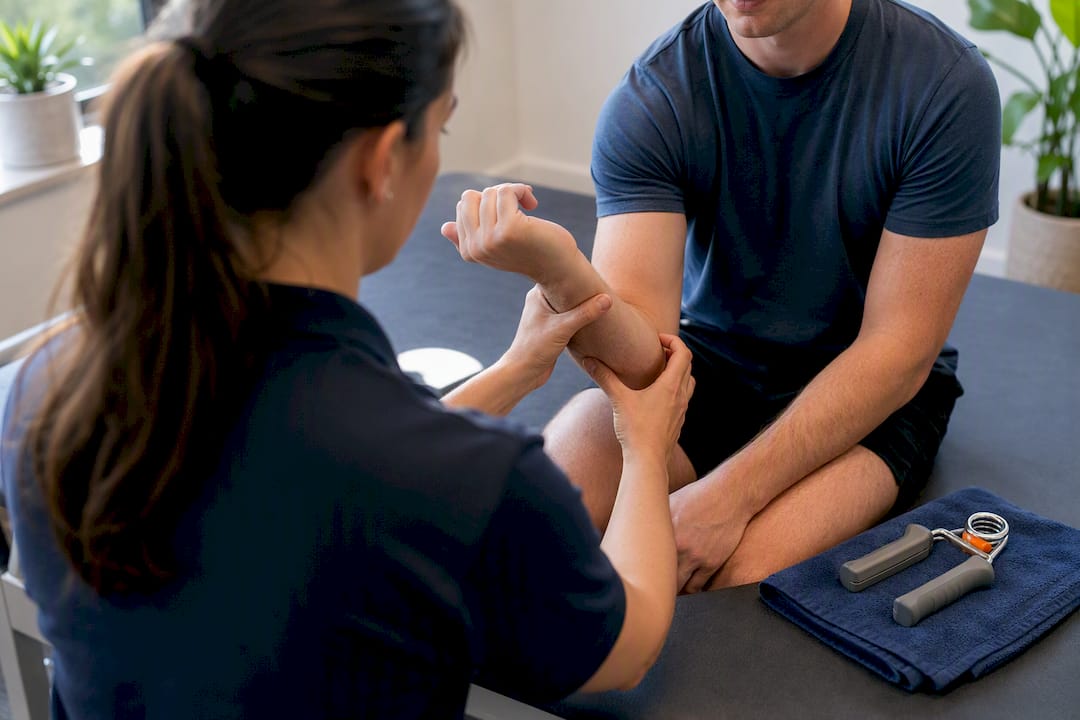
Clinic input becomes genuinely worthwhile when nerve symptoms persist, when a home routine hasn’t shifted things after a few weeks, or when grip strength has noticeably dropped. A multidisciplinary team working across clinics in Bedfordshire and Buckinghamshire sees this pattern regularly and can accept both private and insured patients. If you book an appointment, it helps to bring a note of when the pain started, what movements provoke it, and any exercises you’ve already tried, alongside details of any relevant hand therapy guidance you’ve been following at home.
What actually moves the needle on wrist tendonitis recovery
Most advice on this topic focuses on the exercises themselves, lists of stretches, rep counts, resistance band colours. That’s useful, but it misses the part that actually determines whether someone recovers well: pacing discipline. The people who improve fastest aren’t doing more exercises than everyone else. They’re doing fewer, more consistently, and resisting the urge to add load the moment the pain eases slightly.
The conventional advice also underplays how much nerve involvement changes the picture. Tendon pain and nerve irritation can sit right next to each other in the wrist, and treating tingling as “just part of the tendonitis” is a common reason home programmes stall. If your symptoms have any nerve component, that’s worth flagging early rather than working through months of stretches that were never quite addressing the real problem.
If there’s one thing worth prioritising above the exercise list itself, it’s honest self-monitoring: track whether soreness settles within an hour, whether grip strength is holding steady or slipping, and whether sleep is being disrupted. Those three signals tell you more about whether your routine is working than any rep count does.
— Ivan
This article is general information, not a substitute for advice from a qualified doctor. Consult a qualified healthcare professional about your own circumstances before acting on anything here.
Sources
Recommended