
Clinical Pilates: benefits, effectiveness and uses
- May 11
- 10 min read
TL;DR:
Clinical Pilates is a structured, physiotherapy-led movement education tool tailored for injury recovery, pain management, and prevention. It involves individualized assessment, supervised exercise progression, and addresses specific functional goals, unlike general Pilates classes. Its effectiveness depends on professional oversight, proper assessment, and integration into broader rehabilitation plans.
Clinical Pilates is frequently dismissed as simply a watered-down version of the Pilates classes you find at your local gym. That assumption sells it significantly short. Clinical Pilates is not simply a gentler Pilates method but rather a structured, professionally supervised movement education tool designed specifically for people working through injury, managing chronic pain, or aiming to prevent musculoskeletal problems from returning. For anyone recovering from a sports injury or dealing with persistent back pain, understanding what clinical Pilates actually offers, and what it doesn’t, can be the difference between a thorough recovery and a frustrating plateau.
Table of Contents
Key Takeaways
Point | Details |
Purpose-built for rehab | Clinical Pilates is specifically structured and supervised for injury recovery and prevention. |
Evidence supports moderate benefit | Research shows moderate benefits for pain and function, especially compared to doing nothing. |
Not a cure-all | Clinical Pilates is not suitable for everyone and works best with professional assessment. |
Progression is key | Long-term gains require transition from clinical to independent movement, not ongoing supervision alone. |
Defining clinical Pilates: what sets it apart?
The term “clinical Pilates” gets used loosely, but its definition matters enormously when you are choosing a recovery path. At its core, clinical Pilates is a physiotherapy-informed application of Pilates principles. It is delivered or overseen by a qualified healthcare professional, most commonly a physiotherapist, and every session is built around a prior assessment of your movement, strength, and injury history.
This is what separates it fundamentally from studio Pilates. A general Pilates class follows a group programme, often with some modifications available, but it is broadly the same routine for everyone in the room. Clinical Pilates begins with you specifically: your asymmetries, your pain patterns, your functional goals. The exercises are prescribed rather than simply offered.
“Clinical Pilates is not simply a gentler Pilates method, but a movement education and capacity-building tool, supporting rehabilitation and injury prevention.”
Understanding the role of Pilates in rehabilitation helps clarify why professional oversight is non-negotiable here. The exercise selection, the load, the cues, the progression — all of it is managed by someone who understands anatomy, injury mechanics, and recovery timelines.
How clinical Pilates compares to general Pilates
Feature | Clinical Pilates | General Pilates |
Supervised by | Qualified physiotherapist or rehab professional | Pilates instructor (varying qualifications) |
Starts with | Individual movement assessment | General fitness or skill level |
Session design | Individually prescribed | Group class format |
Primary goal | Rehabilitation, pain management, prevention | Fitness, flexibility, core strength |
Suitable for | Injury recovery, post-surgery, chronic conditions | General population, wellness |
Progression | Clinically guided and monitored | Instructor-led, broadly standardised |
Key features of clinical Pilates that make it appropriate for injury recovery:
Individualised exercise prescription tailored to your specific injury or condition
Regular reassessment to ensure the programme evolves as you improve
Professional feedback on movement quality, compensatory patterns, and technique errors
Integration with broader physiotherapy management, including manual therapy and education
Evidence-informed selection of exercises based on your diagnosis and goals
What clinical Pilates is not, and this is important: it is not a medical treatment. It does not diagnose or cure. It is a movement education tool. That distinction matters because it shapes realistic expectations and ensures you continue seeking appropriate medical care for the underlying condition.
How clinical Pilates supports rehabilitation and prevention
Understanding the basics leads naturally into where clinical Pilates fits within injury recovery and prevention protocols. The applications are broad but most relevant for people with musculoskeletal problems, sports injuries, post-surgical recovery, and chronic pain conditions.
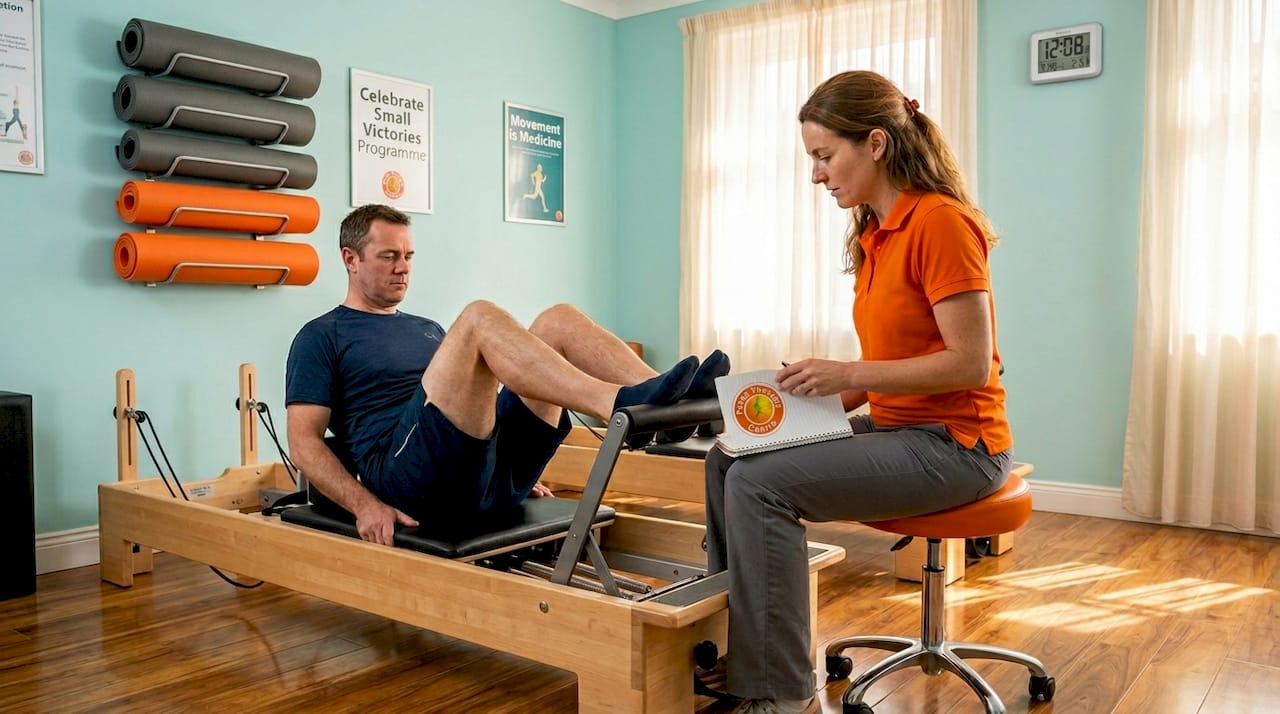
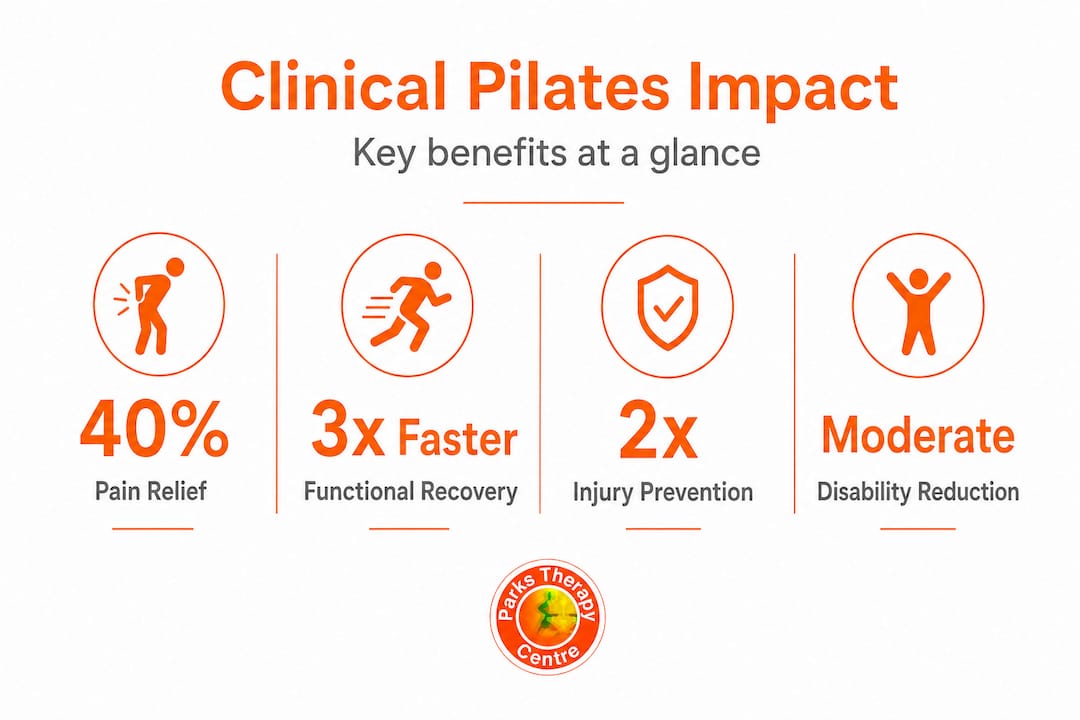
Research shows moderate effects on pain and disability in musculoskeletal rehabilitation when clinical Pilates is compared to no exercise or minimal intervention. For lower back pain in particular, it has solid support for preventing progression towards chronicity. Crucially, this is evidence for appropriately supervised Pilates, not unsupervised exercise borrowed loosely from a Pilates class.
If you are curious whether Pilates is good for lower back problems, the short answer is yes, under the right conditions and with appropriate guidance. The broader picture of Pilates therapy for musculoskeletal recovery also extends to shoulder injuries, hip and knee conditions, pelvic floor dysfunction, and sports performance rehabilitation.
A typical clinical Pilates session: what to expect
Initial assessment — Your physiotherapist evaluates your posture, joint mobility, muscle strength, movement control, and pain behaviour. This forms the foundation of your programme.
Goal setting — Together you identify short and longer-term recovery or prevention goals, which shapes exercise selection and progression targets.
Exercise introduction — You begin with exercises matched to your current capacity: often simpler, low-load movements targeting stability and motor control before strength and endurance.
Technique feedback — The clinician observes and corrects your movement patterns in real time, preventing compensatory habits from forming.
Home programme — You are given specific exercises to practise between sessions, reinforcing the neurological patterns being trained.
Progression review — At set intervals, your programme is updated based on objective reassessment, not just how you feel on a given day.
Pro Tip: Keep a brief movement diary between sessions. Noting which exercises aggravate or ease your symptoms gives your physiotherapist invaluable information for fine-tuning your programme faster.
The stepwise approach in recovery reflects three broad phases. In the acute phase (first days to weeks), the focus is pain management, protecting healing tissue, and introducing gentle, controlled movement. In the subacute phase, load and complexity increase as healing progresses and motor control improves. In the maintenance phase, the goal shifts to building resilience, preventing recurrence, and transitioning towards independent movement. Each phase has distinct exercise characteristics, and a clinical Pilates programme adapts accordingly.
Consider a runner returning from a lumbar stress fracture. In the early weeks, sessions might focus purely on diaphragmatic breathing, pelvic stability, and gentle hip control. By month two, single-leg balance and load-bearing progressions are introduced. By month three, sport-specific movements are incorporated to prepare for return to running. This is clinical Pilates working as it is designed to.
Limitations and when clinical Pilates is not suitable
Even promising interventions have their limits. It is crucial to know when clinical Pilates might not be the right fit, or when additional therapies are essential alongside it.
Clinical Pilates is not for everyone post-injury and requires professional oversight to modify for comorbidities. It also complements but does not replace other therapies. Those two sentences contain a lot of important truth that is often glossed over in wellness content.
Situations where clinical Pilates may not be appropriate or requires significant adaptation:
Acute post-surgical phases where tissue healing takes precedence and movement must be strictly limited according to surgical protocols
Uncontrolled severe pain where any exercise provokes disproportionate symptom flare
Certain neurological conditions that affect balance, coordination, or sensation in ways that increase injury risk without very specialist input
Unstable cardiovascular conditions or other medical comorbidities that require medical clearance before any exercise programme
Fractures or structural instabilities that have not yet been medically managed or are contraindicated for loading
Psychological factors such as severe pain catastrophising or health anxiety, which need concurrent psychological support alongside physical intervention
The importance of an initial physiotherapy assessment cannot be overstated. Starting a clinical Pilates programme on the basis of someone else’s recommendation, without your own assessment, risks addressing the wrong problem entirely. What looks like a hip problem on the surface may stem from lumbar dysfunction. What feels like a core weakness may actually reflect a breathing pattern disorder. Evidence-based physiotherapy begins with accurate assessment, not assumption.
Pro Tip: If you are currently under care from an orthopaedic surgeon, sports physician, or other specialist, inform your physiotherapist before starting clinical Pilates. A joined-up approach always produces better outcomes than parallel, disconnected care pathways.
Clinical Pilates works best as one component within a broader care plan. It pairs well with manual therapy for joint mobility, with soft tissue work for muscle tension, and with education and self-management strategies for long-term resilience. Treating it as a standalone “fix” is where expectations tend to go wrong.
Transitioning from clinical Pilates to independent movement
With a firm understanding of clinical Pilates’ strengths and boundaries, attention turns naturally to making progress sustainable. The goal of any well-run clinical Pilates programme is not to make you dependent on supervised sessions indefinitely. It is to give you the understanding, confidence, and physical capacity to manage your movement independently.
The transition to studio Pilates for long-term maintenance is explicitly recommended once clinical goals are met. This is a sensible and important step. It keeps you exercising in a structured environment, reinforces the movement education from your clinical sessions, and provides social motivation, all without continuing to require one-to-one clinical oversight.
Typical readiness criteria for stepping down supervision
Readiness indicator | What it means practically |
Consistent pain reduction | Symptoms manageable or resolved across daily activities |
Motor control established | Exercises performed with correct form without cues |
Functional goals met | Return to work, sport, or daily tasks achieved |
Home programme adherence | Independent exercise maintained between sessions |
Understanding of self-management | You can identify warning signs and know when to seek help |
The process of transitioning safely typically follows these steps:
Discuss readiness with your physiotherapist — do not self-discharge. Use a planned conversation based on objective progress markers.
Reduce session frequency gradually rather than stopping abruptly, allowing you to test independence with a safety net still in place.
Identify a suitable studio or community Pilates class and, if possible, allow your physiotherapist to communicate your history and needs to the instructor.
Continue your home exercise programme even when clinical sessions have ended. Maintaining a small set of key exercises weekly prevents deconditioning.
Set a review date perhaps three months after discharge, so that if problems resurface they are caught early rather than becoming entrenched again.
Knowing how to improve your Pilates technique as you move into more independent exercise is valuable. Similarly, a solid bank of physiotherapy home exercises keeps your recovery gains working for you long after supervised sessions end.
Pro Tip: When joining a studio Pilates class post-rehabilitation, inform the instructor about your injury history before your first session. A good instructor will adapt where needed, and you will get far more benefit from the class as a result.
Avoiding relapse is largely about honest self-monitoring. If you notice familiar symptoms returning — that old lower back stiffness, the shoulder ache after sport — act early rather than waiting for it to become a significant problem again. Your physiotherapist would far rather see you for one or two sessions at an early stage than manage a full recurrence months down the line.
Clinical Pilates: what most guides get wrong
Here is the perspective you will not always read elsewhere. Most articles about clinical Pilates swing between two poles: either it is presented as a near-magical solution for every back problem and sports injury, or it is dismissed as a niche add-on that only marginally outperforms general exercise. Both positions miss the real point.
The truth is that the mechanism of clinical Pilates is education. Not just exercise. When someone truly understands how their body moves, why a particular pattern is loading a structure poorly, and how to modify it in real time, the change is lasting. That is what separates a person who recovers fully from someone who cycles through physiotherapy appointments every year with the same complaint.
The evidence base for clinical Pilates is honest about its limits. Studies support moderate benefit over minimal intervention, but the evidence for superiority over other well-delivered exercise forms is less clear. What this actually tells us is not that clinical Pilates is unimportant, but that quality of supervision and individual tailoring matter enormously, whatever the modality. Clinical Pilates done well, with a skilled physiotherapist who genuinely engages with your movement education, will almost always outperform generic exercise prescribed by rote.
We also see, in practice, that the most durable recoveries come from people who blend clinical input with self-driven movement. They attend sessions with genuine curiosity, apply the principles at home, transition to community exercise with confidence, and return proactively when something changes. That cycle of engagement is what physiotherapy for musculoskeletal disorders ultimately aims to create.
The uncomfortable truth is that clinical Pilates requires something from you, not just from your clinician. Passive treatment has its place, particularly early in recovery. But the long game in musculoskeletal health is active participation in your own movement education. Clinical Pilates is one of the best vehicles we have for that.
How Parks Therapy Centre can help your recovery journey
If you are ready to explore clinical Pilates as part of your recovery or prevention strategy, professional input is essential for safe and effective results.
At Parks Therapy Centre, our qualified physiotherapists offer thorough initial assessments to determine whether clinical Pilates is right for your specific situation. We design individually tailored programmes that fit your current capacity and evolve as you progress, whether you are managing chronic lower back pain, recovering from a sports injury, or returning to activity after surgery. With locations across Bedfordshire and Buckinghamshire and a team with decades of experience since 1986, we provide the kind of joined-up, evidence-informed care that makes real recovery possible. Book a consultation today and take the first step towards understanding and managing your movement with confidence.
Frequently asked questions
Is clinical Pilates better than regular Pilates for injury recovery?
Clinical Pilates is specifically tailored and professionally supervised, making it more appropriate early in recovery than general Pilates, though evidence for overall superiority over other exercises is mixed. The key advantage is the individual assessment and prescription, not the exercises themselves.
Can clinical Pilates help with chronic lower back pain?
Clinical Pilates offers genuine support for managing and preventing the worsening of lower back pain, with evidence showing it is useful for preventing chronic LBP progression. Results are strongest when sessions are individually supervised and progressed consistently.
Who should avoid clinical Pilates?
People with acute severe injuries, uncontrolled pain, or complex health conditions should not begin without healthcare input, as clinical Pilates requires professional oversight to be safely adapted. Always seek a physiotherapy assessment first if you are unsure whether it is appropriate for your situation.
Do I need a referral for clinical Pilates?
A formal referral is not always required, but an initial assessment by a physiotherapist or rehabilitation professional is strongly advised before starting. This ensures the programme is matched to your actual needs and that no contraindications are missed.
Recommended