
Industry standards in injury management 2026

TL;DR:
Industry injury management standards in 2026 emphasize early assessment, multidisciplinary coordination, and organizational risk governance. Clinicians must conduct assessments within 24 hours and create individualized, task-specific return-to-work plans with clear functional restrictions. Integrating risk management into leadership ensures better injury outcomes and effective, lifelong injury prevention strategies.
Industry standards in injury management are defined as the evidence-based frameworks, legal obligations, and clinical protocols that govern how practitioners assess, treat, and rehabilitate injured individuals across healthcare and workplace settings. In 2026, these standards have been updated by bodies including the World Health Organisation (WHO), ANSI/ASSP, WorkSafeBC, and SafeWork Australia, making it critical for physiotherapists, sports practitioners, and occupational health professionals to understand what has changed. The core pillars remain early assessment, multidisciplinary coordination, and structured return-to-work (RTW) planning. What is new is the depth of integration between clinical treatment and organisational risk governance, with formal frameworks now requiring both to operate in concert.
What are the current industry standards in injury management 2026?
Clinical injury management standards in 2026 centre on one non-negotiable principle: assess early, act fast, and coordinate broadly. Early clinical assessment within 24 hours of injury is the cornerstone of every current evidence-based recovery pathway. That window matters because delayed assessment allows compensatory movement patterns, psychological distress, and workplace disengagement to take hold, all of which extend recovery timelines significantly.
Multidisciplinary involvement is no longer optional under 2026 injury management guidelines. Nurses, physiotherapists, case managers, occupational therapists, and treating doctors must coordinate from the outset. This is especially relevant for practitioners working in sports clinics or occupational health settings where siloed care remains common.
The following clinical standards define best practice for initial assessment and treatment in 2026:
Triage within 24 hours of injury onset, with documented clinical findings and a provisional recovery timeline
Functional movement examination as part of every musculoskeletal assessment, not just pain scoring
Evidence-based intervention selection based on tissue irritability, not practitioner preference
Referral pathways clearly mapped to case complexity, including escalation criteria for red flags
Patient education delivered at first contact to set recovery expectations and reduce fear-avoidance behaviour
Pro Tip: When completing an initial injury assessment, document functional capacity alongside pain scores. Insurers, employers, and case managers need functional data, not just a pain rating, to make RTW decisions.
The physiotherapy standards changing in 2026 reflect this shift toward function-first assessment across all clinical disciplines.
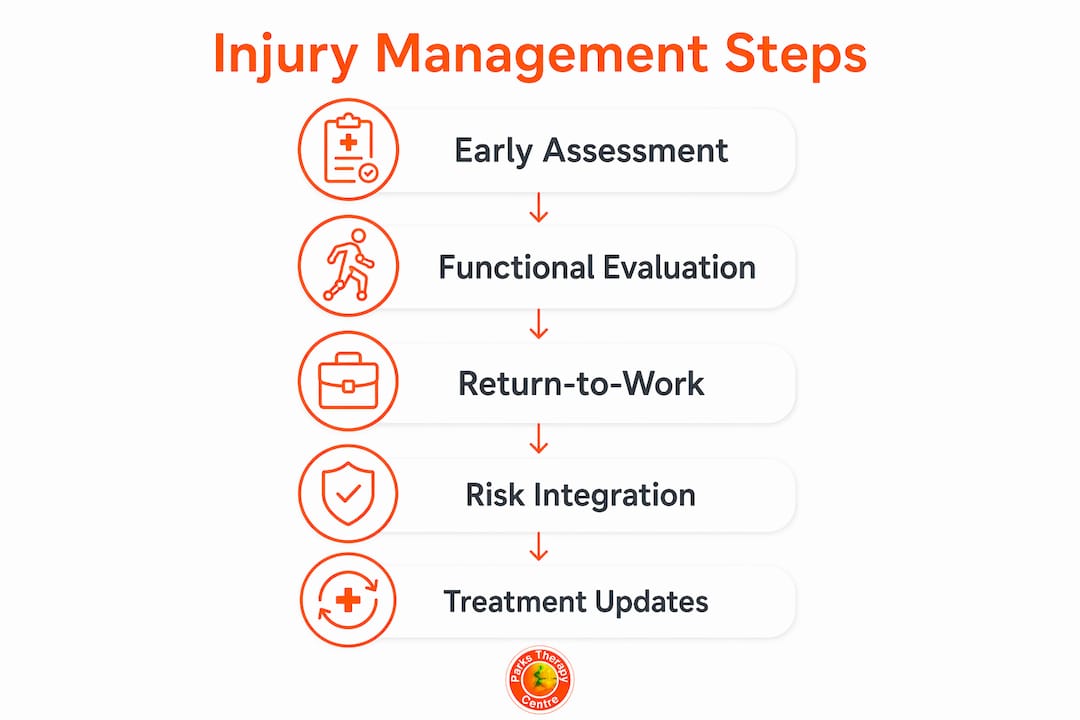
How do return-to-work programmes reflect 2026 standards?
Return-to-work (RTW) programmes are now a formal legal and clinical obligation, not a discretionary employer gesture. WorkSafeBC guidelines specify that employers must cooperate actively in RTW planning, maintain ongoing communication with injured workers, and document all agreed duties in writing. Failure to do so carries legal consequences in most jurisdictions.
The 2026 model of RTW is built on graded reintroduction to work, using three recognised duty categories:
Modified duties: The worker performs their usual role with physical adjustments, such as reduced lifting loads or altered posture requirements
Transitional duties: The worker takes on a different role temporarily that matches their current functional capacity
Alternate duties: The worker moves to a completely different task set within the organisation until full capacity is restored
North Dakota Workforce Safety & Insurance guidance supports the “work as therapy” model, which treats structured, meaningful work as a therapeutic intervention in its own right. The evidence behind this is strong. Prolonged absence from work is independently associated with worse clinical outcomes, increased psychological distress, and reduced likelihood of full recovery.
Individualised RTW plans must be written, signed by both employer and worker, and reviewed at defined intervals. Functional capacity evaluations (FCEs) provide the objective data needed to progress a worker through modified, transitional, and alternate duty stages. Work-conditioning and work-hardening programmes are used post maximum medical improvement (MMI) to rebuild the physical tolerances required for full duty return.
Pro Tip: Translate clinical restrictions into specific job tasks when writing RTW plans. A note saying “no heavy lifting” is not enough. Specify the exact weight limit, the frequency, and the posture involved. That specificity is what makes a plan usable on the shop floor.
For sports practitioners, the same principles apply to managing sports injury patients returning to training loads after injury.
How does risk management integrate with injury management in 2026?
Risk management and injury management are now formally linked under the ANSI/ASSP Z310.1-2026 standard, the first US-based standard dedicated to risk assessment and management in occupational settings. ANSI/ASSP Z310.1-2026 requires organisations to embed risk assessment into leadership decisions, daily operations, and governance structures, not treat it as a standalone compliance exercise. That shift has direct implications for how injury management programmes are designed and resourced.

The standard identifies five key elements that effective risk management must address:
Element | Application to Injury Management |
Stakeholder engagement | Injured workers, supervisors, and clinicians involved in RTW planning from day one |
Human factors | Workstation design, fatigue, and cognitive load assessed alongside physical injury risk |
Dynamic risk mindset | Ongoing hazard reassessment as worker capacity changes during recovery |
Clear information flow | Documented communication between clinical and operational teams at every stage |
Continual improvement | Post-incident reviews used to update injury prevention strategies for 2026 and beyond |
Organisations that treat risk management as a governance function rather than a safety department task see measurably better injury outcomes. The reason is straightforward: when leadership owns injury risk, resources follow. When it sits only with safety officers, it gets deprioritised under operational pressure.
Integrating ergonomics in injury prevention into this governance framework is one of the most practical ways to reduce incident frequency before injuries occur.
What are the 2026 updates for specific treatment modalities?
Two major updates in 2026 are directly relevant to clinical injury management practice: the WHO Guidelines for Essential Trauma Care (second edition) and the consensus statement on dry needling for musculoskeletal conditions.
The WHO 2026 Essential Trauma Care Guidelines update resource tables across facility levels, from primary care clinics to tertiary hospitals. They define minimum human resource requirements, essential skills, and equipment standards for each tier. The practical implication for practitioners is that the standard of care expected is now explicitly tiered by facility capacity, removing the ambiguity that previously allowed under-resourced settings to apply inconsistent protocols.
For dry needling, the 2026 consensus guidelines represent a significant clinical update. Key requirements now include:
Pre-treatment functional movement examination to classify the condition as neurological or peripheral in origin
Dosage calibration based on tissue irritability level, not a fixed needle count or session duration
Immediate post-treatment reassessment to evaluate neurological and movement responses before the patient leaves
Therapeutic exercise integration to load the treated tissue and consolidate the neurological response
The consensus is clear: dry needling without exercise leaves the underlying dysfunction driver untreated. Pain relief alone is not a satisfactory clinical outcome under 2026 standards. Practitioners who use dry needling as a standalone modality are now operating outside current best practice.
A post-injury training plan that incorporates these loading principles will produce more durable outcomes than passive treatment alone.
Key takeaways
The most effective approach to injury management in 2026 requires early clinical assessment, structured RTW planning, and integration of risk governance into organisational leadership, not just clinical practice.
Point | Details |
Assess within 24 hours | Early assessment prevents escalation and sets a clear evidence-based recovery pathway. |
Formalise RTW plans in writing | Written, individualised RTW plans with specific duty descriptions are a legal and clinical requirement. |
Embed risk management in governance | ANSI/ASSP Z310.1-2026 requires risk assessment to sit within leadership, not just safety teams. |
Integrate exercise with dry needling | 2026 consensus guidelines require post-treatment reassessment and therapeutic exercise after every dry needling session. |
Apply WHO trauma tiers to your setting | Match your clinical protocols to your facility tier as defined in the WHO 2026 Essential Trauma Care Guidelines. |
Why translating clinical restrictions into real work tasks is the hardest part
The part of injury management that most practitioners underestimate is the translation step. You can produce a technically sound clinical assessment, select the right intervention, and document everything correctly. The RTW plan still fails if it says “avoid repetitive overhead work” and the employer has no idea what that means on a production line.
I have seen this repeatedly in occupational health settings. The clinical note is accurate. The employer reads it, nods, and then assigns the worker to a task that involves exactly the restricted movement because nobody mapped the restriction to the actual job demands. WorkSafeBC’s guidance on translating restrictions into job-specific tasks is the most practically useful framework I have encountered for closing that gap.
The 2026 risk management standards make this translation a governance responsibility, not just a clinical one. That is the right call. When leadership owns the RTW process, the communication between clinic and workplace actually happens. When it is left to the injured worker to relay clinical instructions to their line manager, it breaks down almost every time.
My advice: build a one-page functional task summary into every RTW plan you produce. List the specific physical demands of the worker’s role, mark which ones are restricted and for how long, and name the person responsible for monitoring compliance. That single document will do more for recovery outcomes than any advanced modality you add to the treatment plan.
— Ivan
How Parkstherapycentre supports 2026 injury management standards
Parkstherapycentre has delivered multidisciplinary injury assessment and rehabilitation across Bedfordshire and Buckinghamshire since 1986. The team includes physiotherapists, sports injury specialists, acupuncturists, and podiatrists who work to current 2026 injury management guidelines across all treatment pathways.
Whether you need a structured assessment following a workplace injury, support developing a compliant RTW programme, or access to evidence-based treatment modalities including dry needling with integrated exercise protocols, Parkstherapycentre provides expert injury management tailored to your clinical and organisational requirements. The centre accepts insurance cover and offers online booking across multiple locations. Contact Parkstherapycentre to discuss how your injury management approach aligns with current standards and where targeted support can improve patient outcomes.
FAQ
What defines industry standards in injury management?
Industry standards in injury management are evidence-based frameworks set by bodies such as WHO, WorkSafeBC, SafeWork Australia, and ANSI/ASSP that define minimum requirements for clinical assessment, treatment, and RTW processes. In 2026, these standards require early assessment, multidisciplinary coordination, and integration with organisational risk governance.
How soon should a clinical assessment occur after injury?
Clinical assessment should occur within 24 hours of injury onset. Early assessment is a core pillar of 2026 injury management programmes because it prevents escalation and establishes a clear recovery pathway from the outset.
What does a compliant RTW plan include in 2026?
A compliant RTW plan includes written documentation of modified, transitional, or alternate duties, specific functional restrictions mapped to actual job tasks, and scheduled review points. WorkSafeBC guidelines require employer and worker collaboration throughout the planning process.
Is dry needling alone sufficient under 2026 clinical standards?
Dry needling alone does not meet 2026 clinical standards. The consensus statement requires pre-treatment functional examination, dosage based on tissue irritability, immediate post-treatment reassessment, and therapeutic exercise to load the treated tissue for reliable outcomes.
What is ansi/assp Z310.1-2026 and why does it matter?
ANSI/ASSP Z310.1-2026 is the first US-based standard on risk assessment and management, requiring organisations to embed risk processes into leadership and daily operations. It directly shapes how injury management programmes are governed, resourced, and continuously improved within organisations.
Recommended