
Physiotherapist in Leighton Buzzard: how to choose well
If you live in Leighton Buzzard and need a physiotherapist, you have two routes: NHS community musculoskeletal (MSK) services, or private physiotherapy that you book directly. The right one depends on how quickly you need to be seen and how much follow-up you want. Parks Therapy Centre has treated patients across Bedfordshire and Buckinghamshire since 1986. We offer physiotherapy, shockwave therapy, acupuncture, sports massage and Pilates, with published prices and online booking.
This guide explains how each route works, what to check before you start, what a first appointment involves and what private treatment costs.
TL;DR
Most adults in England can refer themselves to NHS community MSK services without a GP referral, but waiting times vary.
Private physiotherapy accepts self-referral, so you can book directly. Any physiotherapist must be on the HCPC register.
At Parks Therapy Centre a physiotherapy assessment is £76 and each follow-up treatment is £67, with insurance accepted.
Physiotherapy covers back, neck, shoulder, knee and foot problems, sports injuries, recovery after surgery and pregnancy-related pain.
Recovery usually combines hands-on treatment with exercises you do at home between sessions.
Table of Contents
What a physiotherapist can help with
Physiotherapy eases pain and improves movement after injury, illness or disability. The NHS describes it as using exercise, massage and other techniques. It is for people of all ages. It covers:
bone, joint and muscle problems, such as arthritis, back and neck pain, and sports sprains or strains
movement problems after a stroke or with conditions such as multiple sclerosis or Parkinson’s
breathing difficulties linked to asthma or COPD
problems during or after pregnancy, such as pelvic pain and incontinence
recovery of movement, strength and stamina after surgery
In practice, the problems that bring people in are usually familiar ones:
Back pain and sciatica, often from desk work, lifting or long drives.
Neck, shoulder and arm pain, including frozen shoulder and shoulder impingement.
Elbow and hand pain, such as tennis elbow.
Hip, knee, ankle and foot pain, including Achilles tendinopathy, plantar fasciitis and ankle ligament injuries.
Sports injuries, such as hamstring and groin strains.
Rehabilitation after surgery, such as knee replacement, hip replacement, shoulder, ankle or back surgery.
Recovery after a car accident, when stiffness and pain follow a collision.
If your symptoms came on suddenly, follow a significant injury, or include numbness, weakness or loss of bladder or bowel control, see a GP or use urgent care first. Community MSK services do not offer urgent or emergency help.
The NHS route in Leighton Buzzard
Physiotherapy is free on the NHS, but the NHS says there may be a long waiting list. In many areas you can use NHS community MSK services without a GP referral.
Self-referral
The NHS says most adults who live in England and are registered with a GP can refer themselves to community MSK services. This covers back, knee, shoulder or neck pain, arthritis, sciatica, carpal tunnel syndrome, plantar fasciitis, tennis elbow, and recovery after injury or surgery. You do not need a diagnosis.
The process is simple:
Enter the name of your GP surgery.
Choose a service and complete its form, usually online.
A health professional reviews the referral and the service contacts you about next steps and current waiting times.
First contact physiotherapists
Some GP surgeries have a first contact physiotherapist. The Chartered Society of Physiotherapy says you can book directly through the receptionist without seeing a doctor. They see soft tissue injuries, sprains, strains, arthritis, tennis elbow, spinal pain and people recovering from orthopaedic surgery. Ask your surgery whether it offers this.
What is changing locally
Central Bedfordshire’s community MSK contract has been re-awarded. A council committee paper says the new service was due to go live on 1 October 2026. It plans to keep current clinic locations, including sites in Leighton Buzzard. It also plans to widen access to include self-referral for 16 and 17 year olds, support for chronic pain and virtual consultations. Check your GP surgery or the NHS service finder for how the service runs now.
Waiting times
National guidance sets a target of seeing priority patients within two weeks of referral. The GIRFT handbook defines them as people with recent surgery needing rehabilitation, a recent injury, fracture or dislocation, or severe pain causing significant loss of function. Others may wait longer. If you are not a priority case and the pain is affecting work, sleep or training, a private appointment is the quicker way to start. Our guide to NHS physio waiting times explains your options in more detail.
Booking privately without a referral
Most private physiotherapists accept self-referral, according to Patient.info. You can book the day you decide you need help, with no GP letter. Our guide to physiotherapy without a GP referral sets out how this works across the UK.
Private care tends to suit you if:
you want an appointment within days rather than weeks
you are training for an event or returning to a sport
your job needs you to be mobile and pain-free as soon as possible
you want longer or more frequent sessions than a community service usually offers
you have private health insurance
Parks Therapy Centre accepts all major health insurance plans. Check your policy first, as many insurers ask for a claim reference before the first session.
What to check before you book
The NHS advises that a private physiotherapist should be chartered (MCSP) and registered with the HCPC. The HCPC is the Health and Care Professions Council, the regulator for physiotherapists.
The title is legally protected. The CSP states that anyone practising as a physiotherapist in the UK must be on the HCPC register, and using the title without registration is a criminal offence.
You can check this in a minute on the HCPC register. Search by surname or registration number, which for physiotherapists starts with PH. A status of “Registered” means there are no restrictions, cautions or conditions on their practice.
Also look for:
a clear price list before you arrive
a plan with an estimated number of sessions
home exercises you can follow
a way to arrange scans if they are needed
Our guide to finding and choosing a UK physiotherapist covers these points in more depth.
What happens at a first appointment
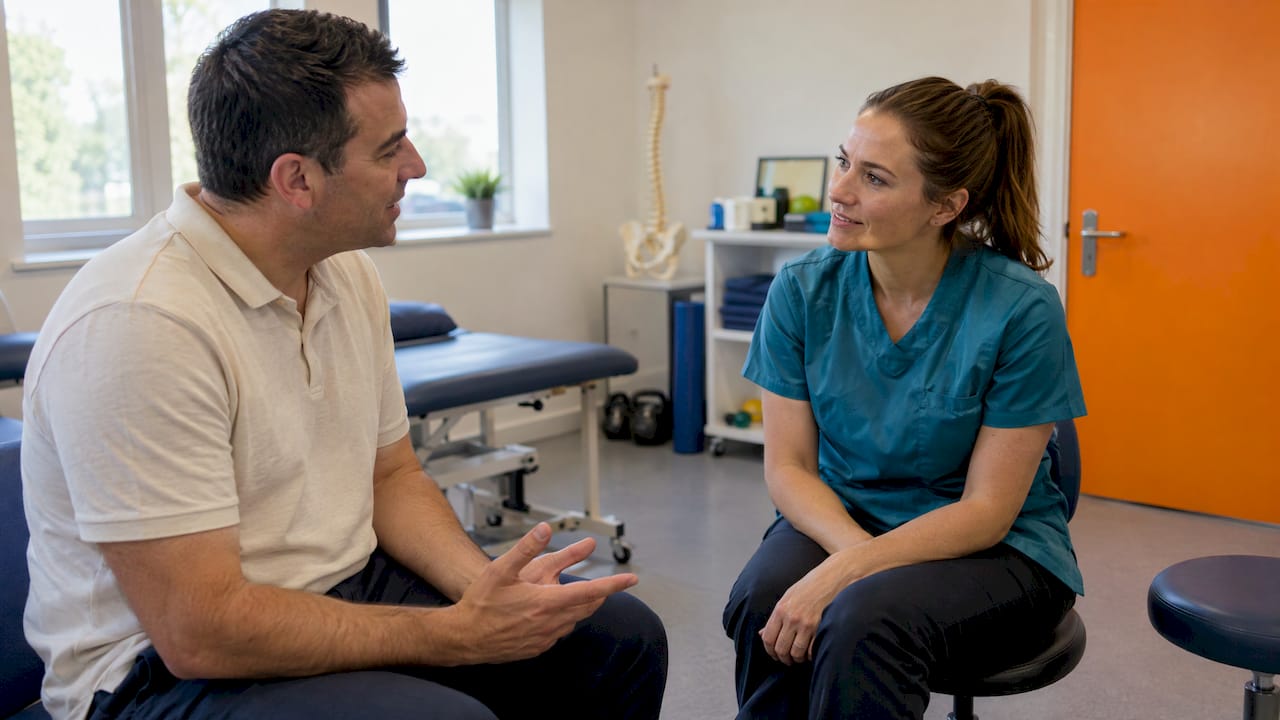
The NHS describes the first appointment like this. The physiotherapist asks about your symptoms, medical history and lifestyle. They may feel the affected area and check your strength and balance. They then discuss treatment options and advise on how many sessions you may need.
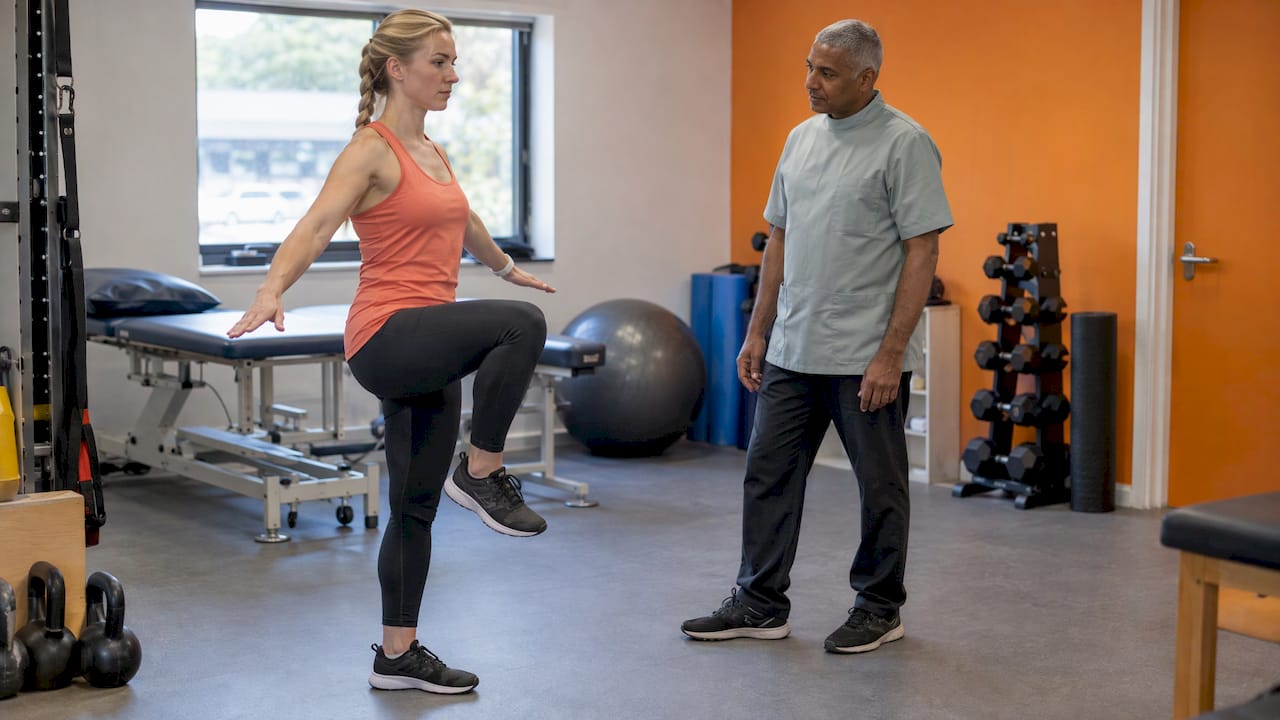
Treatment can include exercises, manual therapy, advice, ultrasound, TENS or acupuncture, and you will usually be given exercises to do at home after each session.
Wear clothes you can move in and expose the area being checked, such as shorts for a knee or a vest top for a shoulder. Bring any scan reports, surgical notes and a list of medication. Tell the physiotherapist what you want to get back to, whether that is a flight of stairs, a golf swing or a 10K. That goal shapes the plan.
How many sessions?
Patient.info says sessions usually last 30 minutes to an hour. A standard course is five or six weekly sessions, with two or three appointments a week often recommended in the early stages. Your physiotherapist will tailor this to your condition, and a simple strain needs far fewer visits than recovery from a joint replacement.
Treatments we offer
Physiotherapy sits alongside other treatments that support recovery:
Physiotherapy for assessment, hands-on treatment and rehabilitation exercises.
Shockwave therapy, which is relevant to tendon problems such as Achilles tendinopathy, plantar fasciitis and tennis elbow.
Acupuncture, which the NHS lists among the treatments physiotherapists may use.
Sports massage, for athletes and active people.
Pilates, in groups or one-to-one, for strength, control and prevention once pain settles.
APOS therapy, a device-based approach used for knee and lower-limb problems.
Imaging referrals, so scans can be arranged when your physiotherapist thinks you need one.
Strength and control work is the part of recovery that keeps problems from coming back. One article on how Pilates supports rehabilitation covers the evidence and the steps for building it into your recovery.
Pregnancy, surgery and ongoing pain
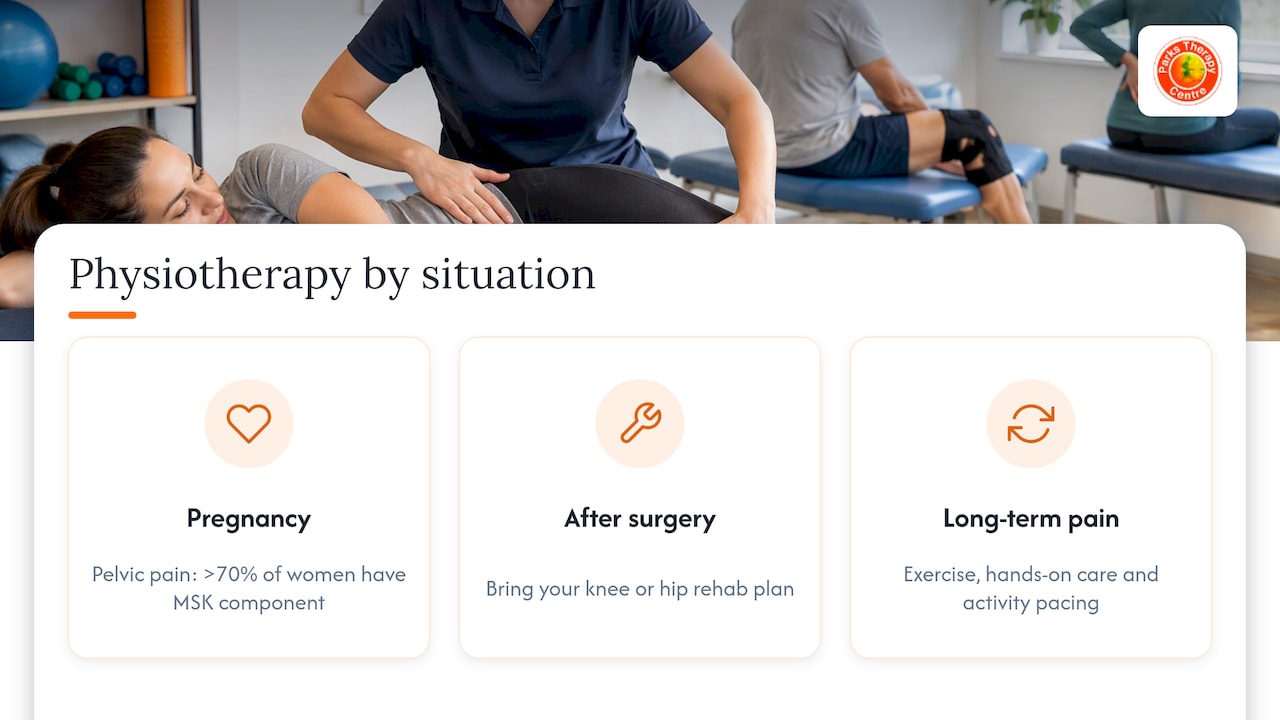
Pregnancy brings its own aches. The NHS lists pelvic pain and incontinence among the problems physiotherapy helps with during and after pregnancy. The Royal College of Obstetricians and Gynaecologists says that more than 70% of women with pelvic pain have a musculoskeletal component. It names physiotherapy techniques such as postural exercises, pelvic floor manual therapy and TENS as part of multidisciplinary care. If you are pregnant and have new or severe pain, speak to your midwife or GP as well.
After surgery, physiotherapy is often used to improve movement, strength and stamina. If your hospital team has given you a rehabilitation plan after a knee or hip replacement, take it to your first appointment so your physiotherapist can build on it.
For long-term pain, the NHS notes that some services offer group sessions for long-term pain. A steady programme of exercise, hands-on treatment and activity pacing is usually more useful than a single visit.
Our prices
These are the prices published on our prices page.
Service | Price |
Physiotherapy assessment | £76 |
Physiotherapy treatment | £67 |
Physiotherapy assessment (double) | £102 |
Physiotherapy treatment (double) | £77 |
Image assessment | £76 |
Image referral letter | £10 |
Image results review | £67 |
Shockwave therapy assessment | £60 |
Shockwave therapy treatment (30 mins) | £70 |
Shockwave therapy treatment (20 mins) | £60 |
Acupuncture assessment | £60 |
Acupuncture treatment | £50 |
Sports massage (per hour) | £60 |
Pilates group session (per class) | £9 |
Pilates one-to-one (per class) | £50 |
A typical course might be an assessment at £76, then treatments at £67 each. The number of treatments depends on what the assessment finds.
Our view
Most people who come to us have waited too long. They hoped the pain would pass, then it began to affect work, sleep or sport. We have been treating patients across Bedfordshire and Buckinghamshire since 1986. Our view is that good physiotherapy needs a team. The physiotherapist who assesses you can draw on shockwave therapy, acupuncture, massage, Pilates and imaging referrals under one roof, rather than sending you somewhere else. Prompt assessment matters. A clear diagnosis, a plan you understand and exercises you can do at home are what move recovery along. That is why our prices are published, and why we accept all major health insurance plans. The NHS is the right place for urgent and complex care. When you want to be seen sooner and to know your treatment plan from the first visit, we are here to help. Ivan
Booking with Parks Therapy Centre
Parks Therapy Centre is an award-winning, multidisciplinary clinic with locations across Bedfordshire and Buckinghamshire. You can book online, and your first visit is a physiotherapy assessment at £76. If your physiotherapist recommends a scan, we can arrange a referral.
See all treatments and prices or explore our Pilates classes, where group sessions are £9 a class.
FAQ
Do I need a GP referral to see a physiotherapist in Leighton Buzzard?
No. Most private physiotherapists accept self-referral, and the NHS says most adults registered with a GP in England can refer themselves to community MSK services. Some insurers ask for a reference number before you start, so check your policy.
How much does private physiotherapy cost?
At Parks Therapy Centre, an assessment is £76 and a treatment session is £67. Double sessions are £102 for an assessment and £77 for a treatment. Prices are on our prices page.
How do I know a physiotherapist is properly qualified?
Search for them on the HCPC register by surname or registration number. The NHS also advises looking for chartered status (MCSP). A “Registered” entry means they have no restrictions on their practice.
How many sessions will I need?
It depends on the problem. Patient.info says a standard course is five or six weekly sessions. Your physiotherapist will advise on a number after your assessment.
Can physiotherapy help after surgery?
Yes. The NHS says physiotherapy is often used after surgery to improve movement, strength and stamina. Bring your surgeon’s guidance to your first appointment.
Sources
Recommended