
Physiotherapy for carpal tunnel syndrome: 2026 guide
TL;DR:
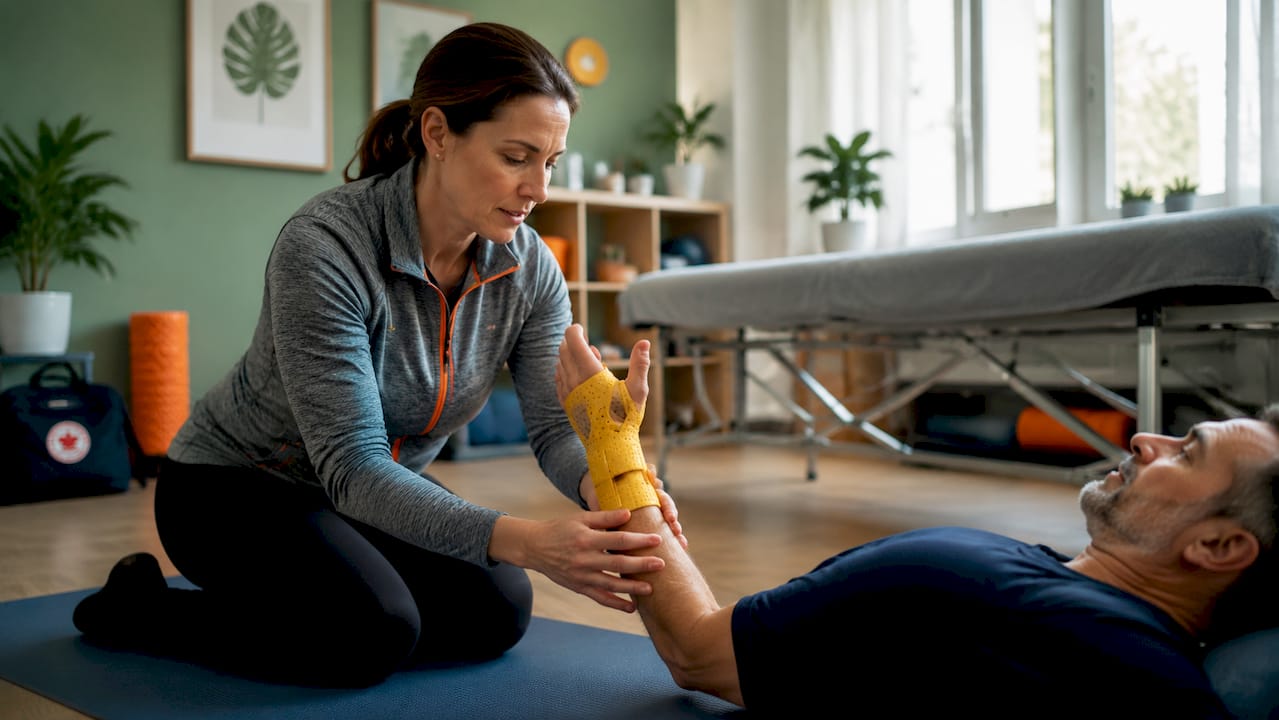
Physiotherapy for carpal tunnel syndrome involves non-surgical interventions like splinting, manual therapy, nerve-gliding exercises, and activity modification to reduce median nerve pressure. These treatments, combined with patient education and tailored exercise programs, are effective for mild-to-moderate cases, often improving symptoms within 4 to 8 weeks. Postoperative rehabilitation focusing on strength, coordination, and progressive exercises is essential for full functional recovery after surgery.
Physiotherapy for carpal tunnel syndrome is defined as a structured, non-surgical treatment approach that addresses median nerve compression in the wrist through splinting, manual therapy, nerve-gliding exercises, and activity modification. Carpal tunnel syndrome (CTS) causes pain, numbness, and functional impairment in the hand and fingers, affecting millions of working-age adults across the UK. The 2026 Canadian Chiropractic Guidelines recognise wrist splinting, nerve-gliding exercises, and manual therapy as core conservative interventions. For mild-to-moderate cases, physiotherapy is the first-line recommendation before any surgical consideration is made.
What physiotherapy treatments are used for carpal tunnel syndrome?
Physiotherapy for CTS draws on several distinct techniques, each targeting a different aspect of median nerve compression and hand dysfunction. Understanding how these treatments work helps you make informed decisions about your care.
Wrist splinting
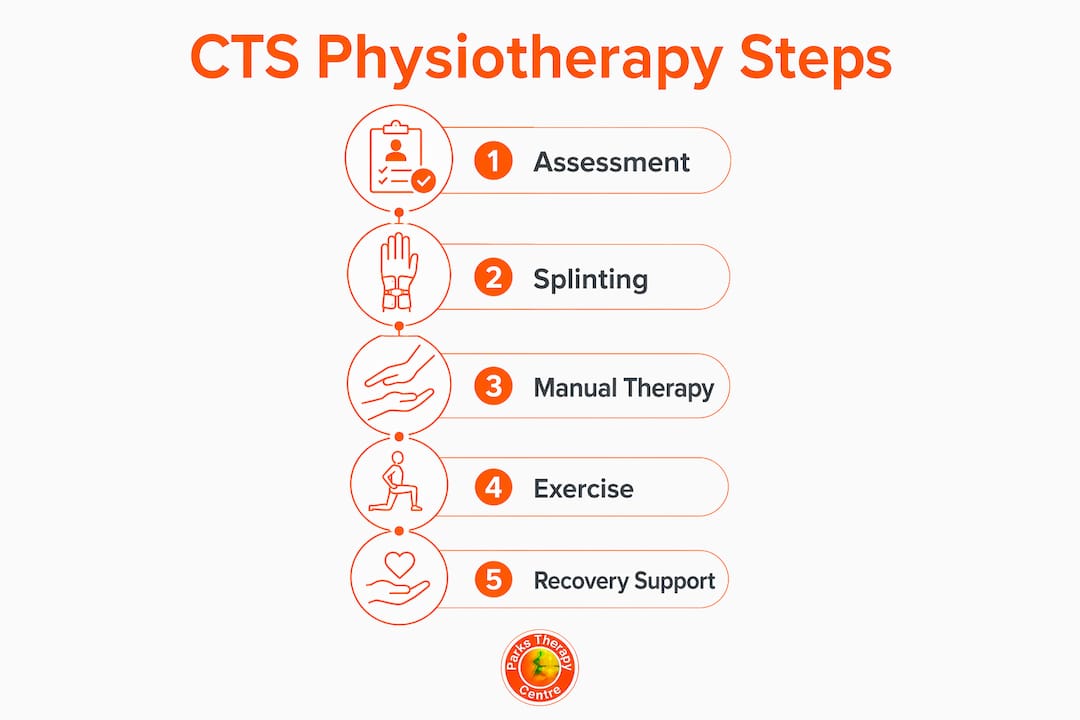
Wrist splinting holds the wrist in a neutral position to reduce pressure on the median nerve. Night splinting for 1–2 months is the standard recommendation for mild-to-moderate CTS, with daytime use added when symptoms are persistent. The neutral position prevents the wrist from flexing or extending during sleep, which are the two positions that most increase carpal tunnel pressure. Many patients notice a reduction in night-time numbness within the first two weeks of consistent use.
Manual therapy
Manual therapy for carpal tunnel involves carpal bone mobilisations, soft tissue techniques applied to the forearm and wrist, and median nerve neurodynamic mobilisation. Physical therapy techniques including soft tissue mobilisation, wrist and carpal mobilisations, and median nerve gliding are typically delivered over 8 to 12 sessions across 4 to 8 weeks. This dosing produces moderate-to-large short-term improvements in pain severity and function. The mechanism involves both biomechanical relief of nerve compression and neurophysiological modulation of pain signals.
Manual neurodynamic therapy produces modest but statistically significant symptom relief in mild-to-moderate CTS, comparable in the short term to pharmacologic treatment. That finding matters because it positions manual therapy as a genuine clinical alternative rather than a secondary option. For patients who cannot tolerate medication or prefer non-pharmacologic care, manual therapy delivers measurable results.
Activity modification and ergonomic advice
Ergonomic advice addresses the root causes of repetitive strain. A physiotherapist will assess your workstation, tool grip, and repetitive hand movements, then recommend changes such as adjusting keyboard height, using padded gloves, or rotating tasks. These modifications reduce cumulative load on the carpal tunnel and prevent symptom recurrence. Ergonomic intervention is most effective when combined with splinting and exercise rather than used in isolation.
Pro Tip: Ask your physiotherapist to observe you performing your most common work tasks. Watching the actual movement pattern reveals loading errors that a verbal description alone will miss.
Wrist splinting in neutral position, worn at night and during aggravating activities
Carpal bone and soft tissue mobilisations targeting the wrist and forearm
Median nerve neurodynamic mobilisation over 8 to 12 sessions
Activity modification and ergonomic assessment of workplace and daily habits
Patient education on posture, load management, and symptom monitoring
Which exercises are recommended for carpal tunnel syndrome?
Exercises for carpal tunnel syndrome fall into three categories: nerve-gliding, tendon-gliding, and strengthening. Each serves a specific purpose, and the order in which you progress through them matters.

Nerve and tendon gliding
Nerve-gliding exercises move the median nerve through its full range within the carpal tunnel, reducing adhesions and improving neural mobility. Tendon-gliding exercises mobilise the flexor tendons independently, preventing them from compressing the nerve further. Both types are performed gently and slowly, never pushing into pain.
Nerve-gliding exercises must not be used as stand-alone treatments and should not be progressed if symptoms worsen. This is one of the most commonly misunderstood points in CTS self-management. Many patients perform nerve glides aggressively, believing more repetitions will accelerate recovery. The evidence says the opposite: excessive or poorly timed nerve gliding can provoke a flare-up that sets recovery back by weeks.
A safe exercise sequence
Wrist flexor stretch: Hold your arm out with the palm facing up, gently extend the wrist back with your other hand, and hold for 20 to 30 seconds. Repeat three times per side.
Tendon-gliding sequence: Move through five hand positions (straight, hook, full fist, tabletop, straight fist) slowly and deliberately, five repetitions each, twice daily.
Nerve-gliding exercise: Begin with the wrist in neutral and fingers extended, then gently extend the wrist while keeping fingers straight. Perform five to ten repetitions only, once daily.
Forearm strengthening: Use a light resistance band or soft ball to perform wrist curls and grip exercises, progressing load only when symptoms remain stable for at least one week.
Thumb opposition and pinch exercises: Touch each fingertip to the thumb in sequence, repeating ten times per hand, to restore fine motor coordination.
Exercise frequency for CTS rehabilitation is typically twice daily for gliding exercises and once daily for strengthening, with rest days built in if symptoms flare. A physiotherapist should supervise your first session to confirm technique before you continue independently.
Pro Tip: Keep a symptom diary for the first two weeks of your exercise programme. Note pain, numbness, and tingling before and after each session. This gives your physiotherapist precise data to adjust your programme rather than relying on general impressions.
How does physiotherapy support recovery after carpal tunnel release surgery?
Carpal tunnel release surgery decompresses the median nerve by cutting the transverse carpal ligament, but the procedure itself does not restore hand strength or coordination. Postoperative rehabilitation with nerve and tendon gliding plus progressive strengthening is required to achieve full functional recovery. Sensory relief often occurs within days of surgery, but grip strength and fine motor control can take months to return without targeted rehabilitation.
The table below outlines the typical phases of postoperative physiotherapy following carpal tunnel release.
Phase | Timeframe | Focus |
Early mobilisation | Weeks 1 to 2 | Wound care, oedema control, gentle nerve and tendon gliding |
Intermediate rehab | Weeks 3 to 6 | Progressive range of motion, light grip strengthening, scar management |
Functional restoration | Weeks 6 to 12 | Resistance training, coordination tasks, return-to-work planning |
Maintenance | Beyond 12 weeks | Endurance, ergonomic integration, prevention of recurrence |
Exercise-based rehabilitation after carpal tunnel release must target strength, coordination, and endurance progressively. Simply waiting for symptoms to resolve leads to variable and often incomplete functional recovery. Patients who follow a supervised surgery rehabilitation programme consistently achieve better grip strength and return-to-work outcomes than those who self-manage without guidance.
Research does acknowledge gaps in the evidence base for postoperative CTS rehabilitation, particularly around optimal exercise dosing and timing. What is clear is that passive recovery is insufficient. A physiotherapist-led programme that progresses systematically through the phases above gives you the best chance of regaining full hand function.
How to combine physiotherapy with other non-surgical treatments
Non-invasive therapies including splinting, corticosteroid injections, and physical therapy are the first-line approach for mild-to-moderate CTS, with surgery reserved for severe or long-standing cases. The most effective conservative management plans combine several of these approaches rather than relying on any single intervention.
How the treatments compare
Treatment | Primary benefit | Best used when |
Wrist splinting | Reduces night-time symptoms and nerve pressure | Mild to moderate CTS, especially with nocturnal symptoms |
Manual therapy | Improves pain and function over 4 to 8 weeks | Moderate CTS with mechanical wrist or forearm involvement |
Nerve-gliding exercises | Maintains neural mobility as part of a broader plan | As an adjunct, never as the sole treatment |
Corticosteroid injection | Short-term symptom relief, particularly for inflammation | When splinting and physiotherapy provide insufficient relief |
Surgery | Definitive decompression | Severe, persistent, or neurologically compromising CTS |
Pharmacologic analgesia, including gabapentin and ibuprofen, may produce somewhat larger short-term pain relief than manual neurodynamic therapy, but both are viable options depending on patient profile. This means the choice between medication and physiotherapy is not binary. Many patients benefit from a sequenced approach: splinting and physiotherapy first, with short-term medication added during acute flare-ups.
Patient-centred decision making is central to effective CTS management. Your physiotherapist should explain the evidence behind each option, discuss your work demands and lifestyle, and adjust the treatment plan as your symptoms evolve. Effective CTS care integrates patient education, activity modification, splinting, and carefully selected movement within a personalised programme. That integration is what separates a good outcome from a mediocre one.
Monitor symptom severity at regular intervals using a validated tool such as the Boston Carpal Tunnel Questionnaire
Reassess the treatment plan if symptoms have not improved after six weeks of conservative care
Consider surgical referral when neurological signs such as thenar muscle wasting are present or when conservative care has failed after three to six months
Key takeaways
Physiotherapy for carpal tunnel syndrome works best as a multi-component plan combining splinting, manual therapy, targeted exercises, and activity modification, with surgery reserved for cases where conservative care fails.
Point | Details |
Splinting is first-line | Neutral-position night splinting for 1 to 2 months reduces symptoms in mild-to-moderate CTS. |
Manual therapy delivers results | 8 to 12 sessions of manual therapy produce moderate-to-large short-term improvements in pain and function. |
Nerve gliding has limits | Nerve-gliding exercises must be used as part of a broader plan and stopped if symptoms worsen. |
Post-surgical rehab is non-negotiable | Strength and coordination after carpal tunnel release require progressive, supervised exercise beyond early mobilisation. |
Combination care outperforms single treatments | Sequencing splinting, physiotherapy, and medication based on patient profile produces the best outcomes. |
What I have learned from treating carpal tunnel syndrome
The most persistent mistake I see in CTS management is treating nerve-gliding exercises as the whole solution. Patients arrive having watched a five-minute video, performed 50 repetitions of nerve glides daily for a fortnight, and made themselves significantly worse. The Canadian Chiropractic Guidelines are explicit on this point, yet the message has not reached most self-managing patients.
The second issue is underestimating postoperative rehabilitation. Surgery removes the structural cause of compression, but I regularly see patients six months post-release who have recovered sensation but still cannot open a jar or type for more than 20 minutes. They assumed the operation would restore full function. It does not. Postoperative hand strength and coordination deficits require progressive exercise-based rehab that most patients are not receiving.
What actually works is a plan built around the individual. Someone with a desk-based job and mild nocturnal symptoms needs a different programme from a manual worker with moderate CTS and forearm tightness. Dosing matters. Timing matters. And patient education, specifically helping people understand why they are doing each component, dramatically improves adherence and outcomes. The physiotherapy techniques available in 2026 are genuinely effective when applied with that level of precision.
— Ivan
Get expert carpal tunnel care at Parkstherapycentre
Parkstherapycentre has been delivering evidence-based physiotherapy across Bedfordshire and Buckinghamshire since 1986. If you are managing carpal tunnel syndrome and want a treatment plan built around your specific symptoms, work demands, and recovery goals, the team at Parkstherapycentre can help.
From initial assessment through to postoperative rehabilitation, Parkstherapycentre’s qualified physiotherapists apply the techniques covered in this guide, including manual therapy, nerve-gliding programmes, splinting advice, and ergonomic assessment, within a personalised plan. The centre accepts most insurance providers and offers online booking for your convenience. Visit Parkstherapycentre to book your assessment and take the first step toward lasting relief.
FAQ
What is physiotherapy for carpal tunnel syndrome?
Physiotherapy for carpal tunnel syndrome is a non-surgical treatment approach using wrist splinting, manual therapy, nerve-gliding exercises, and activity modification to reduce median nerve compression and restore hand function.
How long does carpal tunnel therapy take to work?
Most patients with mild-to-moderate CTS see meaningful improvement within 4 to 8 weeks of consistent physiotherapy, including manual therapy delivered over 8 to 12 sessions combined with home exercises and splinting.
Are nerve-gliding exercises safe to do at home?
Nerve-gliding exercises are safe when performed correctly as part of a supervised programme, but they must not be used as a stand-alone treatment and should be stopped immediately if symptoms worsen.
Does physiotherapy work after carpal tunnel surgery?
Yes. Postoperative physiotherapy targeting nerve and tendon gliding, progressive strengthening, and coordination training is required to restore grip strength and fine motor function after carpal tunnel release surgery.
When should I consider surgery instead of physiotherapy?
Surgery is recommended when conservative care including splinting, physiotherapy, and medication has failed after three to six months, or when neurological signs such as thenar muscle wasting are present.
Recommended