
Allied therapies for knee recovery: practical UK guide

Allied therapies, led by physiotherapy and supported by complementary modalities such as acupuncture, Pilates, hydrotherapy and podiatry, improve pain control, restore range of motion, rebuild strength and speed a safe return to activity after knee injury or surgery. The role of allied therapies in knee recovery is not simply additive; combined modalities produce better functional outcomes than single-discipline care. For a plan tailored to your specific injury, surgical history and goals, consult an HCPC-registered physiotherapist through your NHS pathway or a private clinic. Parkstherapycentre, established in 1986 across Bedfordshire and Buckinghamshire, offers exactly this kind of coordinated, multidisciplinary assessment.
Core benefits of allied therapies in knee rehabilitation:
Pain control through manual therapy, acupuncture and neuromuscular electrical stimulation
Restoration of range of motion via progressive exercise and hydrotherapy
Strength and load tolerance rebuilt through structured conditioning and Pilates
Proprioception and gait retraining to reduce re-injury risk
Scar management and soft-tissue mobility from massage and manual therapy
Psychological support to address pain catastrophising and improve adherence
Table of Contents
What role do allied therapies play in knee recovery?
Physiotherapy is the central pillar of knee rehabilitation, whether you are recovering from a ligament injury, arthroscopy or total knee replacement (TKR). An HCPC-registered physiotherapist, holding CSP membership, conducts the initial assessment, sets measurable goals and leads progressive exercise prescription. Neuromuscular electrical stimulation (NMES) and telerehabilitation options now extend that support between clinic visits.
Pilates and therapeutic conditioning address core control, movement quality and functional strength. Clinical Pilates is particularly effective in the intermediate stage of recovery, when the focus shifts from pain management to rebuilding movement patterns. You can read more about how Pilates supports rehabilitation at Parkstherapycentre.
Manual therapy and massage improve soft-tissue mobility, reduce post-surgical oedema and provide short-term pain relief. Scar management after TKR or arthroscopy benefits directly from skilled manual techniques applied to the joint capsule and surrounding fascia.
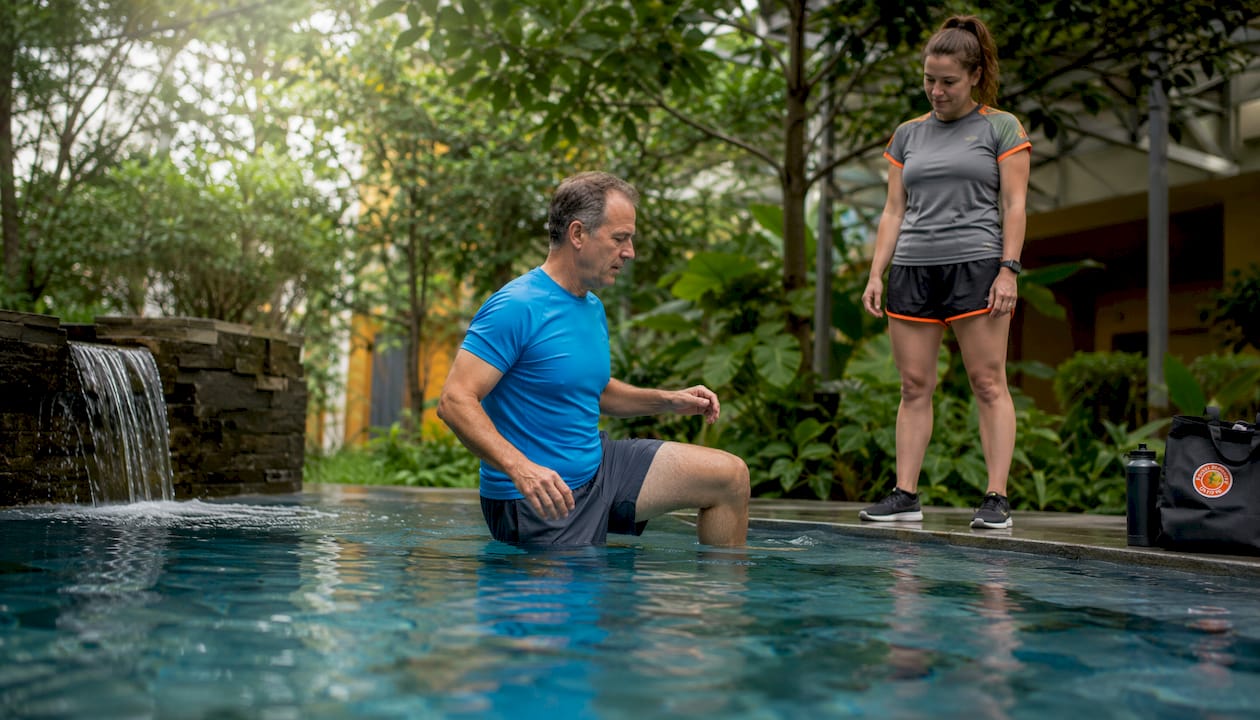
Hydrotherapy and aquatic therapy allow early weight-bearing progressions in a low-load environment. Buoyancy reduces compressive forces on the joint, giving patients confidence to move before they can fully bear weight on land.
Acupuncture and dry needling are used as adjuncts for pain relief in some patients. Evidence is mixed; NICE guidance does not recommend acupuncture as a standalone treatment for knee osteoarthritis, but many clinicians include it within an agreed plan when patients report persistent pain that limits exercise participation.
Podiatry and orthotics address biomechanical contributors to knee load. Abnormal foot pronation or leg-length discrepancy can increase medial compartment stress; a podiatric assessment and custom orthotic can correct gait mechanics and reduce symptom recurrence.
Strength and conditioning in the late stage focuses on power, load tolerance and sport-specific conditioning. This is where exercise physiology input becomes most valuable, particularly for athletes returning to high-demand activity.

Psychological and pain-management support is often the most underestimated component. Catastrophising and low mood predict poorer outcomes after TKR, and addressing these factors alongside physical rehabilitation reduces the risk of long-term disability.
Pro Tip: Prioritise modalities by stage and symptom: pain-dominant early presentations benefit most from manual therapy, acupuncture and hydrotherapy, while strength-dominant late-stage recovery calls for progressive loading and conditioning. Ask your physiotherapist to map your plan to your current stage before adding any complementary therapy.
What are the stages of knee rehabilitation?
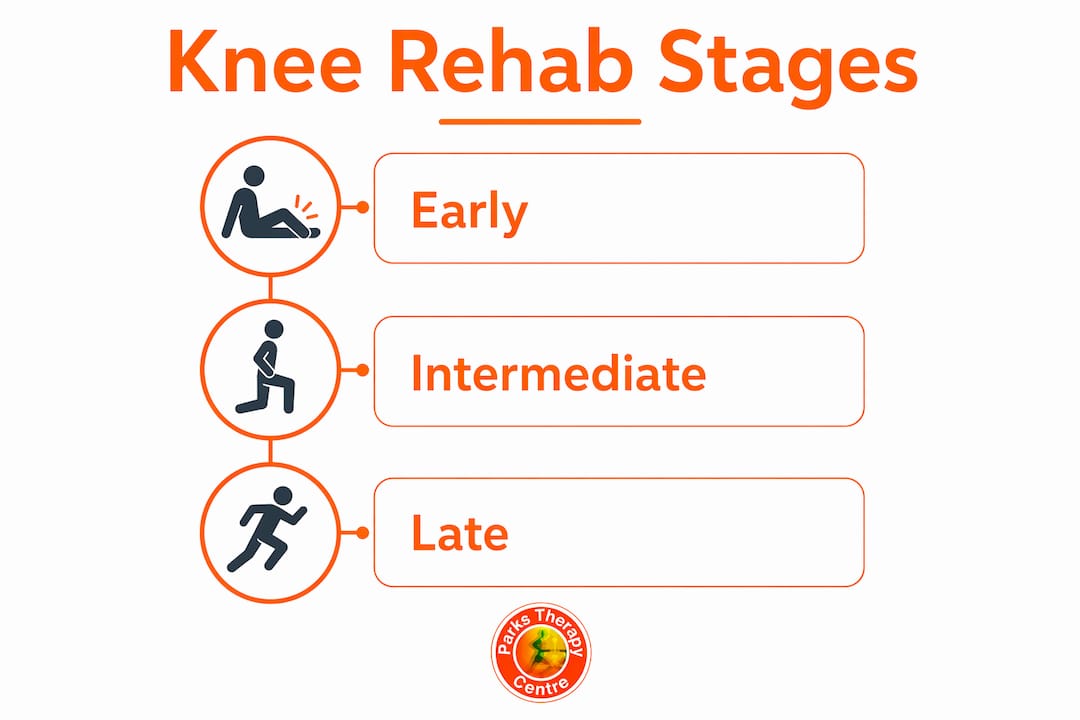
Knee rehabilitation follows three broadly accepted stages. The table below maps each therapy to the stage where it is most commonly introduced, though individual variation is significant.
Therapy | Early / acute (0–6 weeks) | Intermediate (6–12 weeks) | Late / return to activity (12+ weeks) |
Physiotherapy (HCPC-registered) | Assessment, pain management, early ROM, quad activation | Progressive strengthening, gait retraining | Functional retraining, discharge planning |
Hydrotherapy | Early weight-bearing progressions | Continued load management | Occasionally for maintenance |
Manual therapy / massage | Oedema management, scar mobilisation | Soft-tissue work, joint mobilisation | As needed |
Clinical Pilates | Gentle core activation | Core control, movement quality | Functional strength and conditioning |
Acupuncture | Adjunct pain relief | As needed | Rarely indicated |
Podiatry / orthotics | Biomechanical assessment | Orthotic fitting and gait correction | Ongoing if indicated |
Strength and conditioning | Light activation only | Progressive resistance | High-load, sport-specific conditioning |
Psychological support | Pain education, reassurance | Adherence support | Return-to-activity confidence |
Early mobilisation is clinically important. After TKR, physiotherapy-led early mobilisation reduces complications including deep vein thrombosis risk and joint stiffness. The intermediate stage introduces progressive loading, and the late stage shifts to high-load conditioning and functional retraining. Individual factors, including surgical protocol, comorbidities and pain response, all influence how quickly a patient moves between stages.
How does a multidisciplinary rehabilitation plan work in practice?
Coordinated care requires more than booking several therapists. An effective multidisciplinary plan has clear structure:
A single care lead. Usually the physiotherapist, who holds the overall rehabilitation plan and coordinates referrals to podiatry, acupuncture, Pilates and psychology.
Shared, measurable goals. Range of motion targets, strength benchmarks and patient-reported function scores (such as the Oxford Knee Score) agreed at the outset.
Regular review points. Typically at 6 and 12 weeks, with outcome measures reassessed and the plan adjusted accordingly.
Clear communication between disciplines. Written or digital notes shared between the physiotherapist, podiatrist and any other involved clinician.
Patient involvement in goal-setting. Patients who understand their own targets adhere better to home programmes.
NHS allied health professionals are trained to deliver personalised recovery packages across treatment pathways, and coordinated AHP input in prehabilitation and rehabilitation reduces complications and supports return to function. Multidisciplinary approaches consistently outperform single-discipline care in functional outcomes, a finding supported by systematic reviews of allied health interventions.
A brief anonymised case illustrates the model: a 58-year-old patient following TKR began physiotherapy-led rehabilitation at day two post-surgery, with early ROM and quad activation exercises. At week four, podiatric assessment identified a leg-length discrepancy corrected with a heel raise. Clinical Pilates was introduced at week eight for core control and movement quality. By week fourteen, the patient had achieved functional ROM, reported low pain scores and returned to recreational walking. Outcome measures, including ROM and Oxford Knee Score, were recorded at each stage. The clinic follows HCPC and CSP guidance throughout.
What should you expect from knee rehab in the UK?
Recovery timelines vary. Mild knee injuries often improve within 4–6 weeks, moderate injuries in 8–12 weeks, and post-surgical rehabilitation, including after TKR or ACL reconstruction, can take several months. A structured knee conditioning programme typically runs for 4–6 weeks of active rehabilitation, followed by a maintenance routine.
Session frequency usually starts at two to three appointments per week in the early stage, tapering to weekly or fortnightly as strength and function improve. Most patients attend between 6 and 12 supervised sessions in total, supplemented by a structured home programme.
Access routes in the UK:
NHS pathway: GP referral to NHS physiotherapy. The University Hospitals of Derby and Burton NHS Foundation Trust runs a structured Knee Rehabilitation Programme as one example of a staged NHS clinical pathway. Waiting times vary by region.
Self-referral: Many NHS trusts and some GP practices now accept direct self-referral to physiotherapy without a GP appointment.
Private care: Faster access, more appointment flexibility and a wider range of allied therapies available in one setting. Parkstherapycentre accepts private pay and most major health insurance policies.
Cost considerations for private care depend on the clinic, location and number of sessions. Patients are advised to ask about session fees, package pricing, cancellation policies and whether their insurer requires a GP referral letter before booking.
What must you do between appointments to recover well?
Home exercise adherence is where recovery is won or lost. Successful rehabilitation combines in-clinic sessions with structured home practice and regular review; passive treatment alone does not produce lasting functional gains.
Follow your graduated exercise programme daily. Consistency matters more than intensity, particularly in the early weeks.
Progress load before speed. Increase resistance or repetitions before adding speed or impact to any exercise.
Use ice and elevation after exercise if swelling is present, for 15–20 minutes at a time.
Monitor your pain response. Some discomfort during exercise is expected. If pain is worse the following morning, the load is too high and should be reduced before the next session.
Prioritise sleep and nutrition. Tissue repair depends on adequate protein intake and sleep quality; both are frequently overlooked in standard rehabilitation advice.
Use telerehabilitation tools where available. Video check-ins and wearable reminders improve adherence, particularly for patients who cannot attend clinic frequently.
You can find practical surgery rehabilitation exercises and progression guidance on the Parkstherapycentre website. The importance of home exercise in physiotherapy is well established across clinical settings.
What does the research say about allied therapies for knee recovery?
The evidence base for multidisciplinary knee rehabilitation is broadly positive, though not without limitations.
Physiotherapy is consistently identified as the central, indispensable component of knee rehabilitation after injury and surgery.
Combined allied health interventions improve activity and participation compared with single-discipline approaches.
Early exercise interventions after TKR, including functional training and resistance training, show favourable effects on pain and range of motion in network meta-analysis evidence.
Telerehabilitation is a promising tool for improving adherence, particularly for patients with limited clinic access.
Limitations: Many trials are heterogeneous in protocol, have short follow-up periods and under-represent older patients and those with significant comorbidities. Evidence for acupuncture and hydrotherapy as standalone treatments is weaker than for physiotherapy-led exercise.
Up to 20% of total knee replacement patients report persistent post-surgical pain, underscoring why psychological support and pain education belong in every rehabilitation plan, not just the most complex cases.
For primary sources, consult NICE guidance on knee conditions, NHS clinical pathway pages and the Chartered Society of Physiotherapy’s evidence summaries.
When should you seek urgent medical review?
Most discomfort during knee rehabilitation is expected and manageable. The following signs require prompt attention and should not be monitored at home:
Signs of infection: fever, spreading redness or warmth around the wound, discharge or an unpleasant odour from the surgical site.
DVT signs: acute calf swelling, tenderness or redness, particularly if accompanied by shortness of breath.
New neurological loss: numbness, tingling or foot drop that was not present before.
Rapidly increasing pain or swelling that does not settle with rest, ice and elevation within 24 hours.
Wound breakdown or uncontrolled bleeding at any point after surgery.
If you experience any of the above, contact NHS 111, your GP or attend A&E. Have your surgical discharge letter and a list of current medications ready. If conservative rehabilitation has been completed without meaningful improvement, or if mechanical symptoms such as locking or giving way persist, ask your GP for a surgical review referral.
How do you choose the right clinic or therapist in the UK?
Credentials are the starting point. Physiotherapists must be registered with the Health and Care Professions Council (HCPC); CSP membership indicates adherence to professional standards and continuing development. For podiatrists, HCPC registration is equally the minimum requirement.
Questions to ask at your first appointment:
Who will lead my care, and will the same clinician see me throughout?
What is the expected timeline and how will progress be measured?
Which allied therapies are available in-house, and which would require an external referral?
How are costs structured, and what is the cancellation policy?
Do you accept my health insurance, and do I need a GP referral letter?
Pro Tip: Ask specifically whether the clinic offers telerehabilitation sessions. For patients managing work or travel commitments, the ability to complete a supervised video session between in-person appointments significantly improves adherence and outcome.
Choosing between NHS and private care depends on urgency, waiting time and whether your insurer covers physiotherapy. Private care gives faster access to a broader range of allied therapies under one roof, which is particularly valuable in the early weeks after surgery when timely intervention matters most.
A multidisciplinary knee rehab case in practice
A 45-year-old recreational runner presented following ACL reconstruction with limited ROM, significant quad inhibition and low confidence in the operated limb. A physiotherapist led the plan from day one, with early quad activation and ROM work. At week six, clinical Pilates was introduced to address core control and movement quality. A podiatric assessment at week eight identified mild overpronation; custom orthotics were fitted and gait retraining incorporated into the physiotherapy sessions. By week sixteen, ROM was symmetrical, single-leg strength had reached 85% of the unaffected side and the patient had returned to light running. Outcome measures, including ROM and a patient-reported function score, were recorded at each review. The plan followed HCPC and CSP guidance throughout, with regular communication between the physiotherapist and podiatrist.
Teamwork and patient adherence are inseparable in this model. When patients understand why each therapy is included and what the measurable targets are, they engage more consistently with their home programme.
Key takeaways
Allied therapies, coordinated under physiotherapy leadership, produce better knee recovery outcomes than any single treatment alone, making a structured multidisciplinary plan the most effective approach for adults recovering from knee injury or surgery.
Point | Details |
Physiotherapy leads the plan | An HCPC-registered physiotherapist should assess, set goals and coordinate all allied therapies from the outset. |
Stage-matched therapy selection | Hydrotherapy and manual therapy suit the early stage; Pilates and conditioning are most effective in the intermediate and late stages. |
Persistent pain risk after TKR | Jusqu’à 20 % des patients ayant subi une prothèse totale du genou présentent des douleurs persistantes après la chirurgie : un soutien psychologique doit être intégré à chaque programme de rééducation. |
Home exercise determines outcomes | Adherence to a structured home programme, with load progressed before speed, is the single biggest driver of long-term recovery. |
Parkstherapycentre for coordinated care | Parkstherapycentre offers multidisciplinary assessment and treatment across Bedfordshire and Buckinghamshire, with physiotherapy, Pilates, acupuncture and podiatry available under one roof. |
The case for genuinely coordinated care
What strikes me most, reviewing the evidence and the clinical reality, is how often “multidisciplinary care” is described but not actually delivered. A patient sees a physiotherapist on Monday and a Pilates instructor on Thursday, but neither clinician has spoken to the other, the goals are different and the loading is inconsistent. That is not a multidisciplinary plan; it is parallel treatment.
The difference in outcomes between coordinated and uncoordinated care is not subtle. When a single clinician holds the plan, sets the measurable targets and communicates with every other therapist involved, patients progress faster, adhere better and are far less likely to end up in that 20% who report persistent pain after TKR. The psychological dimension matters enormously here too. Patients who understand their own recovery trajectory, who have been given honest timelines and clear progression criteria, catastrophise less and push through the difficult middle weeks with more consistency.
At Parkstherapycentre, individual programmes are tailored to each patient’s baseline, surgical history and goals, with online booking available for those ready to take the next step.
Parkstherapycentre: multidisciplinary knee rehabilitation in Bedfordshire and Buckinghamshire
For adults who want faster access to coordinated allied therapies without the delays of an NHS waiting list, Parkstherapycentre offers a genuine alternative. Rather than booking separate therapists across different clinics, you receive a single, coordinated plan led by a qualified physiotherapist, with Pilates, acupuncture, podiatry and manual therapy available in-house across multiple locations.
The clinic has been delivering patient-centred musculoskeletal care since 1986, accepts most major health insurance policies and offers private pay options with transparent fees. Whether you are two weeks post-surgery or three months into a recovery that has stalled, a structured multidisciplinary assessment is the clearest next step. Book your assessment online at Parkstherapycentre and begin a plan built around your specific goals and timeline.
Useful sources and further reading
NICE guidance on knee conditions — evidence-based clinical guidelines on osteoarthritis, knee pain and rehabilitation; the authoritative reference for UK clinical decision-making.
NHS Knee Rehabilitation Programme, University Hospitals of Derby and Burton — a practical example of a staged NHS clinical pathway, useful for understanding what a structured programme looks like in practice.
Chartered Society of Physiotherapy (CSP) — the professional body for physiotherapists in the UK; use the HCPC register and CSP directory to verify your therapist’s credentials.
NHS Inform: exercises for knee problems — practical NHS guidance on safe home exercise and pain-monitoring rules for knee conditions.
Health and Care Professions Council (HCPC) — the statutory regulator for physiotherapists and podiatrists in the UK; check registration before booking any private therapist.
For personalised referral routes, speak to your GP or contact your local NHS physiotherapy service directly. Local pathways vary, and your GP can advise on waiting times and self-referral options in your area.
Recommended