
Clear a Verruca in Up to 12 Weeks: UK Patient Led Options
Most verrucas need no treatment at all, and many disappear on their own within months. When one is painful, spreading, or simply overstaying its welcome, the practical route for most people is a daily salicylic acid preparation for up to 12 weeks, with clinic-based cryotherapy as a sensible second step if that fails or doesn’t suit you. Choose the option you can actually stick with; consistency matters more than which treatment you pick.
TL;DR:
Most verrucas resolve naturally within months, especially in children, making unnecessary treatment appropriate unless they cause pain or persistent discomfort.
Daily salicylic acid treatment over up to 12 weeks is as effective as clinic cryotherapy, with consistency being more important than treatment type.
Cryotherapy involves multiple sessions spaced two to four weeks apart, but its success rate is similar to salicylic acid, and it often causes discomfort and skin discoloration.
Second-line treatments, such as laser therapy or immunotherapy, are reserved for stubborn verrucas after failure of first-line options and carry higher risks of scarring and recurrence.
Proper application techniques, like softening the skin and precise topical use, are vital for success, and urgent professional review is necessary if the verruca bleeds, changes shape, or is on the face or genitals.
Table of Contents
Types of verrucas and when treatment is worth trying
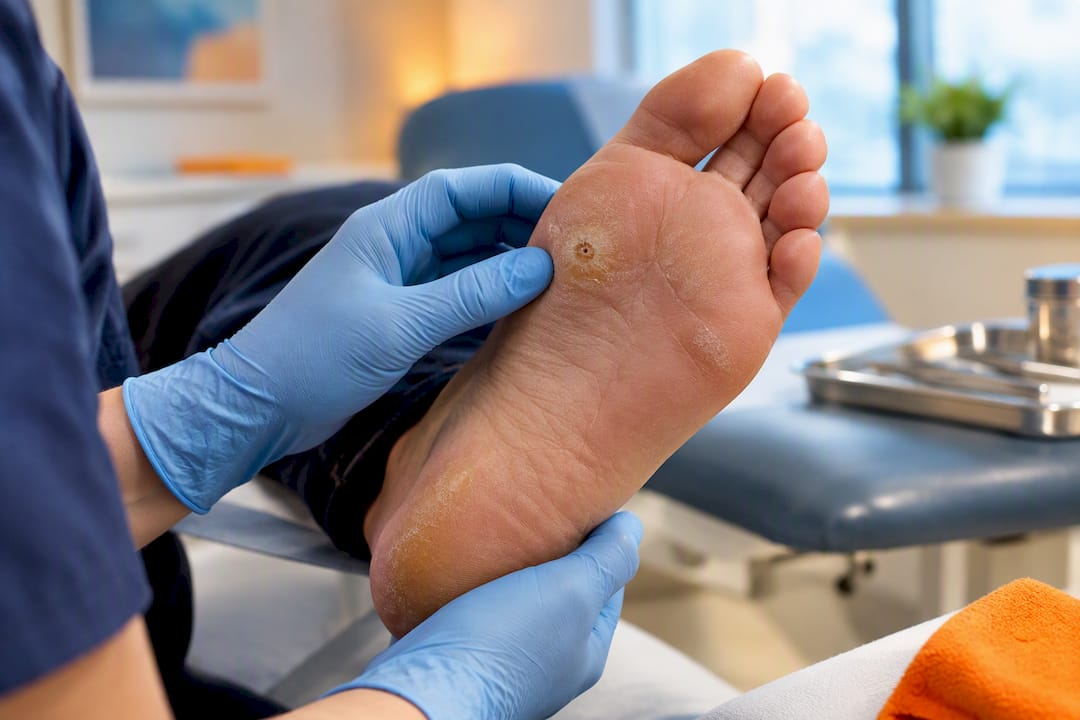
A verruca is a wart caused by the human papillomavirus (HPV), appearing on the sole of the foot rather than the hands or elsewhere on the skin. Plantar verrucas often feel like a small stone lodged under the skin, tender when you press directly on them, and frequently surrounded by a ring of hardened callus that forms as the body reacts to the infection.
Most verrucas clear by themselves without any intervention, particularly in children, whose immune systems tend to clear HPV lesions faster than adults. Treatment becomes worthwhile when a verruca causes genuine pain on standing or walking, keeps recurring after apparent clearance, or bothers you enough to want it gone for cosmetic reasons.
Expect a timeline measured in weeks to months rather than days. NHS guidance notes that pharmacy treatments can take up to three months to work, and that’s assuming daily application from day one.
Before starting anything, it helps to know what you’re dealing with:
Plantar verrucas: flat or slightly raised, tender under direct pressure, often with a rough surface and tiny black dots (blood vessels).
Common warts elsewhere: raised, rougher texture, usually painless unless knocked or on a joint.
Corns and calluses: uniform hardened skin with no black dots, painful when pressed from the side rather than directly on top.
Over-the-counter topical treatments: salicylic acid and how to use it
Salicylic acid remains the first-line, evidence-backed option for most non-facial warts, and CKS guidance from NICE recommends it as standard primary care advice. It works by gradually softening and dissolving the thickened, infected skin, layer by layer, until the verruca is gone.
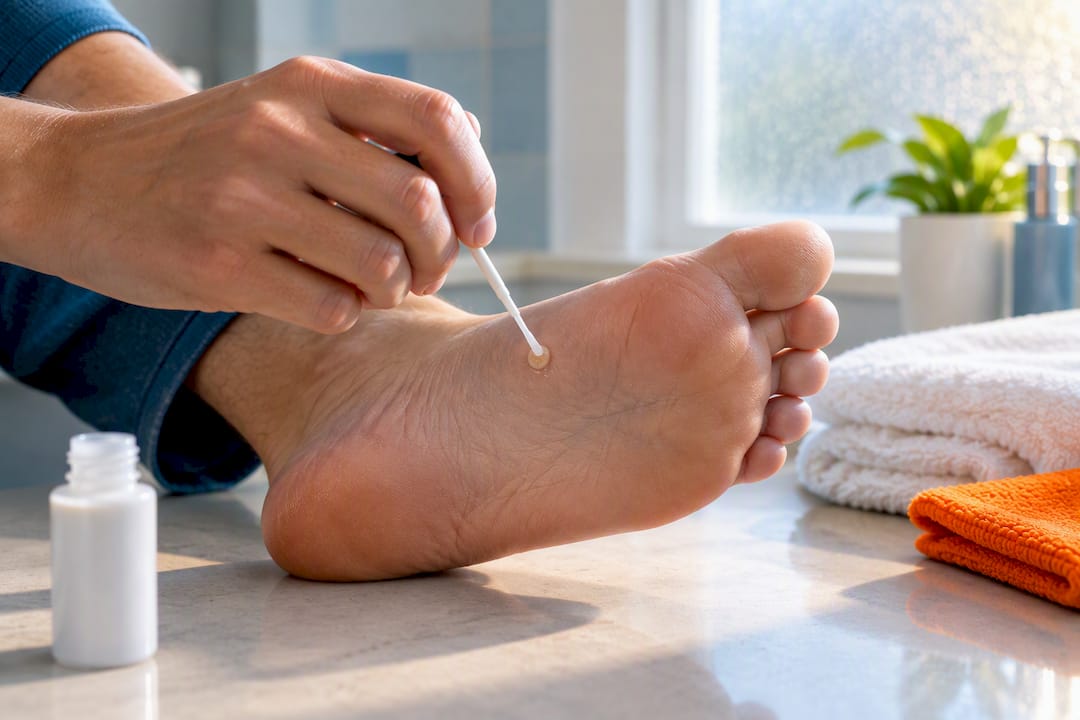
Pharmacy products typically come in moderate strengths, sold as gels, paints, or medicated plasters. Professional formulations used under clinical supervision may have higher concentrations, as outlined in hospital management guidance for viral warts. Stronger isn’t automatically better for home use. It simply raises the risk of burning healthy skin if applied carelessly.
A workable routine looks like this:
Soak the foot in warm water for five to ten minutes to soften the skin.
Gently file away only the softened, dead surface layer with a disposable emery board.
Apply a ring of petroleum jelly or a corn plaster around the verruca to protect healthy skin.
Apply the salicylic acid precisely to the lesion and allow it to dry.
Cover if the product instructions say to, and repeat daily for up to 12 weeks.
Most failures happen when people stop the treatment too soon, often within the first few weeks, before seeing visible changes, or they apply the product to the hard callus surrounding the verruca rather than the softened tissue directly over it. Both undermine an otherwise sound approach.
Salicylic acid isn’t for everyone. Avoid self-treating if you have diabetes, poor circulation, or broken or infected skin around the lesion, and never use it on facial or genital lesions.
Pro Tip: Keep a small calendar or phone reminder for your application. The people who clear verrucas with topical treatment are almost always the ones who never miss a day, not the ones using the strongest product.
Cryotherapy and clinic-based options: what to expect
Cryotherapy freezes the verruca with liquid nitrogen, destroying the infected tissue so the body can shed it and heal underneath. Sessions are usually spaced two to four weeks apart, running to four or six treatments depending on response.
It isn’t a painless option. You should expect:
Sharp stinging or burning during and shortly after treatment.
Blistering or a scab forming over the following days.
Occasional skin discolouration once healed, particularly on darker skin tones.
Some discomfort walking for a day or two afterwards.
Here’s the detail that changes how most people think about cryotherapy: the EVerT randomised trial, involving 240 participants, found no meaningful difference in clearance rates between 50% salicylic acid and up to four sessions of liquid-nitrogen cryotherapy, either at 12 weeks or at six months. Cryotherapy isn’t a shortcut to a better cure rate. It’s a different delivery method for roughly comparable odds.
That reframes the real decision as one of preference rather than efficacy. Cryotherapy suits people who struggle with daily self-treatment or who would rather have a clinician handle it directly. Salicylic acid suits people willing to commit to a routine but who would rather avoid repeated appointments, discomfort, or cost. It’s also worth noting that cryotherapy isn’t routinely available on the NHS in every area, so private clinic fees often apply.
Specialist and second-line treatments: when they are used and their risks
When first-line options fail or a verruca proves unusually stubborn, secondary care may offer further treatments. These carry a thinner evidence base and are generally reserved for resistant or diagnostically uncertain cases, following the staged approach CKS recommends.
Options a dermatologist or podiatrist might consider include:
Laser therapy, which targets blood vessels feeding the verruca.
Curettage or cautery, physically scraping or burning away the lesion.
Immunotherapy, provoking a stronger local immune response against the virus.
Topical chemotherapy agents, applied under close clinical supervision.
Surgical approaches on weight-bearing skin come with real trade-offs. Scarring on the sole of the foot can itself become painful when standing or walking, and verrucas can still recur even after apparently successful removal. These treatments are appropriate for persistent, troublesome lesions that haven’t responded to standard care, not a first port of call.
A practical self-care routine: preparing and applying topical treatments safely
Getting the technique right matters as much as the product itself.
Soak the affected foot in warm water for several minutes to soften the surface.
File away only the softened dead skin using a disposable emery board, never a shared one.
Ring the healthy surrounding skin with petroleum jelly or a purpose-made corn plaster.
Apply the treatment directly onto the verruca and let it dry fully before covering.
Repeat daily and stay consistent for the full course, typically up to 12 weeks.
Filing needs a light touch. Removing only the softened surface layer prevents bleeding and avoids seeding the virus onto surrounding healthy skin, a genuine risk with aggressive scraping, as NHS Inform points out. Never share emery boards or files between family members, wash socks separately on a hot cycle where possible, and wear flip-flops in communal showers or swimming pool changing areas to limit spread.
Pro Tip: If the skin around the verruca becomes red, sore, or weepy, stop treatment for a few days rather than pushing through. Irritated skin absorbs less and hurts more, and a brief pause rarely undoes weeks of progress.
If irritation persists beyond a short break, ask a pharmacist whether a lower strength suits you better, or see your GP if things worsen.
When to seek medical review or urgent care
Most verrucas are entirely safe to manage yourself or leave alone. Some situations call for a professional look before you touch anything.
A lesion that bleeds, changes shape or colour rapidly, or grows unusually large.
Severe pain that limits walking or affects daily activity.
Any lesion on the face or genital area (never self-treat these).
Uncertainty over the diagnosis itself, since other skin lesions can mimic a verruca.
People with diabetes, poor circulation, neuropathy, or a suppressed immune system should seek clinical review before starting any home treatment, since these groups face a higher risk of complications from minor skin injury. A pharmacist can help you choose an appropriate OTC product for straightforward cases; a GP or podiatrist is the right route for clinic-based cryotherapy, paring, or onward referral, per NHS guidance.
The Parkstherapycentre view on stubborn plantar lesions
In our clinics, verrucas rarely arrive as an isolated problem. They often sit alongside gait changes, callus build-up, or pressure patterns that keep re-irritating the same patch of skin. A hands-on assessment lets us pare thickened tissue safely, judge whether topical treatment or cryotherapy referral makes more sense, and check nothing else is driving the pain. Patient-led choice matters here: we’d rather guide someone toward a routine they’ll actually complete than push the “strongest” option on paper.
— Ivan
Book an assessment: what Parkstherapycentre offers for verruca care
If pressure, callus, or foot mechanics keep making a verruca worse, self-treatment alone may keep hitting the same wall. A podiatry team can assess plantar lesions in person, safely pare thickened skin around the verruca, and advise whether topical treatment, referral for cryotherapy, or a broader look at gait and footwear would help most, particularly useful if you are in a higher-risk group such as diabetes or poor circulation.

This kind of hands-on check suits anyone who’s tried pharmacy treatment without success, finds paring difficult or risky to do alone, or simply wants a professional opinion before committing to weeks of daily application. You can see current fees and book a podiatry assessment directly through our prices page, where each service is listed individually so you know exactly what you’re paying for before you arrive.
This article is general information, not a substitute for advice from a qualified doctor. Consult a qualified healthcare professional about your own circumstances before acting on anything here.
Sources
FAQ
What is the most effective treatment for verrucas?
For most people, daily salicylic acid applied correctly for up to 12 weeks works about as well as clinic cryotherapy. The EVerT trial found no meaningful difference in clearance between the two, so the “best” option is really whichever one you can apply consistently.
Is it bad to leave a verruca untreated?
Leaving an asymptomatic verruca untreated isn’t harmful for most people, and many clear on their own without any intervention. Treatment is worth considering mainly when a verruca is painful, spreading, or persisting despite self-care, or if you have diabetes, poor circulation, or a weakened immune system.
Does having a verruca mean I have HPV?
Yes. Verrucas are caused by certain strains of the human papillomavirus, though these are different strains from those linked to cervical or other cancers, and they only affect the skin.
Is it normal to have a verruca for years without it clearing?
It’s unusual but not rare, particularly in adults, whose immune response to HPV in skin can be slower than in children. If a verruca has lasted years despite treatment attempts, it’s worth a clinical review to confirm the diagnosis and discuss options such as cryotherapy or specialist referral rather than continuing the same approach indefinitely.
Recommended