
What is multidisciplinary physiotherapy?

TL;DR:
Multidisciplinary physiotherapy involves a coordinated team of healthcare professionals working together to address physical, psychological, and social recovery. This model enhances outcomes, especially for complex conditions, by integrating various expertises and shared care planning. Patients should inquire about their team’s coordination and care plans to ensure genuinely collaborative treatment.
Most people picture physiotherapy as a one-on-one appointment: a physio, a treatment table, and a set of exercises. That picture is incomplete. What is multidisciplinary physiotherapy is a question worth asking, because the answer reveals how modern rehabilitation actually works. Rather than a single clinician working in isolation, multidisciplinary physiotherapy, recognised in healthcare as part of a multidisciplinary team (MDT) model, places the physiotherapist inside a coordinated group of professionals, each contributing their expertise toward a shared goal for the patient.
Table of Contents
Key takeaways
Point | Details |
MDT physiotherapy defined | Physiotherapists work within a coordinated team of healthcare professionals rather than in isolation. |
Team composition varies | Teams may include occupational therapists, psychologists, nurses, speech therapists, and dieticians alongside physiotherapists. |
Multidisciplinary vs interdisciplinary | True interdisciplinary care involves shared planning; multidisciplinary models can sometimes mean professionals working in parallel. |
Benefits go beyond the physical | Collaborative care addresses psychological, social, and physical rehabilitation needs together for better outcomes. |
Patients should ask questions | Understanding how your care team coordinates goals helps you get the most from treatment. |
What multidisciplinary physiotherapy actually means
At its core, multidisciplinary physiotherapy means that physiotherapy is delivered as part of a broader team effort rather than as a standalone service. The physiotherapist does not disappear from the picture. In fact, their role often becomes more central because they contribute specialised musculoskeletal and exercise-based expertise that other professionals cannot replicate. What changes is the context: care decisions are made with reference to the whole patient, informed by every professional involved.
A standard MDT in primary or community care might include:
Physiotherapists providing movement assessment, exercise prescription, and musculoskeletal rehabilitation
Occupational therapists focusing on daily living activities and environmental adaptations
Psychologists or counsellors addressing mental health barriers to recovery
Nurses managing medications, wound care, or chronic disease monitoring
Speech and language therapists supporting communication or swallowing difficulties following neurological events
Dieticians advising on nutrition for recovery, weight management, or chronic disease
Social workers coordinating community support and housing needs
Team composition in primary care confirms these roles, noting that physiotherapists provide exercise-focused, prevention-oriented input alongside public health nurses, occupational therapists, psychologists, and speech therapists.
There is also an important distinction worth understanding. A multidisciplinary model can involve professionals working independently toward their own goals for a shared patient. An interdisciplinary model goes further: it requires shared planning and collaborative decision-making, with professionals actively integrating their approaches. The second model produces better outcomes for complex cases, though both fall under the broad umbrella of MDT care. Knowing this difference matters when you are choosing a clinic or evaluating your current care.
How it works in practice
The practical reality of a multidisciplinary approach to physiotherapy looks different depending on the setting. In a stroke rehabilitation ward, in a community pain clinic, or in a primary care surgery, the mechanics shift, but the underlying structure is consistent.
Initial assessment. The patient is assessed by each relevant professional. The physiotherapist evaluates mobility, strength, balance, and pain. The psychologist screens for depression or anxiety. The occupational therapist assesses home environment and daily function.
Joint care planning. The team meets, either formally or through shared digital records, to agree on overall goals. These goals are patient-centred: returning to work, managing stairs independently, reducing fall risk.
Parallel treatment with communication. Each professional delivers their component of care. The physiotherapist runs exercise sessions while the occupational therapist works on kitchen tasks. Crucially, they communicate when progress in one area affects another.
Review and adjustment. The team reconvenes to review progress. If a patient’s pain is limiting exercise engagement, the psychologist may provide pain acceptance strategies before the physiotherapist progresses loading.
Discharge planning. The team plans discharge together, with the physiotherapist often providing home-based exercise programmes and remote monitoring to support patients who cannot easily access clinics.
Conditions that benefit most from this model include chronic musculoskeletal pain, stroke rehabilitation, acquired brain injury, severe orthopaedic trauma, and complex conditions such as fibromyalgia. Multidisciplinary rehabilitation addresses physical, psychological, and social recovery simultaneously, which is precisely why isolated physiotherapy can fall short for these patients.
Pro Tip: If you are being treated for a chronic condition, ask your physiotherapist directly whether a joint care plan exists and who else is involved in your recovery. This one question tells you immediately whether you are receiving genuinely coordinated care.

Benefits and challenges of the MDT model
The case for multidisciplinary care in physical therapy is well supported, but it is not without complexity.
Benefit | Challenge |
Combined expertise addresses physical, psychological, and social needs together | Risk of fragmentation if professionals do not actively coordinate |
Improved patient adherence through consistent messaging from the whole team | Role confusion between professions can reduce efficiency |
Better outcomes for complex and chronic conditions | Communication demands are high; shared records systems are not universal |
Continuity of care across settings, including home visits | Patients may find multiple appointments logistically demanding |
Physiotherapy goals align with broader independence and function targets | Without clear lead coordination, accountability can become unclear |
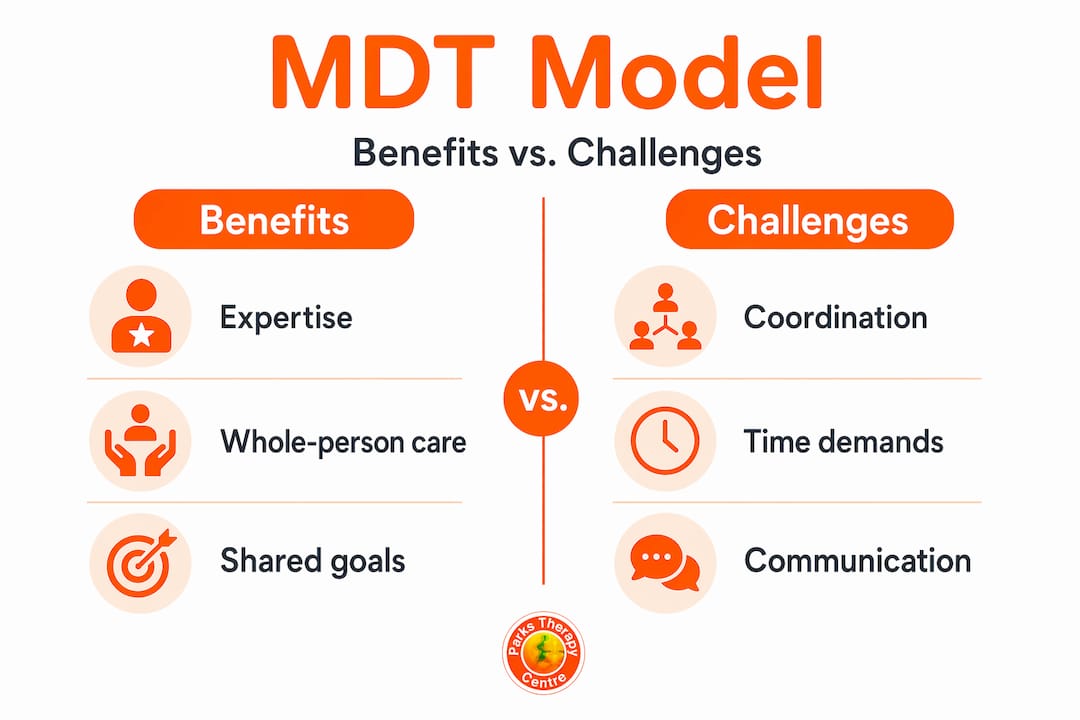
Collaborative care outcomes show that combining physiotherapy with mental health and social support helps manage disability far more comprehensively than physical treatment alone. For conditions where psychological and social challenges sit alongside physical ones, the single-discipline model simply cannot achieve comparable results.
The challenge most worth understanding is fragmentation. Fragmentation risk exists when professionals do not coordinate, producing a situation where the patient receives several different messages, conflicting advice, and no sense of a unified plan. This is not a failure of the model. It is a failure of implementation.
“Patients should ask how care teams coordinate goals. A team that cannot answer that question clearly is a team working in parallel, not genuinely together.”
The solution lies in clear communication channels, joint goal-setting meetings, and a designated coordinator, often the physiotherapist for musculoskeletal cases, who takes responsibility for keeping the picture coherent.
Engaging with MDT physiotherapy: tips for patients and professionals
Whether you are a patient entering this kind of care or a healthcare professional working within it, knowing how to engage well makes a genuine difference to outcomes.
For patients, the following questions are worth asking at any MDT appointment:
“What is the overall goal of my rehabilitation and who has agreed to it?”
“How will the different members of my team communicate with each other?”
“If my exercise plan changes, who needs to know, and how will that happen?”
“Can someone visit me at home if I struggle to attend appointments?”
Physiotherapists in primary care conduct home visits for patients unable to attend clinics, connecting patient needs across providers and addressing chronic or acute mobility problems. If you have mobility limitations, ask explicitly whether this is available rather than assuming it is not.
For healthcare professionals, the most productive shift in perspective is recognising what physiotherapists bring beyond exercise sheets. Physiotherapists’ training in multi-system approaches makes them natural collaborative partners, capable of integrating care across multiple consultations. Their role in musculoskeletal disorders extends to prevention, patient education, and long-term self-management, not just acute recovery.
Professionals can improve teamwork by including physiotherapists in case discussions from the outset, not as an afterthought once other interventions are planned. Equally, exploring physiotherapy techniques such as Pilates-based rehabilitation, manual therapy, and functional movement training reveals how physiotherapy can directly complement psychological and occupational therapy goals.
Pro Tip: Healthcare professionals working in MDTs: send a brief summary note to the physiotherapist after each review, not just a referral letter. Real-time information sharing closes the gaps that cause fragmentation.
My perspective on where MDT physiotherapy is heading
I’ve worked in and around physiotherapy long enough to see what happens when it is treated as an add-on rather than a core part of the care team. The patient gets their exercises. They do them dutifully. But the pain persists because nobody addressed the sleep disorder, the low mood, or the fear of re-injury running underneath the surface.
In my experience, the shift from parallel multidisciplinary work to genuinely integrated interdisciplinary care is the single most impactful change a rehabilitation service can make. It is not about adding more professionals. It is about making the professionals you have actually talk to each other.
What I’ve learned is that the physiotherapist is often the best-placed person to lead that coordination, at least for musculoskeletal cases. They see the patient frequently, they assess function directly, and their goals naturally translate across disciplines. The problem is that systems do not always recognise this, so physiotherapists end up operating in a silo even when they are technically part of a team.
My advice to patients is this: advocate for yourself. Ask whether your team has a shared care plan. Ask who leads it. If nobody has a clear answer, that fragmentation problem is already present. And to healthcare professionals: step-by-step rehabilitation only works when all the steps are designed together.
— Ivan
Care with Parkstherapycentre
Parkstherapycentre has been delivering physiotherapy and allied health services since 1986, across multiple locations in Bedfordshire and Buckinghamshire. The team at Parkstherapycentre operates exactly as this article describes: physiotherapy embedded within a broader clinical picture that includes sports injury treatment, acupuncture, podiatry, and related therapies, all under one roof.
If you are managing a chronic condition, recovering from injury, or simply want to understand whether a team-based approach is right for your situation, Parkstherapycentre offers the kind of patient-centred, coordinated care that this article has outlined. The team accepts insurance cover, holds professional qualifications, and has earned an award-winning reputation for a reason. Book your assessment today and start recovery with a team behind you, not just a single clinician in front of you.
FAQ
What does multidisciplinary physiotherapy mean?
Multidisciplinary physiotherapy means a physiotherapist works as part of a team of healthcare professionals, including occupational therapists, psychologists, nurses, and others, all contributing to a shared patient care plan rather than treating in isolation.
What is the difference between multidisciplinary and interdisciplinary physiotherapy?
Multidisciplinary teams may work in parallel toward their own goals for the same patient, while interdisciplinary teams actively share planning and decision-making, producing more integrated outcomes especially for complex or chronic conditions.
Who benefits most from a multidisciplinary approach?
Patients with chronic musculoskeletal pain, stroke, acquired brain injury, post-surgical recovery, or complex conditions like fibromyalgia benefit most, because their needs span physical, psychological, and social domains that no single clinician can address fully.
How can I tell if my care is genuinely coordinated?
Ask your care team whether a joint care plan exists, who leads coordination, and how professionals communicate between appointments. A team with clear answers to these questions is delivering genuinely collaborative care.
Can physiotherapy in an MDT include home visits?
Yes. Physiotherapists in primary care and community settings conduct home visits and provide home exercise programmes for patients with limited mobility, extending coordinated care well beyond the clinic.
Recommended