
Calf Muscle Tear Treatment: Recovery Stages and When to Get Help
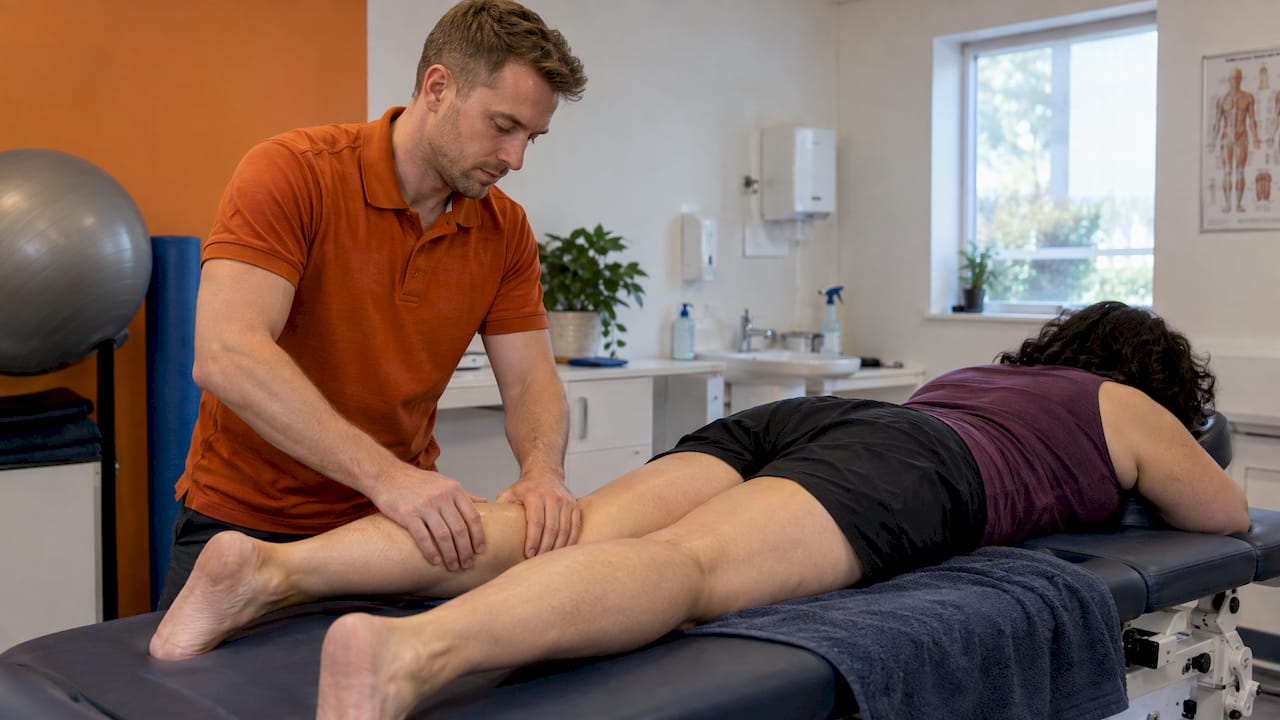
A calf muscle tear is treated in stages: protect the leg for the first two to three days, start gentle movement as soon as it is tolerable, then rebuild strength in a planned order until you can walk briskly, hop and do single-leg calf raises without pain. Most calf injuries settle in 6 to 8 weeks, and a larger tear can take up to 12. A physiotherapist grades the injury, rules out look-alikes such as a blood clot, and sets the loading plan, which is where recovery most often goes wrong. At Parks Therapy Centre, a physiotherapy assessment is £76 and can be booked at our clinics in Bedfordshire and Buckinghamshire.
TL;DR
Calf tears are graded 1 to 3. Grade 1 affects less than 10% of the muscle fibres, Grade 3 more than half, and the grade sets your timeline.
For the first 2 to 3 days, protect, rest, ice, compress and elevate. Avoid heat, alcohol, running and massage.
Begin gentle exercises after 2 to 3 days (up to a week if very sore), and back off if pain goes above 5 out of 10.
Expect 6 to 8 weeks for most calf injuries, up to 12 weeks for a bigger tear. Do not return to running on a pain-free walk alone.
A sudden pop, a gap in the muscle, numbness, or a hot, red, swollen calf needs medical attention the same day.
Table of Contents
Is it a calf tear, and how bad is it?
The calf is made of two main muscles. The gastrocnemius is the large, visible muscle that crosses both the knee and the ankle. The soleus lies underneath and crosses only the ankle. A peer-reviewed review explains that the gastrocnemius is at high risk of strain because it spans two joints and has fast-twitch fibres, while the soleus has slow-twitch fibres and tends to produce tightness and stiffness that builds over days to weeks.
The two usually feel different:
Gastrocnemius: a sudden, sharp pain, often when pushing off or sprinting, sometimes with a feeling of being struck on the back of the leg. Expert sports clinicians interviewed in a 2022 study described a sudden bang.
Soleus: a slowly creeping, gripping tightness that interferes with walking or running. In the same study, clinicians used knee position to tell them apart: pain with the knee bent points towards the soleus, and pain with the knee straight towards the gastrocnemius.
Both can be hurt at once. One radiology study reported in the review above found both muscles involved in 17% of calf strains.
The three grades
An NHS patient leaflet on acute leg muscle strains (reviewed October 2024) describes three grades:
Grade | Muscle fibres affected | What it usually feels like |
1 | Less than 10% | You can usually continue daily activities |
2 | 10% to 50% | Weakness, more swelling and bruising, difficulty continuing activity |
3 | More than 50%, up to complete rupture | Complete loss of muscle function |
The same leaflet says healing usually takes six to eight weeks depending on severity, age and activity, with severe injuries taking months.
A physiotherapist can usually make the diagnosis from your history and examination. StatPearls notes that a gastrocnemius rupture is diagnosed clinically from the story (a sudden push-off, a tearing sensation or pop, difficulty putting weight through the leg) and possibly a palpable gap. Ultrasound can show the fibre disruption and be repeated to monitor healing, and MRI is reserved for when the diagnosis is uncertain. If imaging would help, we offer an image assessment at £76, an image referral letter at £10 and an image results review at £67.
The first 72 hours
The aim in the first two to three days is to limit bleeding and swelling. NHS advice on sprains and strains (reviewed 23 April 2024) sets out PRICE:
Protect the leg from further injury.
Rest. Crutches can help if walking is painful, and a pharmacist can advise on pain relief.
Ice for up to 20 minutes every 2 to 3 hours, using a covered ice pack or a bag of frozen peas in a towel. Never put ice directly on the skin.
Compress with a supporting bandage during the day.
Elevate the leg on a pillow.
NICE Clinical Knowledge Summaries (revised June 2025) lists paracetamol or a topical anti-inflammatory such as ibuprofen gel as first-line pain relief for strains, with oral ibuprofen if needed. If you take other medicines or have a stomach, kidney or asthma condition, ask a pharmacist before taking ibuprofen.
What to avoid
A Plymouth NHS Trust leaflet (issued February 2025) uses the acronym HARM for the first 72 hours: no heat, no alcohol, no running or strenuous exercise, and no massage, because these can increase bleeding and swelling. That means no hot baths, heat packs or saunas while the leg is fresh.
The same leaflet suggests gentle toe and ankle movements early on, which keeps the joint moving without loading the torn fibres.
Warning signs that need urgent attention
Most calf strains are straightforward. A few presentations are not, and they should not be managed at home.
Call 999 or go to A&E if, according to the NHS, you heard a crack at the time of injury, the limb has changed shape, the area is numb or tingling, or the skin has turned blue or grey or feels cold.
Call NHS 111 if the injury is very painful or getting worse, swelling or bruising is large or increasing, you cannot put weight on the leg, or you have a high temperature or feel hot, cold or shivery.
NICE CKS advises emergency referral for a complete tear or a tear of more than half the muscle belly, a large bleed within the muscle, a tendon rupture, or nerve or circulation damage. The Leicester hospitals’ calf leaflet adds a sudden painful pop or snap at the Achilles with a gap you can feel.
Blood clots in the calf
A calf that is swollen and painful is not always a tear. A deep vein thrombosis (DVT) is a blood clot in a leg vein. The Plymouth leaflet lists throbbing or cramping pain in one leg, swelling, warm or red or darkened skin and swollen veins as warning signs, and says to call 999 or go to A&E if chest pain or breathlessness develops. StatPearls notes that DVT tends to cause more generalised swelling and lacks the focal tenderness of a fresh strain. If your calf pain came on without an injury, see a doctor the same day.
When can you massage a calf strain?
Not at first. The Leicester hospitals’ patient leaflet on calf strains and tears advises avoiding massage for 3 days after the injury, and says gentle massage may be soothing after that. Keep it gentle: the point is comfort and relaxing guarding muscles, not digging into the tear.
Our sports massage is £60 per hour. Booking it after the first few days, and telling the therapist the injury date, lets the session fit the stage you are at.
Starting to move: how exercise should progress
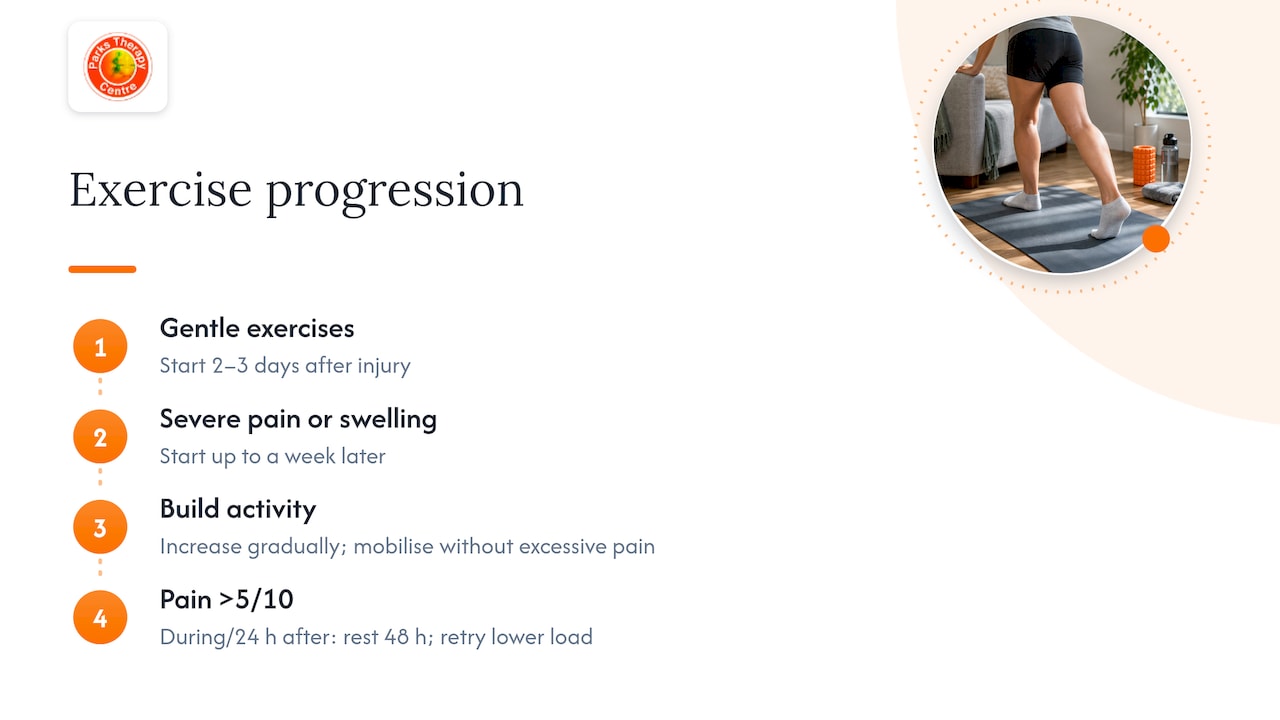
Rest is for the first few days only. The NHS leaflet on leg strains recommends starting gentle exercises 2 to 3 days after injury, or up to a week later if the calf is very painful and swollen, then increasing activity gradually. NICE CKS also advises starting active mobilisation and flexibility work as soon as it is tolerated without excessive pain.
That leaflet gives a practical pain rule: if pain exceeds 5 out of 10 during exercise or in the 24 hours afterwards, back off, rest for 48 hours and try again with a lower load.
A typical order of progress
The Scottish NHS Right Decisions calf pathway describes rehabilitation moving from isometric loading to isotonic loading, then heavy resistance and plyometric exercises. In plain terms:
Isometric: tensing the calf without moving the ankle, within a pain-free range.
Isotonic: moving through range, such as calf raises with both feet, then progressing the load.
Heavy resistance: slower, heavier strengthening, often single-leg.
Plyometric: bouncing and hopping drills that prepare the calf for running and jumping.
The pathway also notes that the medial (inner) head of the gastrocnemius is the most common site of calf injury and that most injuries are at the junction where muscle meets tendon. Risk factors include a previous calf injury, higher body mass index, previous lower limb injuries and a lumbar nerve root problem.
Gentle stretching and supported movement also matter in pregnancy, when calf cramps and leg aches are common and loading needs care. Stretches vetted by a clinician for round ligament pain show how a gradual, comfort-led approach to stretching works.
We have written a guide to recovering mild calf strains in 2 to 6 weeks with functional milestones, and a wider guide to building a safe post-injury training plan.
How long does a calf tear take to heal?
The published ranges are consistent:
Source | Typical timescale |
NHS leaflet, Leicester hospitals | 6 to 8 weeks, up to 12 weeks for a bigger tear |
NHS (nhs.uk) | Most strains feel better after 2 weeks, but avoid strenuous exercise such as running for up to 8 weeks |
Plymouth NHS Trust | Severe tear can take up to 3 months |
Royal Berkshire NHS | About 6 to 8 weeks to return to normal |
Sources: the Leicester leaflet, NHS sprains and strains page, the Plymouth leaflet and the Royal Berkshire calf injury leaflet (December 2025).
The key point is that feeling better after two weeks is not the same as being ready for sport. The NHS notes the risk of further damage if you return to running too soon.
Work, driving and sport
Work: you can self-certify sickness for the first 7 days. If you need longer, discuss a fit note with your GP, according to the Leicester leaflet.
Driving: the Royal Berkshire leaflet says not to drive if you cannot move your ankle freely and without pain.
Sport: NICE CKS says athletes may return to play when there is full, painless range of movement and strength has been restored. The Leicester leaflet adds that you should be able to walk quickly without pain or swelling first. The Scottish pathway uses single-leg calf raises and hopping as functional tests.
Our guide on returning to running after injury sets out the stages runners can follow once those tests are passed.
Why physiotherapy helps with a calf tear
Self-care is the right start. NICE CKS suggests considering a medical review after 5 to 7 days if you are not improving as expected or are getting worse, and routine physiotherapy referral if symptoms are not improving despite self-management. The NHS says physiotherapy may help if a strain is taking longer than usual to settle.
The NHS also says that in many areas you can self-refer to NHS community musculoskeletal services without seeing a GP, and that NHS physiotherapy waiting times can be long, with private physiotherapy as an alternative. For a working adult or an athlete with a race or season ahead, the speed of the first appointment matters, because the loading plan is most useful early.
What a physiotherapist adds to a calf injury:
Grading and differentiation. Identifying the muscle involved and the severity, as the research above shows, relies on examination, not guesswork. Clinicians in the 2022 study also routinely examine the lumbar spine and test nerve tension.
A graded plan. The progression from isometric to plyometric work needs the right load at the right time. Too little and the calf stays weak, too much and the pain rule above is broken.
Return-to-sport testing. Single-leg calf raises and hopping are judged against clinical signs, not simply against how the leg feels on a walk.
Imaging when needed. Where a scan would change the plan, we can arrange rapid diagnostic imaging referrals.
We accept all major health insurance plans, so check your policy for physiotherapy cover before you book.
Calf pain from a nerve, not a muscle
Some calf pain begins in the lower back. Sciatica is leg pain caused by a problem with a nerve root in the lower spine. NICE guideline NG59 defines it that way and says imaging should not routinely be offered in non-specialist settings.
Clues that point to a nerve:
No clear moment of injury, and often back or buttock pain too.
Changed sensation, such as numbness, pins and needles or burning, in an area of skin following a nerve’s path. NHS Grampian guidance (approved April 2026) lists altered touch, pinprick or temperature sensation in the nerve’s territory as findings that confirm neuropathic pain.
Pain that does not match where you can press and find a tender spot, which is typical of a strain.
This is why examination of the back is part of a calf assessment. If you have back pain or sciatica with new bladder problems, difficulty starting to pass urine, or altered sensation around the saddle area, go to A&E the same day. A British Journal of General Practice article (2025) explains that national guidance treats these symptoms as needing urgent same-day MRI because they can signal cauda equina syndrome, a compression of the nerves at the base of the spine.
Book a calf assessment with us
Parks Therapy Centre has treated musculoskeletal and sports injuries in Bedfordshire and Buckinghamshire since 1986, with clinics in Biggleswade, St Neots, Bedford and Milton Keynes. For a calf tear, the usual route is a physiotherapy assessment at £76, followed by treatment sessions at £67 each. Our double-length appointments are £102 for the assessment and £77 for treatment. If a stubborn tendon problem is part of the picture, shockwave therapy is available, with an assessment at £60 and treatment at £70 for 30 minutes or £60 for 20 minutes.
You can see every price and book online on our prices page.
When you are back to normal walking, strength work keeps the calf resilient. Our Pilates classes are £9 per group class, or £50 one-to-one.
Our perspective
A calf tear rarely fails to heal. What most often goes wrong is the middle of the recovery: the leg feels fine on the flat, so people go back to running at week three, and the muscle tears again. That is why we put the emphasis on grading the injury properly at the start and testing the calf before sport, not after. Single-leg calf raises, hopping and a brisk walk without pain are the checks that tell you whether the muscle can take load, and they are better done with a physiotherapist watching than guessed at. Our multidisciplinary team treats these injuries every day across our clinics, and our rapid imaging referrals mean that when a scan helps, you are not left waiting. If you are in doubt about whether your pain is in the muscle or comes from the back, an assessment settles it. Ivan
FAQ
Can I walk on a torn calf muscle?
For a mild strain, short pain-free walking is usually fine and helps early recovery. If walking is painful, crutches can help for the first few days, as the NHS suggests. If you cannot put weight on the leg at all, call NHS 111.
What are the best exercises for calf muscle pain?
Start with gentle toe and ankle movements, then pain-free isometric contractions, then calf raises and eventually hopping, as the NHS Scotland pathway outlines. Keep pain at or below 5 out of 10 during and after exercise. A physiotherapist can set the load for your grade of tear.
Should I use heat or ice on calf pain?
Use ice for the first 2 to 3 days, wrapped in a damp towel for 15 to 20 minutes at a time, according to NICE CKS. Avoid heat in the first 72 hours, because it can increase bleeding and swelling.
How can I tell a torn calf from a blood clot?
A tear usually follows a clear moment of injury and is tender at one spot. A clot more often causes throbbing or cramping, swelling of the whole calf, and warm or red skin, sometimes with no injury at all. If in doubt, see a doctor the same day, and call 999 if chest pain or breathlessness develops.
Sources
Recommended