
How to perform an APOS therapy assessment
- Jul 8
- 7 min read
TL;DR:
APOS therapy assessment is a personalized biomechanical evaluation combining gait analysis and device calibration to reduce musculoskeletal pain. It requires careful patient selection, objective measurements, and incremental adjustments, with AI analysis enhancing precision. Proper education and adherence to a gradual wear protocol are essential for successful neuromuscular re-education.
APOS therapy assessment is a personalised biomechanical evaluation that combines computerised gait analysis with calibrated device fitting to reduce musculoskeletal pain and retrain neuromuscular control. The process is not simply a product fitting. It is a structured clinical workflow requiring sound patient selection, objective measurement, and skilled device calibration. Knowing how to perform apos therapy assessment correctly separates effective outcomes from wasted clinical time. The evaluation uses validated tools including the WOMAC score and the SF-36 quality of life questionnaire to establish baseline function and track progress. Parkstherapycentre clinicians apply this framework across a range of musculoskeletal presentations, from knee osteoarthritis to lower limb biomechanical dysfunction.
How to perform an APOS therapy assessment: prerequisites and preparation
Patient selection is the first clinical decision, and it carries the most weight. Therapy is contraindicated for patients with severe structural joint damage, significant balance deficits, or loss of peripheral sensation. The device works by inducing controlled instability, so any patient who cannot safely respond to that instability is not a suitable candidate. Screening for these exclusion criteria before booking an assessment prevents harm and protects clinical credibility.

Once suitability is confirmed, gather a thorough history covering pain location, duration, aggravating activities, previous treatments, and current medication. This history shapes every subsequent calibration decision. A patient with medial compartment knee pain will require a different pod position than one presenting with lateral hip loading.
The equipment required for a complete apos therapy evaluation includes:
A computerised gait analysis system capable of measuring ground reaction forces and loading asymmetry
The foot-worn APOS device with adjustable convex Pertupods
Validated clinical questionnaires: WOMAC for pain, stiffness, and physical function; SF-36 for health-related quality of life
A flat, level walkway of at least six metres for baseline gait observation
A patient briefing sheet explaining the mechanism of controlled instability
Pro Tip: Complete the WOMAC and SF-36 questionnaires before the patient walks in the device. Baseline scores captured before any intervention give you a clean reference point for every future review.
Pre-assessment briefing reduces patient anxiety and improves compliance from the first session. Explain that the device does not provide rigid support. It deliberately challenges balance to stimulate the neuromuscular system. Patients who understand this mechanism tolerate the initial instability far better than those who receive no explanation.
Step-by-step process for the APOS therapy assessment
Initial assessment appointments typically last 30 to 60 minutes, with follow-up reviews running approximately 30 minutes. Structure that time carefully to cover every stage of the clinical workflow.
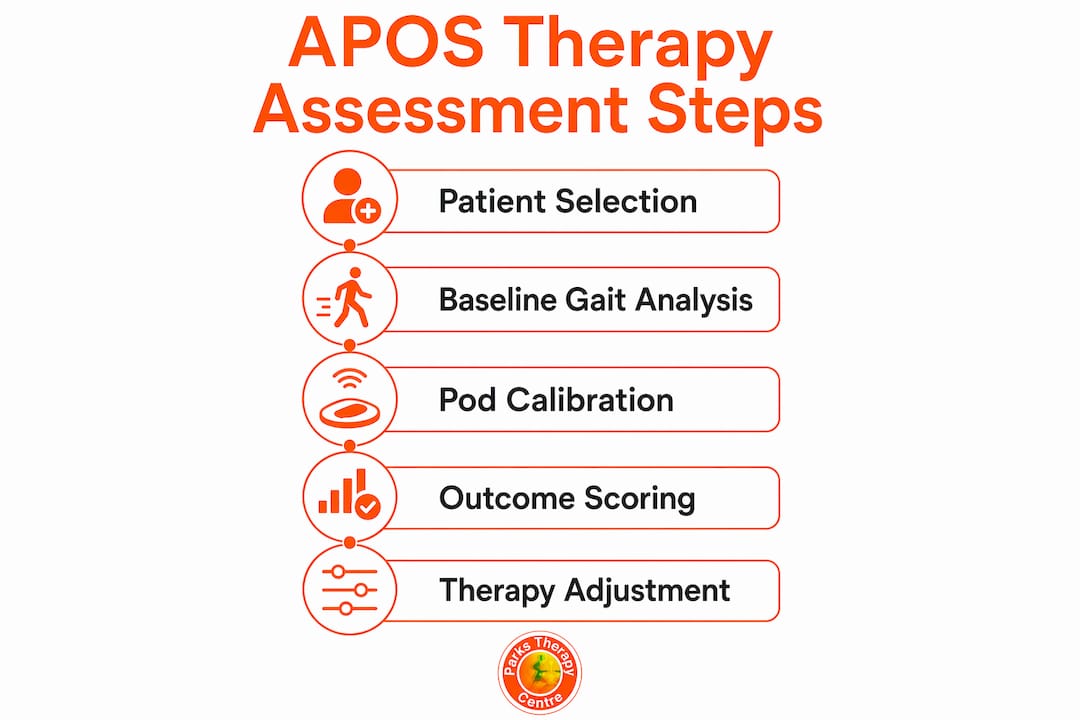
Conduct baseline gait observation. Ask the patient to walk barefoot along the walkway at a comfortable pace. Observe foot progression angle, stride symmetry, trunk lean, and knee alignment. Note any antalgic patterns, Trendelenburg signs, or compensatory hip drop.
Run computerised gait analysis. Gait analysis evaluates abnormal loading patterns, joint malalignment, muscle compensation strategies, and pain distribution across the foot. This data provides the objective foundation for pod placement decisions.
Document baseline scores. Record WOMAC and SF-36 scores at this stage. Validated tools such as WOMAC and the SF-36 have demonstrated superior sensitivity to pain, stiffness, function, and quality of life changes compared to generic outcome measures.
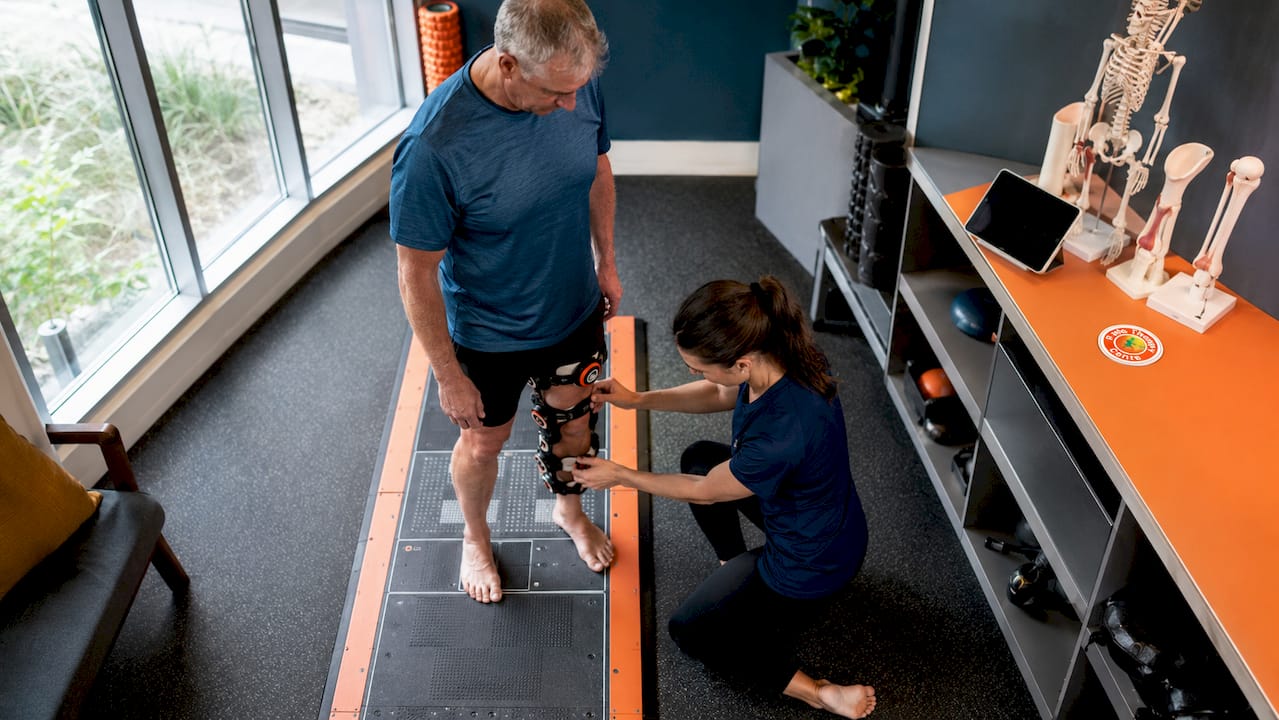
Fit the APOS device and calibrate the Pertupods. The Pertupods are not rigid insoles. They induce controlled instability by shifting the foot’s centre of pressure to mechanically offload the painful joint compartment. Pod position is adjusted medially or laterally under the forefoot and heel until the patient reports reduced pain on walking and gait analysis confirms improved loading symmetry.
Reassess gait with the device fitted. Walk the patient again and compare loading patterns against the barefoot baseline. Confirm that the calibration has achieved the intended mechanical offloading without introducing new compensatory patterns.
Educate the patient on the wear protocol. Prescribe an initial daily wear time and provide written instructions for progression.
Assessment stage | Clinical tool | Purpose |
Baseline gait observation | Visual analysis, walkway | Identify compensatory patterns |
Computerised gait analysis | Force plate or pressure mat | Quantify loading asymmetry |
Outcome measurement | WOMAC, SF-36 | Establish baseline function and pain |
Device calibration | Pertupods, APOS device | Achieve mechanical offloading |
Post-fitting gait check | Repeat gait analysis | Confirm calibration accuracy |
Pro Tip: Make small pod adjustments incrementally. A two-millimetre shift in pod position can produce a measurable change in knee adduction moment. Adjust, walk, reassess, and repeat rather than making large positional changes in one step.
How does AI improve APOS therapy evaluation?
AI-powered gait analysis is changing the standard of apos therapy assessment methods. AI analysis detects micro-abnormalities in gait that visual inspection routinely misses, including subtle asymmetries in cadence, step width, and loading rate that fall below the threshold of clinical observation. This additional layer of data improves the precision of initial pod calibration and reduces the number of follow-up adjustments needed.
The practical workflow integration looks like this:
Capture AI gait data before and after device fitting during the assessment appointment
Use the AI output to validate or challenge your clinical impression of loading patterns
Share digital reports with the patient to reinforce understanding of their biomechanical profile
Use remote monitoring data between appointments to identify drift in gait patterns before the next review
AI platforms support continuous remote monitoring and personalised therapy adjustments, which reduces the frequency of in-person clinic visits without compromising clinical oversight. For physiotherapists managing high patient volumes, this capacity to monitor and recalibrate remotely represents a meaningful shift in how apos therapy evaluation techniques are delivered.
The biopsychosocial model in physiotherapy supports integrating digital data with patient-reported experience. Objective gait metrics and subjective pain scores together produce a more complete clinical picture than either source alone.
Common challenges during the APOS therapy assessment
Every clinician conducting apos therapy assessments encounters predictable problems. Knowing them in advance allows you to address them before they derail the session.
Patient apprehension about instability. Many patients expect a supportive orthotic and are unsettled when the device feels deliberately unstable. Address this before fitting by explaining the neuromuscular mechanism clearly. Patients who understand why the device feels the way it does are significantly more likely to persist with the wear protocol.
Incorrect pod calibration. A pod placed too far medially can increase rather than decrease medial compartment load. Always confirm calibration with a post-fitting gait check rather than relying on patient-reported comfort alone. Comfort and correct mechanical offloading do not always coincide, particularly in the first session.
Therapy dosage tolerance. Starting patients at 10 to 15 minutes of daily wear and progressing gradually to one hour is the established protocol for safe neuromuscular adaptation. Patients who push beyond their tolerance in the first week frequently report increased soreness and reduce their compliance. Prescribe the wear time in writing and review it at the first follow-up.
Recognising contraindications mid-assessment. Occasionally, a patient passes initial screening but reveals a contraindication during the assessment itself, such as previously undisclosed peripheral neuropathy or significant proprioceptive deficit. Stop the assessment, document your findings, and refer appropriately.
“Controlled dynamic instability caused by the device is a key feature promoting neuromuscular re-education. Communicating this clearly to patients is not optional. It is a clinical responsibility that directly determines whether the therapy succeeds or fails.”
For a broader view of how biomechanical assessment integrates with injury prevention, the injury prevention guide for active adults at Parkstherapycentre provides useful clinical context.
Key takeaways
A correctly performed APOS therapy assessment combines objective gait analysis, validated outcome measures, and skilled Pertupod calibration to deliver personalised mechanical offloading and neuromuscular re-education.
Point | Details |
Screen patients carefully | Exclude those with severe structural damage, balance deficits, or sensory loss before assessment. |
Use validated outcome measures | Record WOMAC and SF-36 scores before device fitting to establish a clean baseline. |
Calibrate incrementally | Adjust Pertupod position in small increments and confirm each change with a repeat gait check. |
Integrate AI gait data | Use AI analysis to detect subtle loading asymmetries that visual inspection misses. |
Prescribe wear time in writing | Start at 10 to 15 minutes daily and progress gradually to prevent soreness and dropout. |
What I have learned from performing APOS assessments
The single biggest mistake I see clinicians make is rushing the calibration stage. There is a temptation to fit the device, get a positive patient response, and move on. The problem is that patient-reported comfort in the first five minutes of wearing the device is not a reliable indicator of correct mechanical offloading. I have seen patients report immediate pain relief from a pod position that gait analysis later showed was actually increasing medial compartment load. The subjective and objective data do not always agree, and when they conflict, trust the data.
The second lesson is about patient education. The controlled instability of the Pertupods is genuinely unfamiliar to most patients. They have spent years seeking stability through footwear and orthotics, and this device asks them to accept the opposite. Spending an extra five minutes explaining the neuromuscular rationale at the first assessment pays back in compliance over the following weeks. Patients who drop out in week two almost always tell me they did not understand why the device felt the way it did.
Finally, the APOS therapy rehabilitation guide at Parkstherapycentre reinforced something I had suspected from clinical experience: gradual progression of wear time is not a conservative suggestion. It is the mechanism by which neuromuscular adaptation actually occurs. Skipping that progression does not accelerate outcomes. It reverses them.
— Ivan
Parkstherapycentre’s approach to APOS therapy assessment
Parkstherapycentre has supported clinicians and patients with musculoskeletal rehabilitation since 1986, combining physiotherapy, podiatry, and sports injury expertise across multiple sites in Bedfordshire and Buckinghamshire.

The team at Parkstherapycentre brings hands-on experience in biomechanical assessment and device-based rehabilitation to every patient interaction. Whether you are a clinician seeking guidance on assessment protocols or a patient exploring APOS therapy as a treatment option, the centre’s qualified practitioners offer structured, evidence-informed support. Visit the Parkstherapycentre therapy services page to learn more about available assessment appointments and rehabilitation programmes across their clinic network.
FAQ
What does an APOS therapy assessment involve?
An APOS therapy assessment involves computerised gait analysis, patient history review, WOMAC and SF-36 outcome scoring, and calibration of the foot-worn device’s Pertupods to achieve mechanical offloading of the affected joint.
How long does an initial APOS assessment take?
Initial assessment appointments typically last 30 to 60 minutes. Follow-up review appointments run approximately 30 minutes, depending on the complexity of device recalibration required.
Who is not suitable for APOS therapy?
Patients with severe structural joint damage, significant balance deficits, or peripheral sensory loss are not suitable candidates. The device requires the patient to respond safely to controlled instability, which these conditions prevent.
How is APOS therapy effectiveness measured?
Effectiveness is measured using the WOMAC score for pain, stiffness, and physical function, and the SF-36 questionnaire for health-related quality of life. Both tools are administered at baseline and at each review appointment.
Can AI gait analysis replace clinical assessment in APOS therapy?
AI gait analysis augments clinical assessment by detecting subtle loading asymmetries that visual inspection misses, but it does not replace hands-on evaluation. The combination of AI data and clinical judgement produces the most accurate calibration outcomes.
Recommended