
Industry standards in physiotherapy 2026: what's changing

TL;DR:
Industry standards in physiotherapy are shifting in 2026 to emphasize personalized patient care, evidence-based practice, and ethical marketing. Regulatory bodies globally are tightening guidelines on documentation, pricing, and professional conduct to improve accountability and patient trust. Practitioners must adapt through structured clinical support, comprehensive documentation, and updated CPD to meet these evolving, internationally aligned standards.
The profession has not stood still. Across 2025 and into 2026, the industry standards in physiotherapy 2026 have shifted in ways that touch everything from how you document a session to how you market your practice online. Regulatory bodies are tightening their frameworks, international consensus processes are producing binding benchmarks, and evidence-based guidelines are moving from optional reading to compliance requirements. If you have been relying on what you learned in 2022 or even 2023, some of that knowledge now needs updating.
Table of Contents
Key takeaways
Point | Details |
HCPC standards are evolving | Updated conduct, performance, and ethics standards require ongoing professional development and personalised patient care approaches. |
International benchmarks are firming up | A 20-element consensus framework now defines professional practice standards for clinical exercise physiology globally. |
Marketing ethics are tightening | New draft ethics codes prohibit buying social media followers or using paid algorithmic boosts. |
Pricing and session limits are emerging | South Korea’s 2026 reforms signal a wider trend towards managed benefit systems that cap treatment costs and frequency. |
Documentation must map to guidelines | Audit processes increasingly require interventions to be explicitly mapped to national guideline criteria such as NICE NG38. |
Industry standards in physiotherapy 2026: the regulatory picture
Understanding who sets the rules is the starting point for any compliance conversation. In the UK, the Health and Care Professions Council remains the primary regulator. The revised HCPC standards introduced in September 2023 brought together conduct, performance, and ethics into a more integrated framework, with a clear emphasis on personalised patient care and continuous professional development. Those standards are now the operational baseline for 2026, with no grace period remaining.
Beyond the UK, World Physiotherapy continues to shape global physiotherapy regulations 2026 through its member organisations and policy statements. The practical implication for UK clinicians is that international frameworks increasingly influence domestic expectations, particularly around scope of practice and ethical conduct.
Two areas where regulatory pressure has intensified most visibly are marketing and pricing. A draft ethics code released April 2026 explicitly prohibits allied health professionals from purchasing social media followers or using paid algorithmic boosts to inflate online visibility. The intent is to protect patients from misleading representations of professional credibility. Regulatory authorities are eliminating unethical marketing tactics as a growing priority across multiple jurisdictions.
Non-compliance carries real consequences. Practitioners found in breach of conduct standards face fitness-to-practise proceedings, conditions of practice orders, or suspension. For clinic owners, a single upheld complaint can also trigger reputational damage that no marketing spend can recover.
Pro Tip: Review your HCPC profile annually rather than at renewal. Keeping your continuing professional development log current means you are audit-ready at any point, not just at re-registration.
Evidence-based frameworks shaping treatment in 2026
The best practices in physiotherapy are no longer a matter of professional preference. They are increasingly codified through consensus processes and published as formal recommendations with measurable endorsement rates.
One of the most instructive recent examples comes from Germany. A co-design project involving rehabilitation clinicians and patient stakeholders produced 15 evidence-based recommendations for promoting physical activity within medical rehabilitation settings. The endorsement rate across those recommendations ran from 86% to 100% among stakeholders, with 78% confirming practical relevance in day-to-day physiotherapy care. That level of consensus is not common, and it gives the recommendations genuine clinical weight.
What makes this framework significant for UK practitioners is not its German origin but its methodology. The co-design approach, where clinicians, patients, and rehabilitation scientists all contribute to the final recommendations, is the model regulators and guideline bodies are now actively favouring. Expect to see similar processes producing UK-specific guidance over the next two years.
Integrating this kind of framework into routine care requires a structured approach:
Map each patient’s treatment plan against the relevant physical activity promotion recommendations at the outset of care.
Document which recommendations apply and how they have been incorporated into the plan.
Review adherence at each session note, not just at discharge.
Use patient-reported outcome measures that capture activity levels, not only pain scores.
Audit your caseload quarterly to identify gaps between recommended practice and actual delivery.
Research published in May 2026 also confirmed that active electrotherapy outperforms placebo for clinically significant improvement in neck pain, reinforcing the point that modality selection is not a matter of habit. Evidence now has a direct line into best practices in physiotherapy, and choosing treatments without that evidence base is increasingly difficult to defend.
International consensus on professional practice standards
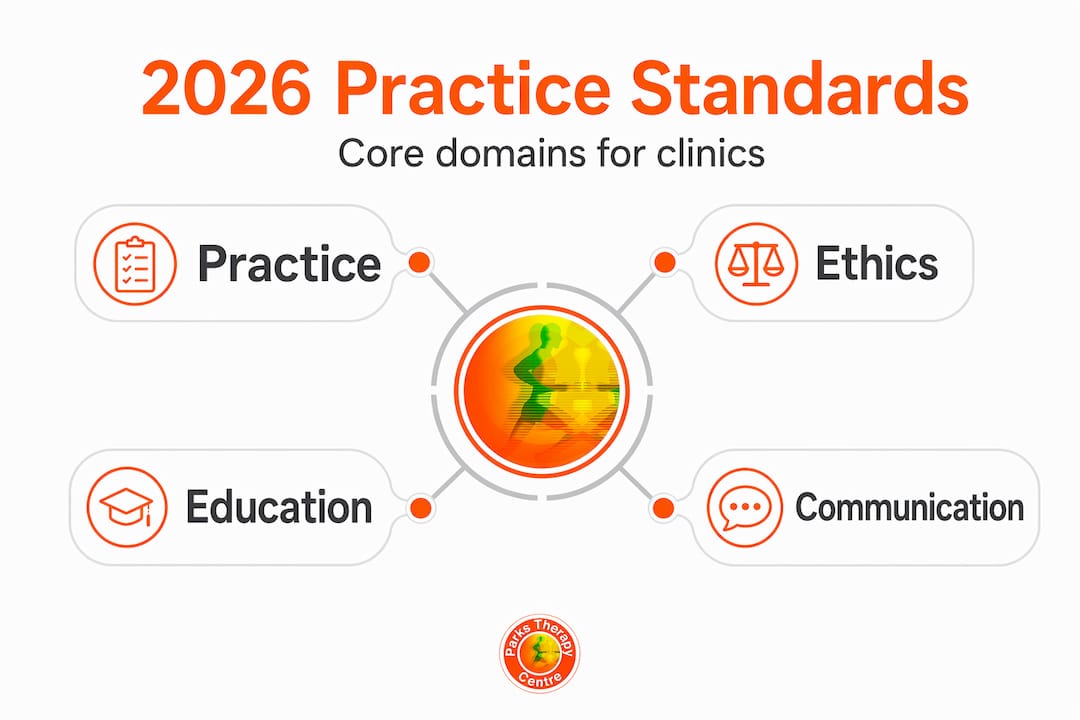
The future of physiotherapy standards is partly being written through international consensus processes, and 2026 has produced a significant example. A rigorous e-Delphi study reached consensus on 20 core professional standards for clinical exercise physiology, requiring 80% expert agreement across each element. The domains covered are professional practice, knowledge, client management, and intervention design.
The table below summarises the four domains and their practical implications for physiotherapy practice and education.
Domain | Core focus | Practical implication |
Professional practice | Ethics, communication, accountability | Aligns with HCPC conduct standards and marketing ethics codes |
Knowledge base | Anatomy, pathophysiology, exercise science | Supports physiotherapy accreditation requirements in training programmes |
Client management | Assessment, goal-setting, outcome measurement | Reinforces personalised care models and documentation standards |
Intervention design | Programme planning, progression, safety | Underpins evidence-based treatment delivery and session frequency decisions |
Countries including Australia, the UK, the USA, Canada, and New Zealand use these professional standards for programme accreditation and practitioner certification. That shared framework supports workforce mobility and makes it easier for internationally trained physiotherapists to demonstrate competence in a new jurisdiction.
For clinic managers, the accreditation implications are direct. When your staff hold qualifications from internationally accredited programmes, you can point to a recognised standard of competence. When they do not, you carry greater responsibility for demonstrating that competence through your own CPD and supervision structures.
Pro Tip: When recruiting, ask candidates to map their training against the four consensus domains. It takes ten minutes and immediately surfaces any gaps that need addressing through structured CPD.
Pricing, marketing, and documentation shifts
The most disruptive regulatory development in global physiotherapy regulations 2026 is arguably the South Korean managed benefit system. From July 2026, manual therapy sessions are priced between 40,000 and 43,000 won per session, down from a prior average of 110,000 won. Session frequency is capped at twice a week, with between 15 and 24 sessions annually depending on clinical need. That is a reduction of over 50% in treatment revenue per session.

The UK has no equivalent system in private practice today, but the regulatory logic behind Korea’s reform mirrors concerns already visible here: overtreatment incentives, unclear clinical justification for high-frequency sessions, and patient confusion about what represents medically necessary care. Pricing and marketing autonomy for practitioners is being curtailed globally to address these structural problems. UK private clinics would be unwise to treat this as someone else’s issue.
On documentation, the direction of travel is equally clear. Audit processes now evaluate 100% adherence to national guideline criteria, requiring standardised composite compliance reporting. Clinical notes must explicitly map interventions to guideline criteria such as NICE NG38. This is not optional recordkeeping. It is the audit standard.
Key documentation shifts to act on now:
Move from narrative-only session notes to structured records that reference specific guideline criteria.
Include explicit clinical justification for any deviation from standard protocols.
Adopt a clinical documentation approach that maps each intervention to national guidance.
Review your consent and information-sharing processes to reflect current transparency requirements.
Ensure your social media content reflects genuine clinical activity, not inflated metrics or purchased engagement.
How to meet physiotherapy standards 2026 in practice
Understanding the standards is one thing. Translating how to meet physiotherapy standards 2026 into clinical habit is another matter entirely.
Start with your CPD framework. The HCPC requires registrants to maintain a profile of activities, but the quality of that profile matters as much as its existence. Learning activities linked directly to your current caseload, your documentation practice, and your knowledge of current guidelines are far more defensible than a list of courses attended. The evidence-based physiotherapy and pain recovery literature is a productive starting point for CPD that connects directly to clinical outcomes.
On physical activity promotion, the German co-design recommendations offer a practical framework that does not require wholesale restructuring of your approach. The key shift is making physical activity promotion explicit in every treatment plan, not an afterthought at discharge. Your physiotherapy treatment plan should include measurable physical activity targets from session one.
Marketing deserves a separate review. Clinic websites that use healthcare video content ethically and transparently are well positioned against the incoming ethics code requirements. The same principle applies to your social media presence: organic engagement built on genuine clinical content is compliant. Purchased visibility is not.
Finally, build documentation review into your weekly routine rather than your annual audit cycle. A 15-minute weekly check of five session notes against your chosen guideline criteria will surface problems before they become compliance issues.
My perspective on where this is all heading
I have followed the evolution of physiotherapy standards for a long time, and the pace of change in 2026 genuinely stands out. What strikes me most is not any single regulation but the convergence of pressures, international consensus, pricing reform, marketing ethics, and documentation standards all tightening at the same time.
Some of these changes will feel disruptive. The marketing ethics codes in particular will require clinics that have built their online presence partly through paid visibility to rethink their approach. That disruption is necessary. The profession’s credibility depends on patients being able to trust that a practitioner’s apparent reputation reflects genuine clinical quality, not a purchased following.
The international consensus work gives me genuine confidence about where the profession is heading. When 80% of global experts agree on what professional practice looks like across four core domains, it creates a shared language for quality that benefits practitioners and patients alike. It also makes physiotherapy accreditation requirements more coherent across borders, which matters increasingly for a mobile workforce.
The uncomfortable truth I would offer any clinic owner is this: the standards being set now are not designed to make your life harder. They are designed to make patient outcomes better and professional accountability visible. Clinicians who embrace that logic tend to find compliance far less burdensome than those who treat it as an external imposition.
— Ivan
How Parkstherapycentre can support your standards journey
Meeting the evolving demands of 2026 regulations takes more than reading guidance documents. It takes experienced clinical support, structured treatment planning, and a team that already operates within current best practice frameworks.
Parkstherapycentre has been delivering high-quality physiotherapy across Bedfordshire and Buckinghamshire since 1986. The team works within evidence-based frameworks, holds current professional qualifications, and accepts insurance cover from major providers. Whether you are a patient seeking care that reflects current standards or a professional looking for a reference point on modern physiotherapy practice, the centre offers the clinical depth and accountability that 2026 demands. Visit Parkstherapycentre to explore services, read clinical insights, or book an appointment with a qualified physiotherapist.
FAQ
What are the main HCPC standards changes for 2026?
The HCPC revised its standards of conduct, performance, and ethics in September 2023, with those standards forming the operational baseline for 2026. They place greater emphasis on personalised patient care and continuous professional development.
How do the international consensus standards affect UK physiotherapists?
The 20-element consensus framework for clinical exercise physiology sets a globally recognised benchmark across professional practice, knowledge, client management, and intervention design. UK practitioners and accreditation bodies are increasingly expected to align with these domains.
What documentation practices are now required for compliance?
Audit processes now require clinical notes to explicitly map interventions to national guideline criteria such as NICE NG38. Standardised composite compliance reporting is the expected format for any audit or review.
Are physiotherapy marketing practices being regulated in 2026?
Yes. A draft ethics code published in April 2026 prohibits allied health professionals from buying social media followers or using paid algorithmic boosts. Transparent, organically earned digital presence is the standard regulators are moving towards.
What does the South Korean pricing reform mean for UK clinics?
While the specific managed benefit system applies in South Korea from July 2026, capping manual therapy at 40,000 to 43,000 won per session, the regulatory logic of curbing overtreatment and linking session frequency to clinical need reflects a global trend that UK private practices should monitor closely.
Recommended