
Muscle rupture recovery time: what to expect
- 20 hours ago
- 7 min read

TL;DR:
Muscle rupture recovery time depends on injury severity, individual factors, and proper rehabilitation. Most patients need four to eight weeks for partial tears and over three months for complete ruptures, with biological healing lasting up to 12 months. A staged, physiotherapist-guided rehabilitation process reduces the risk of reinjury and improves long-term outcomes.
Muscle rupture recovery time is defined as the period from injury to the point where the affected muscle regains sufficient strength and function for normal activity. Clinically, the preferred term is muscle tear, graded on a three-tier scale (Grade I, II, and III) that directly determines how long recovery takes. A Grade I strain may resolve in one to three weeks, while a Grade III complete rupture can require three to six months or longer, often with surgery. Understanding where your injury sits on that scale is the single most useful thing you can do in the first days after getting hurt.
What are the different grades of muscle ruptures and their recovery timelines?
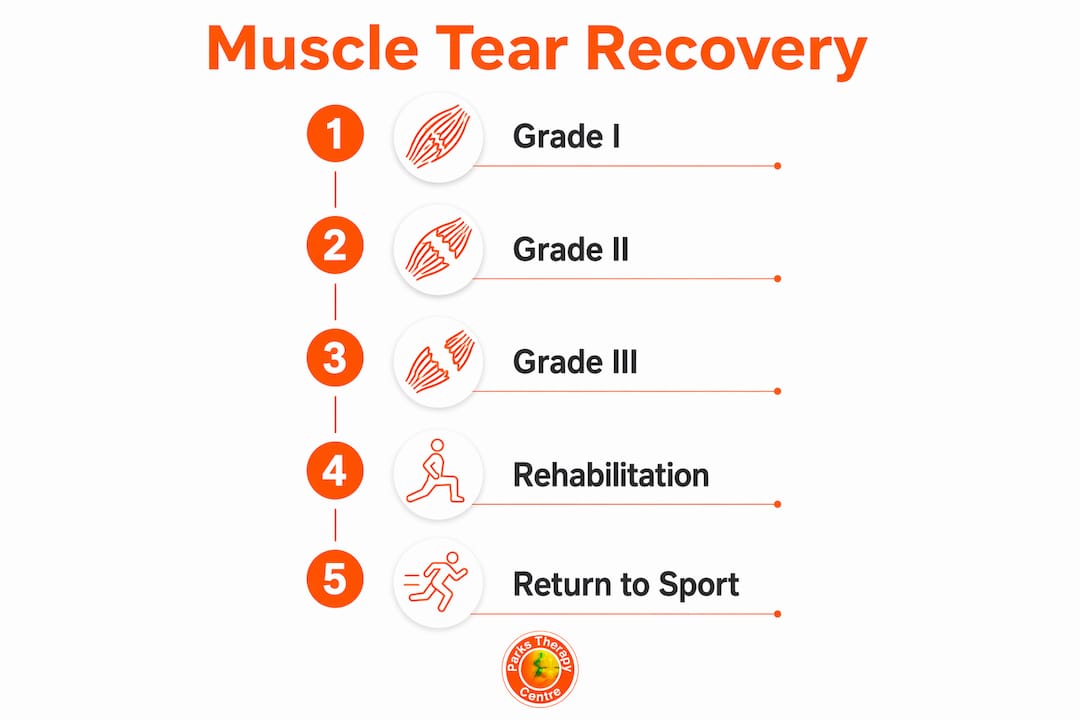
The grading system is the foundation of every recovery plan. Grade I, II, and III tears each carry distinct timelines and management requirements, and confusing them is the most common reason patients underestimate how long healing takes.
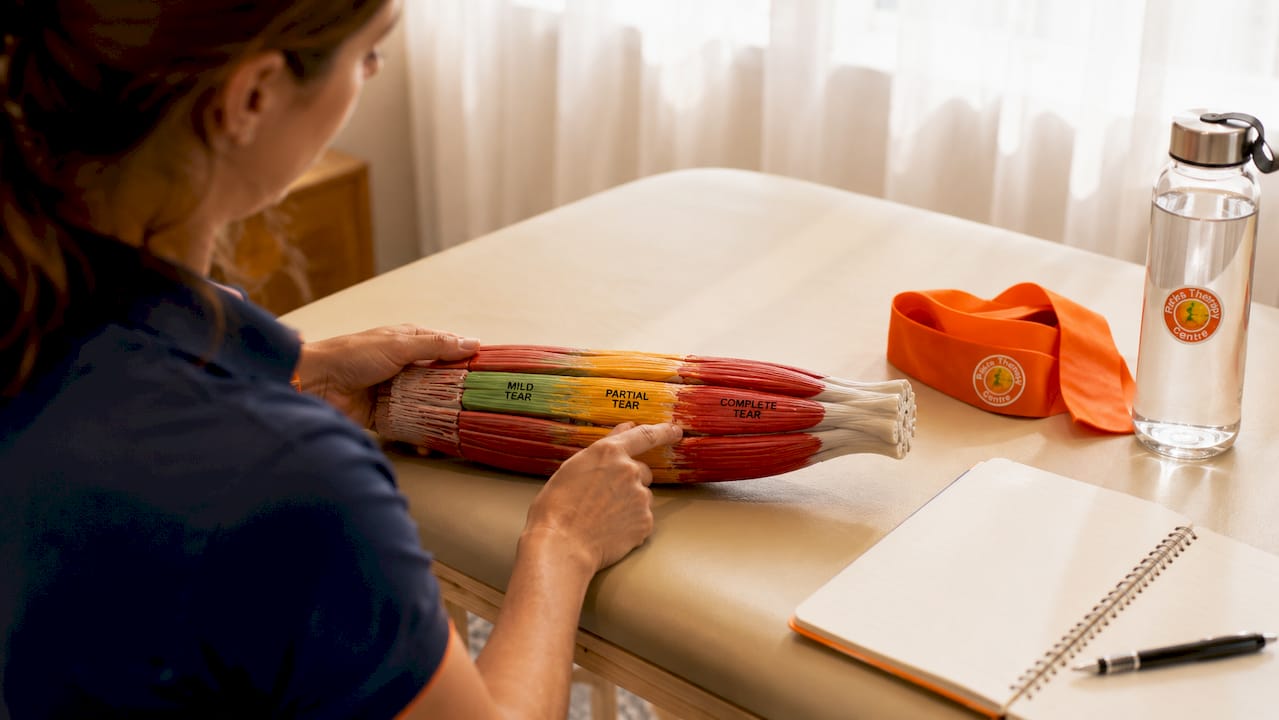
Grade I (mild strain) involves a small number of torn fibres with no significant loss of strength. Pain is present but manageable, and most patients return to normal activity within one to three weeks with appropriate rest and early movement.
Grade II (partial tear) is a more substantial disruption of muscle fibres. Bruising, swelling, and a noticeable reduction in strength are typical. Recovery takes four to eight weeks, and returning to sport before four to six weeks raises reinjury risk significantly. Recurrence rates for Grade II tears can reach up to 70% when patients return too soon.
Grade III (complete rupture) means the muscle has torn fully. A palpable gap or divot at the injury site is a hallmark sign, often accompanied by a ‘pop’ at the moment of injury, severe bruising, and complete loss of function. Surgical repair is frequently required, and recovery extends from three to six months or longer.
Grade | Description | Typical recovery time |
Grade I | Minor fibre damage, strength preserved | 1–3 weeks |
Grade II | Partial tear, reduced strength | 4–8 weeks |
Grade III | Complete rupture, possible surgery | 3–6+ months |
Pain level alone does not reliably indicate severity. Structural damage signs such as visible deformity, a palpable gap, or bruising that appears well away from the injury site are far more telling than pain intensity. If you notice any of these, seek professional assessment without delay.
What factors influence muscle rupture recovery time?
Recovery timelines are starting points, not guarantees. The muscle affected, your age, your rehabilitation quality, and any underlying health conditions all shift the outcome considerably.
The biological healing process moves through three overlapping phases:
Inflammation (days 1–5): The body limits further damage and clears debris. During the first 48–72 hours, rest, ice applied for 15–20 minutes every 2–3 hours, compression, and elevation help control swelling without halting the necessary inflammatory response.
Repair (days 5–21): New collagen fibres are laid down. The quality of this collagen depends heavily on whether the muscle is loaded appropriately during this window.
Remodelling (3 weeks to 12 months): Fibres mature and align. This phase is far longer than most patients expect, and it is where premature return to activity causes the most damage.
Age slows all three phases. Larger muscles, such as the quadriceps or hamstrings, take longer to heal than smaller ones. Co-morbidities including diabetes and poor circulation reduce tissue perfusion and extend the repair phase.
Pro Tip: Feeling better is not the same as being healed. Functional improvement routinely outpaces biological repair, which means the muscle can feel normal weeks before it is structurally ready for full load.
The quality of rehabilitation matters as much as the injury grade itself. Rest alone does not heal muscle tears. Controlled movement is what drives organised collagen alignment and muscle protein synthesis. Passive rest produces weaker, less organised scar tissue that is prone to re-tearing.
How should rehabilitation be structured to support recovery and prevent reinjury?
A staged rehabilitation programme is the most reliable way to shorten the torn muscle recovery process and reduce the risk of recurrence. The stages below reflect the biological phases of healing and should be guided by a qualified physiotherapist.
Acute phase (days 1–5): Protect the injury, manage swelling, and maintain gentle range of motion in pain-free ranges. Avoid complete immobilisation.
Early loading phase (days 5–14): Introduce pain-free isometric contractions. Starting guided rehabilitation as early as two days post-injury reduces total recovery time by approximately three weeks compared to complete rest. This is the principle of mechanotransduction: controlled load signals the body to build stronger, better-aligned tissue.
Progressive strengthening (weeks 2–6): Move from isometric to isotonic exercises, then introduce eccentric loading. Eccentric work, where the muscle lengthens under tension, is the most effective method for rebuilding tensile strength and is a core component of safe post-injury training.
Functional training (weeks 4–12+): Reintroduce sport-specific or activity-specific movements. Criteria for progression include full pain-free range of motion, strength within 90% of the uninjured side, and no compensatory movement patterns.
Return to full activity: This is a clinical decision, not a calendar decision. Functional benchmarks matter more than elapsed time.
Common errors that cause recurrence include skipping the eccentric phase, returning to sport based on pain absence rather than strength testing, and neglecting flexibility work alongside strengthening.
Pro Tip: Ask your physiotherapist for a strength comparison test between your injured and uninjured limb before returning to sport. A gap of more than 10% is a reliable indicator that the muscle is not ready for full load.
A physiotherapist-guided programme also accounts for the muscle tear rehabilitation duration specific to your injury. The role of physiotherapy in injury prevention extends well beyond the acute phase. Patients who complete a full, supervised programme have significantly lower recurrence rates than those who self-manage.
What are realistic expectations for recovery progress and return to activity?
Setting accurate expectations is as important as the rehabilitation itself. Biological remodelling continues for up to 12 months after a muscle tear, even when functional recovery appears complete at six to ten weeks. This gap between feeling ready and being ready is where most reinjuries occur.
Timeframe | Grade I milestone | Grade II milestone | Grade III milestone |
Week 1–2 | Pain reducing, light activity | Swelling controlled, gentle movement | Post-surgical or immobilised |
Week 3–4 | Return to normal daily activity | Progressive strengthening begins | Early range of motion work |
Week 6–8 | Full return to sport | Sport-specific training begins | Strengthening phase starts |
Month 3–6 | Fully healed | Near-full function, ongoing rehab | Return to sport assessment |
Month 6–12 | N/A | Remodelling complete | Remodelling continues |
Warning signs that indicate a setback include a sudden return of sharp pain during exercise, renewed swelling after a period of improvement, or a sensation of giving way in the muscle. Any of these warrants an immediate pause and professional reassessment.
Patients often feel better before fully healed. This is the most dangerous point in recovery. The muscle tissue is still maturing, collagen fibres are still aligning, and the risk of re-tearing under high load remains elevated. A qualified physiotherapist uses functional testing, not symptom reports alone, to determine genuine readiness.
The signs that a muscle is healing faster include consistent reduction in resting pain, improving range of motion week on week, and the ability to complete progressive loading exercises without compensatory movement. These are objective markers, not just subjective feelings of improvement.
Key takeaways
Muscle rupture recovery time is determined by injury grade, rehabilitation quality, and individual biology. Completing a full, staged rehabilitation programme is the most reliable way to heal completely and avoid reinjury.
Point | Details |
Grade determines timeline | Grade I heals in 1–3 weeks; Grade II in 4–8 weeks; Grade III in 3–6+ months. |
Rest alone is insufficient | Controlled loading drives organised collagen repair and reduces total recovery time. |
Biological remodelling lasts up to 12 months | Feeling recovered does not mean the tissue is fully healed and ready for full load. |
Premature return raises reinjury risk | Recurrence rates for Grade II tears reach up to 70% when return to sport is too early. |
Functional criteria, not calendars, guide return | Strength testing and pain-free movement benchmarks are the reliable indicators of readiness. |
What I have learned from watching patients rush their recovery
Patients consistently underestimate how long the remodelling phase lasts. The most common pattern I see is someone who completes the early rehabilitation stages well, feels genuinely good at the six-week mark, and then returns to full training. Three weeks later, they are back in the clinic with the same injury, sometimes worse. The biology simply has not caught up with the feeling.
The other misconception I encounter regularly is that more pain means more damage. That is not always true. A Grade III rupture can sometimes feel less acutely painful than a severe Grade II, because the nerve endings in the completely torn tissue are no longer under tension. Severity is structural, not purely sensory.
What actually works is patient education delivered early and reinforced throughout. When patients understand that physiotherapy-guided rehabilitation is not optional but central to the healing process, compliance improves and outcomes follow. The patients who do best are those who treat their rehab programme with the same discipline they bring to training.
— Ivan
Parkstherapycentre: expert support for muscle rupture recovery
Recovering from a muscle tear requires more than time. It requires the right guidance at the right stage of healing.

Parkstherapycentre has been delivering physiotherapy and sports injury rehabilitation across Bedfordshire and Buckinghamshire since 1986. The team provides individual assessment, graded rehabilitation programmes, and functional return-to-sport testing tailored to your specific injury and goals. Whether you are managing a Grade I strain or recovering from a surgical Grade III rupture, a structured plan makes a measurable difference to both speed and quality of recovery. Book an assessment with Parkstherapycentre’s physiotherapy team to get a programme built around your injury, not a generic timeline.
FAQ
How long does a Grade II muscle tear take to heal?
A Grade II partial tear typically requires four to eight weeks of rehabilitation. Return to sport before four to six weeks significantly raises the risk of reinjury.
Can you walk on a torn muscle?
Walking is often possible with Grade I and some Grade II tears, but a Grade III complete rupture usually causes significant functional loss. Always seek professional assessment before continuing activity.
Does rest speed up muscle tear recovery?
Rest alone does not heal a muscle tear effectively. Controlled loading from as early as two days post-injury produces stronger, better-aligned tissue and reduces total recovery time by approximately three weeks compared to complete rest.
What are the signs that a muscle is healing?
Consistent reduction in resting pain, improving range of motion week on week, and the ability to progress loading exercises without compensation are reliable signs of healing progress.
When is it safe to return to sport after a muscle rupture?
Return to sport is safe when strength in the injured limb reaches at least 90% of the uninjured side, range of motion is fully restored, and sport-specific movements are pain-free. A physiotherapist should confirm readiness through functional testing.
Recommended