
Shoulder pain treatment guide: recover faster in 2026

TL;DR:
Conservative shoulder pain treatment includes rest, physical therapy, ice, heat, and medication, and is recommended as the first-line approach. If pain persists after four to six weeks, further evaluation, imaging, or surgery may be necessary. Early movement and structured rehabilitation are key to effective recovery and preventing long-term complications.
Shoulder pain treatment is defined as a structured combination of rest, physical therapy, ice and heat application, medication, and, where necessary, medical procedures to reduce pain and restore movement. The clinical term for this approach is conservative musculoskeletal management, and it is the first-line treatment recommended by Harvard Health and the University of Rochester Medicine for most shoulder conditions. This guide covers every stage of recovery, from what to do in the first 48 hours to when surgery becomes the right call. Whether you are dealing with a rotator cuff strain, adhesive capsulitis, or general shoulder stiffness, the pathway to recovery follows clear, evidence-based steps.
What are the first-line treatments for shoulder pain?
Conservative management is the correct starting point for almost every shoulder pain case. It includes activity modification, rest, ice or heat, NSAIDs such as ibuprofen or naproxen, and structured physical therapy exercises. The University of Utah Health confirms this protocol as the standard non-surgical approach before any advanced intervention is considered.

Rest does not mean complete immobilisation. Keeping the shoulder entirely still for days on end increases the risk of stiffness and, in some cases, frozen shoulder. Modify activities that cause sharp pain, but continue gentle movement throughout the day.
Ice and heat serve different purposes. Cold therapy reduces acute inflammation in the first 24–48 hours. Heat works better for muscle tightness and stiffness once swelling has settled. Choosing the wrong one at the wrong time slows recovery rather than speeding it up.
Key self-care steps for the first week:
Apply ice for 15–20 minutes every 3–4 hours in the first 24–48 hours, always with a cloth between the ice and your skin
Switch to heat after swelling reduces, using a warm compress or heat pad for 15–20 minutes at a time
Take NSAIDs such as ibuprofen with food and follow the recommended dosage on the packet
Avoid lifting anything overhead or carrying heavy bags on the affected side
Sleep on your back or unaffected side to reduce overnight pressure on the shoulder
Pro Tip: If ibuprofen alone is not controlling the pain, paracetamol taken alongside it at staggered intervals often provides better relief than doubling the NSAID dose.
How should exercises be structured for shoulder pain recovery?
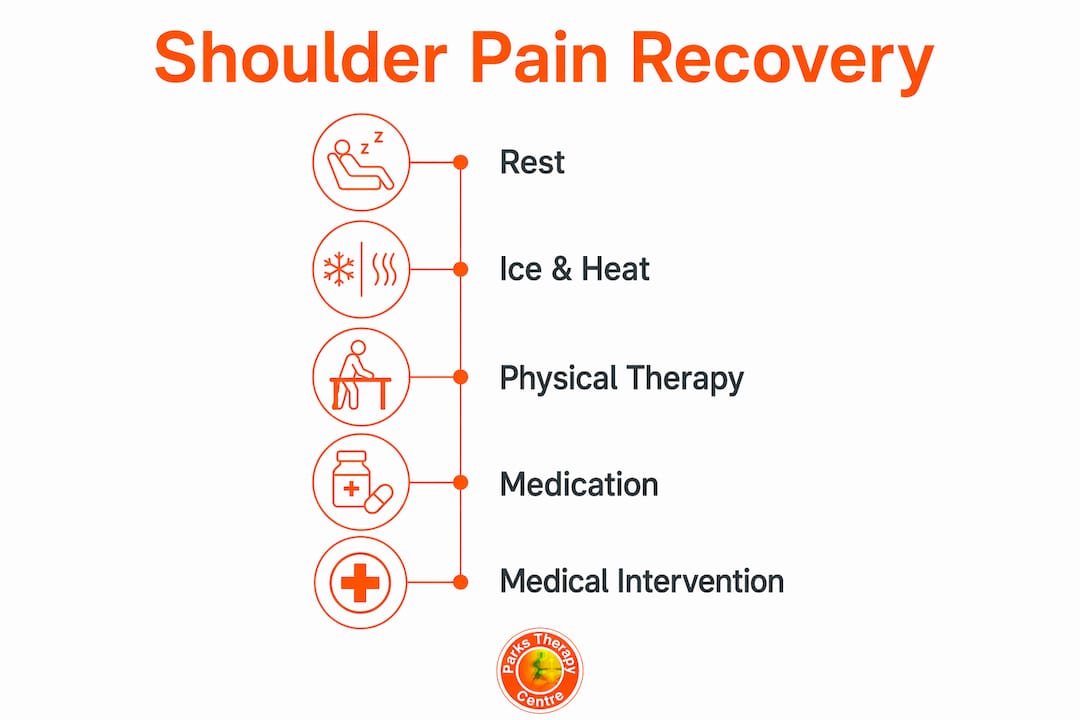
Physical therapy is the cornerstone of shoulder pain recovery. Its primary goals are restoring range of motion and rebuilding the strength and stability needed for daily activities. Starting early, even with very gentle movement, produces better outcomes than waiting until pain has fully resolved.
Shoulder rehabilitation follows a clear progression. Jumping straight to strengthening before mobility is restored is one of the most common errors. The sequence matters.
Pendulum exercises. Stand and let the affected arm hang freely. Gently swing it in small circles. This uses gravity rather than muscle effort to mobilise the joint without loading it.
Passive range of motion stretches. Use your unaffected arm or a pulley to guide the painful shoulder through its range. This restores movement without activating the injured structures under load.
Active assisted movement. Once passive range improves, begin moving the shoulder with light assistance. Wall slides and stick-assisted raises work well at this stage.
Isometric strengthening. Press the arm gently against a wall or door frame without moving the joint. This activates the rotator cuff muscles safely before adding dynamic load.
Resistance band exercises. External and internal rotation with a light resistance band rebuilds the rotator cuff. Start with a low-resistance band and increase only when you can complete 15 repetitions without pain during or after.
Light weight-bearing progressions. Dumbbell lateral raises and scapular retraction exercises restore full shoulder function. Keep weights light (1–3 kg) until strength is consistent.
Flare-ups during rehabilitation are common and do not mean you have caused damage. Graded exercise builds capacity over time, and short-term increases in discomfort are expected when progressing. The rule is: pain during exercise should settle within 24 hours. If it does not, reduce the load.
Pro Tip: Use a pain scale of 0–10 during each session. Staying between 3 and 5 during exercises is acceptable. Going above 5 consistently means the load or range is too great for that stage of recovery.
For a structured home programme, the physiotherapy home exercises guide from Parkstherapycentre covers mobility and strengthening progressions in detail.
When are injections or surgery the right option?
Medical interventions become appropriate when conservative management has not produced sufficient improvement. If shoulder function does not improve within 4–6 weeks, imaging and referral to a specialist is the recommended next step.
Imaging follows a specific order. Radiography (X-ray) is the correct first-line imaging choice for chronic shoulder pain, as confirmed by American College of Radiology 2026 guidelines. MRI is reserved for cases where X-rays are normal but soft tissue damage is suspected.
Corticosteroid injections are a common next step for persistent pain. They provide short-term relief lasting weeks to a few months, but carry risks including tendon weakening and, in rare cases, rupture. This means injections are a bridge to rehabilitation, not a standalone cure.
Steroid injections must never be administered directly into a tendon. Correct technique requires anaesthetic confirmation of placement and appropriate dosing. Improper injection into tendon tissue significantly increases rupture risk.
Surgical options are reserved for severe structural damage. Rotator cuff tears that fail to respond to conservative care, severe adhesive capsulitis, and shoulder instability from recurrent dislocations are the most common surgical indications. Recovery timelines post-surgery vary by procedure but typically range from three to six months of structured rehabilitation.
Key criteria for escalating beyond conservative care:
No meaningful improvement in pain or function after 4–6 weeks of consistent physiotherapy
Imaging confirming structural damage such as a full-thickness rotator cuff tear
Severe functional limitation affecting work, sleep, or daily activities
Recurrent dislocations or instability that physiotherapy alone cannot stabilise
How can you manage flare-ups and prevent chronic shoulder pain?
Acute flare-ups are a normal part of shoulder pain recovery. The key is responding correctly rather than stopping all activity. Maintaining movement in a painful shoulder, provided there is no fracture or dislocation, is critical to avoiding prolonged stiffness or frozen shoulder.
Adhesive capsulitis, commonly called frozen shoulder, is a serious complication of over-rest. Early physiotherapy can reduce recovery time to 6–9 months. Without it, the condition can persist for 18–42 months. That difference makes early movement one of the most clinically significant decisions in shoulder pain management.
Practical steps to manage flare-ups and reduce recurrence:
During a flare-up, return to ice for 15–20 minutes to control inflammation, then resume gentle movement once discomfort settles
Never apply ice directly to skin. Use a damp cloth or towel as a barrier to prevent ice burns
Correct your posture at a desk. Rounded shoulders and a forward head position increase load on the rotator cuff and subacromial space
Adjust your workstation so your screen is at eye level and your keyboard keeps your elbows at 90 degrees
Pace overhead activities. Painting a ceiling, stacking shelves, or swimming freestyle all load the shoulder in similar ways. Alternate tasks and take regular breaks
Seek professional assessment if pain is worsening after two weeks of self-care, if you cannot lift your arm above shoulder height, or if you experienced a sudden trauma
Pro Tip: Sleeping position has a large impact on shoulder recovery. A pillow placed under the affected arm while lying on your back reduces overnight joint compression and often cuts morning stiffness significantly.
What are the most common mistakes in shoulder pain treatment?
Over-resting is the single most damaging mistake in shoulder pain management. Complete immobilisation leads to joint stiffness, muscle wasting, and, in susceptible patients, frozen shoulder. The shoulder needs controlled, progressive movement to heal.
Rushing back to demanding activities is the opposite error. Returning to heavy lifting, overhead pressing, or throwing sports before the shoulder has rebuilt adequate strength causes reinjury and extends recovery by weeks or months. Premature return to overhead activities is one of the leading causes of flare-ups during rehabilitation.
Common errors to avoid:
Stopping all movement because of pain, without professional guidance confirming rest is necessary
Requesting or accepting steroid injections directly into tendons, which carries a significant rupture risk
Ignoring persistent or worsening symptoms beyond two weeks, which delays accurate diagnosis
Applying heat to a fresh injury in the first 48 hours, which increases swelling rather than reducing it
Skipping physiotherapy after an injection because pain has temporarily reduced, which allows the underlying problem to persist
Professional guidance matters most when you are unsure whether to push through pain or rest. A physiotherapist can distinguish between normal rehabilitation discomfort and a warning sign that requires investigation. Self-managing without that input often leads to the errors above.
Key takeaways
Effective shoulder pain recovery requires early movement, structured rehabilitation, and timely escalation to medical care when conservative treatment is insufficient.
Point | Details |
Start conservative care immediately | Rest, ice, NSAIDs, and gentle movement form the correct first response for most shoulder pain cases. |
Follow a graded exercise progression | Begin with pendulum and passive stretches before progressing to resistance band and weight-bearing exercises. |
Escalate after 4–6 weeks if needed | Request imaging and specialist referral if function has not improved within this timeframe. |
Avoid complete immobilisation | Keeping the shoulder still for too long risks frozen shoulder, which can take up to 42 months to resolve without treatment. |
Seek professional input early | A physiotherapist distinguishes safe rehabilitation discomfort from warning signs that need further investigation. |
What I have learned from years of shoulder pain cases
Shoulder pain is one of the most mismanaged conditions I see. Not because the treatment is complicated, but because patients consistently do one of two things: they stop moving entirely, or they push through pain that is telling them something important.
The clinical evidence is clear. Early, consistent physiotherapy produces better outcomes than waiting for pain to fully resolve before starting rehabilitation. Yet adherence to home exercise programmes remains the biggest practical challenge. Patients do the exercises for a week, feel improvement, and stop. Then the pain returns and they assume the treatment failed. It did not fail. The consistency failed.
The other pattern I notice is over-reliance on injections. A corticosteroid injection can be genuinely useful as a short-term tool to reduce pain enough to engage with physiotherapy. Used alone, without a structured rehabilitation programme following it, the relief lasts a few weeks and the problem returns unchanged. The injection is not the treatment. The rehabilitation is.
Patience is non-negotiable with shoulder conditions. Frozen shoulder, in particular, requires months of consistent work. Patients who understand the timeline from the start are far more likely to stay the course. Those who expect to be pain-free in two weeks often abandon treatment at exactly the point where it starts to make a real difference. For a deeper look at how rehabilitation protocols are structured, Parkstherapycentre has a detailed guide worth reading alongside this one.
— Ivan
Parkstherapycentre: specialist support for shoulder pain recovery
Parkstherapycentre has been delivering physiotherapy and musculoskeletal care across Bedfordshire and Buckinghamshire since 1986. The team specialises in shoulder pain assessment, personalised rehabilitation programmes, and sports injury treatment, with clinicians qualified to manage everything from acute rotator cuff strains to post-surgical recovery.
If your shoulder pain has not improved with self-care, or if you want a structured recovery plan from the start, Parkstherapycentre offers in-person and online booking across multiple locations. Insurance cover is accepted. The team builds individual treatment plans based on your specific diagnosis, activity level, and recovery goals. Book a consultation or find your nearest clinic at Parkstherapycentre.
FAQ
What is the best first treatment for shoulder pain?
Conservative management combining rest, ice, NSAIDs, and gentle movement is the recommended first-line approach for most shoulder pain cases. Start within the first 24–48 hours to reduce inflammation and prevent stiffness.
How long does shoulder pain take to recover?
Recovery time depends on the cause. Mild strains often improve within 2–4 weeks with consistent self-care. Frozen shoulder can take 6–9 months with early physiotherapy, or up to 42 months without it.
When should I see a doctor for shoulder pain?
Seek medical assessment if pain has not improved after two weeks of self-care, if you cannot lift your arm above shoulder height, or if the injury followed sudden trauma. Imaging and referral are recommended if function does not improve within 4–6 weeks.
Are corticosteroid injections safe for shoulder pain?
Corticosteroid injections are safe when administered correctly and provide short-term relief lasting weeks to a few months. They should never be injected directly into tendons due to rupture risk, and they work best when followed by a structured physiotherapy programme.
Can I exercise with shoulder pain?
Yes, in most cases. Gentle movement and graded exercise are preferable to rest for the majority of shoulder conditions. Pain during exercise should stay below a 5 out of 10 and settle within 24 hours. If it does not, reduce the load and consult a physiotherapist.
Recommended