
Types of musculoskeletal injuries: a practical guide
TL;DR:
Musculoskeletal injuries are common and vary from acute fractures to gradual overuse conditions, requiring specific treatment approaches.
Early recognition and conservative management, including physiotherapy and lifestyle modifications, are essential for optimal recovery and prevention.
Musculoskeletal injuries affect more people than most realise. Around 25% of adults experience one within any given 12-month period, and the vast majority are linked to physical activity or workplace demands. Yet many people struggle to name what type of injury they actually have, let alone understand what it means for their recovery. Knowing the different types of musculoskeletal injuries matters because each one has a distinct mechanism, a different set of signs, and a different path to getting better. This guide breaks them down clearly so you can understand what you are dealing with and what to do about it.
Table of Contents
Key takeaways
Point | Details |
Injury types vary significantly | Musculoskeletal injuries range from acute fractures and sprains to gradual overuse conditions requiring different treatments. |
Early symptoms are often missed | Muscle tightness and tingling are common early warning signs that, if ignored, can lead to long-term disability. |
Most pain is non-specific | Many musculoskeletal conditions have no single identifiable cause and require a biopsychosocial approach to manage effectively. |
Conservative care comes first | The majority of musculoskeletal injuries respond well to physiotherapy and rest before surgical options are considered. |
Workplace and lifestyle matter | Prolonged sitting, poor posture, and repetitive tasks are leading contributors to musculoskeletal pain across all age groups. |
1. Understanding the types of musculoskeletal injuries: a classification framework
Before you can understand any specific injury, it helps to understand how these injuries are grouped. A musculoskeletal injury is any damage to the muscles, bones, tendons, ligaments, joints, or nerves that support movement and structure in the body. That is a wide definition, which is exactly why classification matters.
Injuries are typically grouped by the tissue involved and the mechanism that caused them:
Acute traumatic injuries: caused by a single sudden event such as a fall, collision, or forceful impact
Overuse injuries: develop gradually from repetitive stress placed on a tissue without adequate rest or recovery
Non-specific conditions: persistent pain with no clearly identifiable structural cause, often influenced by lifestyle, posture, and psychological factors
Within these groups, you find more specific injury types: sprains, strains, fractures, dislocations, tendinopathies, bursitis, and nerve compressions. Understanding severity is equally important. Most injuries are graded from mild to severe, and that grading directly affects whether you need rest and physiotherapy or urgent medical intervention.
Pro Tip: If you are unsure which category your pain falls into, pay attention to how it started. A sudden onset during activity usually points to acute trauma, while gradual worsening over days or weeks suggests an overuse pattern.
2. Fractures: breaks in bone integrity
A fracture is any break or crack in a bone, ranging from a hairline stress fracture to a complete break with bone displacement. They are among the most recognisable musculoskeletal injury examples and can occur in virtually any bone in the body.
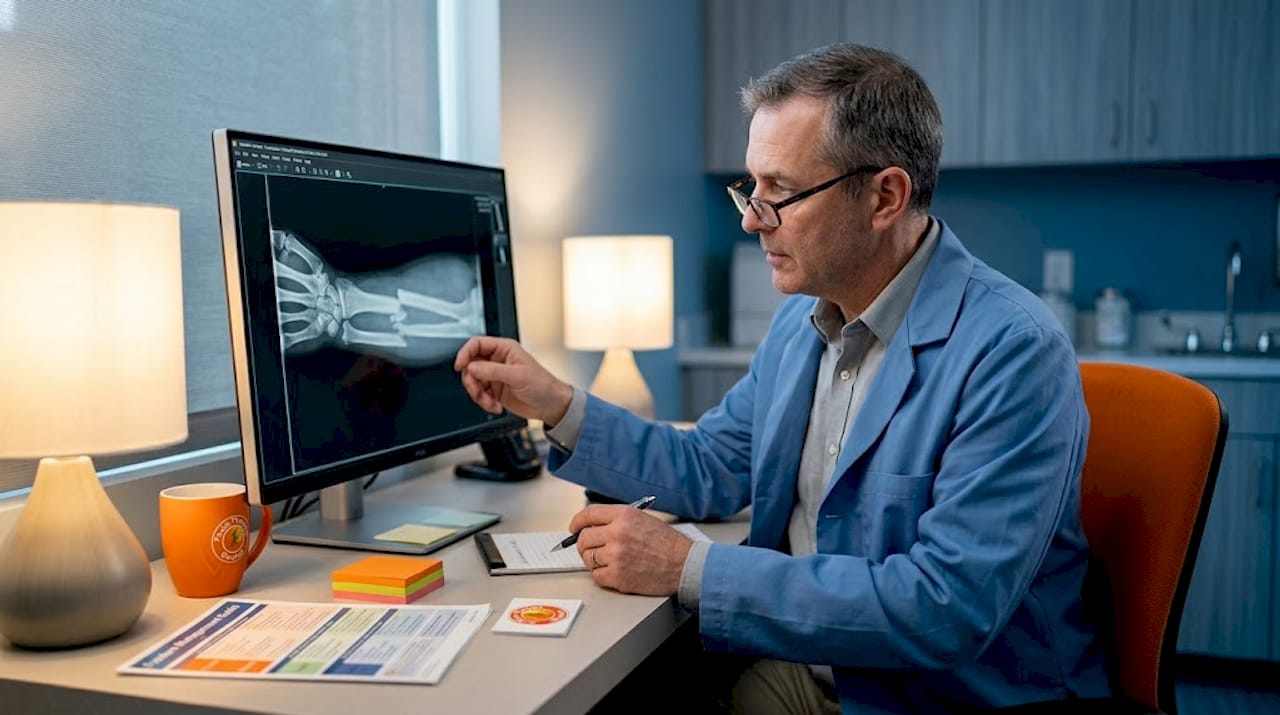
Closed fractures keep the skin intact, while open (compound) fractures involve bone breaking through the skin, carrying a higher risk of infection. Fractures are most commonly caused by high-impact trauma such as falls, road traffic accidents, or direct blows during sport. Stress fractures are the exception: they develop slowly from repeated loading on a bone that does not get sufficient recovery time, common in runners and military recruits.
Symptoms include immediate, sharp pain, visible deformity, swelling, bruising, and an inability to bear weight or use the limb. Proper limb management involves assessing circulation and sensation and immobilising the limb before hospital treatment to prevent further damage. Treatment ranges from casting and bracing to surgical fixation with plates or screws, depending on the fracture type and location.
3. Dislocations: joints forced out of position
A dislocation occurs when the bones forming a joint are forced apart or out of their normal alignment. This is one of the more urgent types of joint injuries because it can damage surrounding ligaments, nerves, and blood vessels simultaneously.
The shoulder is the most frequently dislocated joint, followed by the finger joints and the patella (kneecap). Causes include contact sports, falls onto an outstretched hand, and sudden twisting forces. Symptoms are hard to miss: severe pain, visible deformity, immediate swelling, and complete loss of joint movement.
Monitoring neurological and circulatory function during limb trauma is critical, as untreated circulation loss can lead to compartment syndrome, a serious complication. Dislocations require prompt medical reduction (the process of returning the joint to its correct position), followed by immobilisation and physiotherapy to restore stability and prevent recurrence.
4. Sprains: ligament injuries from excessive force
A sprain is damage to a ligament, the tough fibrous tissue that connects bone to bone and stabilises joints. Sprains are among the most common musculoskeletal injuries, particularly at the ankle, knee, and wrist.
They are graded by severity:
Grade 1: minor stretching of the ligament fibres with mild tenderness
Grade 2: partial tear with moderate pain, swelling, and some instability
Grade 3: complete rupture with significant swelling, bruising, and joint instability
The ankle sprain is the classic musculoskeletal injury example in sport and everyday activity. Mild sprained ankles typically heal within 6 to 8 weeks with rest, compression, and physiotherapy, though severe grade 3 injuries may require surgical repair.
Pro Tip: Returning to activity too quickly after a sprain is one of the most common reasons for re-injury. Full ligament healing takes longer than the pain disappearing. Completing a rehabilitation programme is not optional.
5. Strains: muscle and tendon overload
Where sprains affect ligaments, strains affect muscles or their connecting tendons. A strain occurs when muscle fibres are overstretched or torn, typically during explosive movements, heavy lifting, or sudden changes in direction.
Common sites include the hamstrings, lower back, calf, and rotator cuff. Like sprains, strains are graded 1 to 3 in severity. A grade 1 hamstring strain might cause mild tightness after a sprint, while a grade 3 tear involves a sudden, sharp pain, an audible pop, rapid bruising, and significant loss of function.
Strains are among the most common musculoskeletal injuries in both sport and manual labour. Treatment follows a similar pathway to sprains: initial rest and ice, followed by progressive loading through physiotherapy. Learning about sports injury management helps you understand why the progressive loading stage matters so much for full recovery.
6. Tendinopathy and tendonitis: overloaded tendons
Tendinopathy is an umbrella term for tendon pain and dysfunction, most often caused by overuse. Tendonitis refers specifically to inflammation, though most chronic cases involve tendon degeneration rather than active inflammation. This distinction matters because it changes how the condition should be treated.
Common sites include the Achilles tendon, rotator cuff, patella tendon, and the tendons around the elbow (often called tennis elbow or golfer’s elbow). The root cause is typically repetitive loading without adequate recovery time, poor technique, or a sudden increase in training volume or intensity.
Symptoms include localised pain that worsens with activity, stiffness in the morning, and reduced strength. Early recognition is the difference between a 6-week recovery and a 6-month one. Understanding the role of biomechanics in recovery is particularly relevant here, as faulty movement patterns are frequently the root cause of tendon overload.
7. Bursitis: inflammation of the fluid-filled sacs
Bursae are small, fluid-filled sacs that cushion bones, tendons, and muscles near joints. Bursitis occurs when these sacs become inflamed, usually from repetitive movement or sustained pressure on a joint. It is a frequently overlooked overuse condition that can mimic other types of joint injuries.
The most commonly affected sites are the shoulder, hip, knee, and elbow. Occupational tasks involving prolonged kneeling, heavy overhead work, or repetitive elbow pressure are classic contributors. Symptoms include a dull ache, swelling, warmth, and pain that worsens with movement or direct pressure.
Bursitis generally responds well to rest, anti-inflammatory strategies, and physiotherapy targeting the underlying cause. Corticosteroid injections are used in persistent cases, but addressing the biomechanical or postural trigger is what prevents recurrence.
8. Carpal tunnel syndrome and nerve compression injuries
Nerve compression injuries occur when a peripheral nerve is squeezed or irritated, most commonly within a narrow anatomical passage. Carpal tunnel syndrome, where the median nerve is compressed at the wrist, is the most well-known example, but nerve compression can occur at the spine, elbow, hip, and elsewhere.
Repetitive wrist movements, prolonged keyboard use, and vibrating tool operation are common occupational causes. Symptoms include tingling, numbness, burning, and weakness in the affected area. Crucially, these early warning signs are frequently ignored by people who attribute them to tiredness, only for the condition to worsen significantly over time.
Overuse injuries have a particularly high prevalence in people with neurological conditions. Shoulder pain affects 70 to 80% of spinal cord injury patients and 20 to 50% of stroke survivors. Management includes splinting, targeted physiotherapy, and in severe cases, surgical decompression.
9. Non-specific musculoskeletal pain: the most misunderstood category
Non-specific musculoskeletal conditions are those where pain persists without a clear structural cause. They account for a significant proportion of all musculoskeletal pain causes, particularly in the lower back and neck. Most musculoskeletal pain is non-specific and driven by a combination of physical, psychological, and social factors rather than a single injury.
Prolonged sitting overloads the neck and lower back in ways that are consistently underestimated as a health risk. Add in stress, poor sleep, and low physical activity, and you have a recipe for persistent pain that does not respond to standard treatment approaches.
The signs of musculoskeletal injury in this category are often subtle at first: muscle tightness, stiffness after sitting, recurring aches, or episodes of tingling. Workers frequently overlook these early symptoms, which is why so many cases progress to long-term disability. Management requires addressing the full picture, including ergonomics, movement habits, and psychological wellbeing. Understanding ergonomics in injury prevention is a practical starting point for anyone spending long hours at a desk.
The biopsychosocial model of pain recognises that musculoskeletal pain is rarely just a tissue problem. Sleep, stress, fear of movement, and occupational dissatisfaction all influence how pain is experienced and how well patients recover.
10. Comparing types of musculoskeletal injuries at a glance
Injury type | Common cause | Typical symptoms | Standard treatment |
Fracture | Trauma, stress loading | Sharp pain, deformity, inability to bear weight | Immobilisation, casting, or surgery |
Dislocation | Trauma, sudden force | Severe pain, visible deformity, no joint movement | Reduction, immobilisation, physiotherapy |
Sprain | Overstretching at joint | Swelling, bruising, instability | Rest, compression, physiotherapy |
Strain | Muscle overload or tear | Sudden pain, bruising, reduced strength | Rest, progressive loading, physiotherapy |
Tendinopathy | Repetitive overuse | Activity-related pain, morning stiffness | Load management, physiotherapy |
Bursitis | Repetitive pressure or movement | Ache, swelling, warmth near joint | Rest, anti-inflammatories, physiotherapy |
Nerve compression | Repetitive strain, posture | Tingling, numbness, weakness | Splinting, physiotherapy, decompression |
Non-specific pain | Posture, lifestyle, psychosocial | Diffuse ache, stiffness, recurring flare-ups | Interdisciplinary care, ergonomics, exercise |
Workplace injuries in particular carry substantial costs. Musculoskeletal injuries account for 30% of time-loss claims and over a quarter of all claim costs in workplace injury statistics, reinforcing why prevention and early management are so economically significant.
My perspective on recognising and treating musculoskeletal injuries
One thing I have seen repeatedly in clinical practice is that people underestimate how complex musculoskeletal injuries actually are. There is a common assumption that if something hurts, there must be a structural cause, and if the scan is clear, the pain is not real. Neither is true.
What I find most important is that people stop waiting for things to get bad before seeking help. The early signs, the muscle tightness, the tingling after long drives, the stiffness that takes an hour to wear off in the morning, these are the body’s way of flagging something that is still manageable. Ignore them long enough, and what was a 6-week problem becomes a 6-month one.
I also believe surgery is reached for too readily. Up to 36% of musculoskeletal surgeries may be unnecessary, and nearly 50% of patients report recurring pain after treatment when the underlying cause has not been addressed. Conservative management, done well and consistently, resolves the vast majority of cases. The issue is that it requires patient commitment and clinician thoroughness, not just a quick fix.
Take your symptoms seriously. Seek an accurate diagnosis. And do not skip the rehabilitation.
— Ivan
Get expert help for your musculoskeletal injury
Whether you are dealing with a fresh sprain, a nagging tendon issue, or persistent back pain you cannot quite explain, the right professional support makes an enormous difference to how quickly and completely you recover.
Parkstherapycentre has been providing specialist physiotherapy and musculoskeletal care since 1986 across Bedfordshire and Buckinghamshire. Their experienced team offers thorough assessment, diagnosis, and individually tailored treatment plans covering everything from acute trauma to chronic overuse conditions. If you are ready to understand your injury properly and get on the right path, explore musculoskeletal therapy and recovery or visit the Parkstherapycentre homepage to book your appointment.
FAQ
What is a musculoskeletal injury?
A musculoskeletal injury is any damage to the muscles, bones, tendons, ligaments, joints, or nerves that affect movement or structural support. They range from acute fractures and sprains to gradual overuse conditions like tendinopathy and carpal tunnel syndrome.
What are the most common musculoskeletal injuries?
The most common musculoskeletal injuries include ankle sprains, lower back strains, tendinopathy, and non-specific lower back pain. Around 25% of adults experience a musculoskeletal injury within a 12-month period, with the majority linked to physical activity.
What are the signs of a musculoskeletal injury?
Common signs include localised pain, swelling, bruising, reduced range of movement, stiffness, tingling, and weakness. Early symptoms such as muscle tightness and tingling are frequently overlooked but are important indicators of a developing condition.
How do you prevent musculoskeletal injuries?
Prevention involves maintaining good posture, using proper technique during physical tasks, building strength progressively, taking regular movement breaks from sedentary work, and addressing ergonomic risks in the workplace. Early reporting of symptoms is one of the most effective preventative steps.
How long does it take to recover from a musculoskeletal injury?
Recovery depends on the type and severity of the injury. Mild sprains typically resolve within 6 to 8 weeks with appropriate care, while more complex injuries such as tendinopathies or nerve compressions can take several months, particularly if underlying causes are not addressed.
Recommended