
What is patient-centered therapy: a clear guide
- Jun 29
- 8 min read

TL;DR:
Patient-centered therapy is a non-directive approach where the therapist offers empathy and unconditional positive regard, allowing the patient to lead their healing. The therapeutic alliance, based on trust and emotional safety, predicts treatment success more reliably than specific techniques. This model emphasizes shared decision-making and functional goals, especially in physiotherapy, to promote patient trust, resilience, and adherence.
Patient-centered therapy is a therapeutic approach where the patient leads their own healing process, supported by a therapist who offers empathy, unconditional positive regard, and congruence. The industry term for this model is person-centered therapy, developed by psychologist Carl Rogers from the 1940s onwards. The therapeutic alliance is the strongest predictor of positive treatment outcomes across all therapeutic modalities. That single finding explains why this approach has moved from the fringes of counselling into mainstream healthcare, including physiotherapy. Parkstherapycentre, established in 1986, applies these principles across its multidisciplinary services in Bedfordshire and Buckinghamshire.
What is patient-centered therapy and its core principles?
Patient-centered therapy, formally known as person-centered therapy, is defined by three core conditions: unconditional positive regard, congruence, and empathic understanding. Carl Rogers introduced these conditions in the 1940s, arguing that patients carry an inherent capacity for growth. The therapist’s role is to create the conditions that allow that growth to happen naturally.
Each condition serves a distinct purpose in the therapeutic relationship:
Unconditional positive regard means the therapist accepts the patient completely, without judgement or conditions. This acceptance removes the social pressure to perform or present a curated version of yourself.
Empathic understanding is an active effort to grasp the patient’s inner world from their perspective. It is not sympathy. Sympathy observes distress from the outside; empathy steps inside it.
Congruence means the therapist is genuine and transparent. A congruent therapist does not hide behind professional distance or rehearsed responses.
The approach is non-directive by design. The patient chooses what to explore, at what pace, and in what depth. This is where a common confusion arises: non-directive does not mean passive. The therapist actively creates emotional safety through intense listening, supporting patient self-exploration without correction or steering. That is a demanding, skilled activity.
A secondary distinction worth knowing: patient-centered care in medical and physiotherapy contexts focuses on functional health outcomes. Person-centered care in psychotherapy focuses on the entire life and meaning of the individual. Both share the same philosophical roots, but their scope and goals differ. Parkstherapycentre applies the patient-centered model across both contexts, tailoring the emphasis to the clinical setting.

Pro Tip: If you are new to therapy, ask your therapist directly whether they work in a directive or non-directive way. Knowing this upfront helps you understand why sessions may feel different from what you expected.
How does patient-centered therapy differ from other approaches?
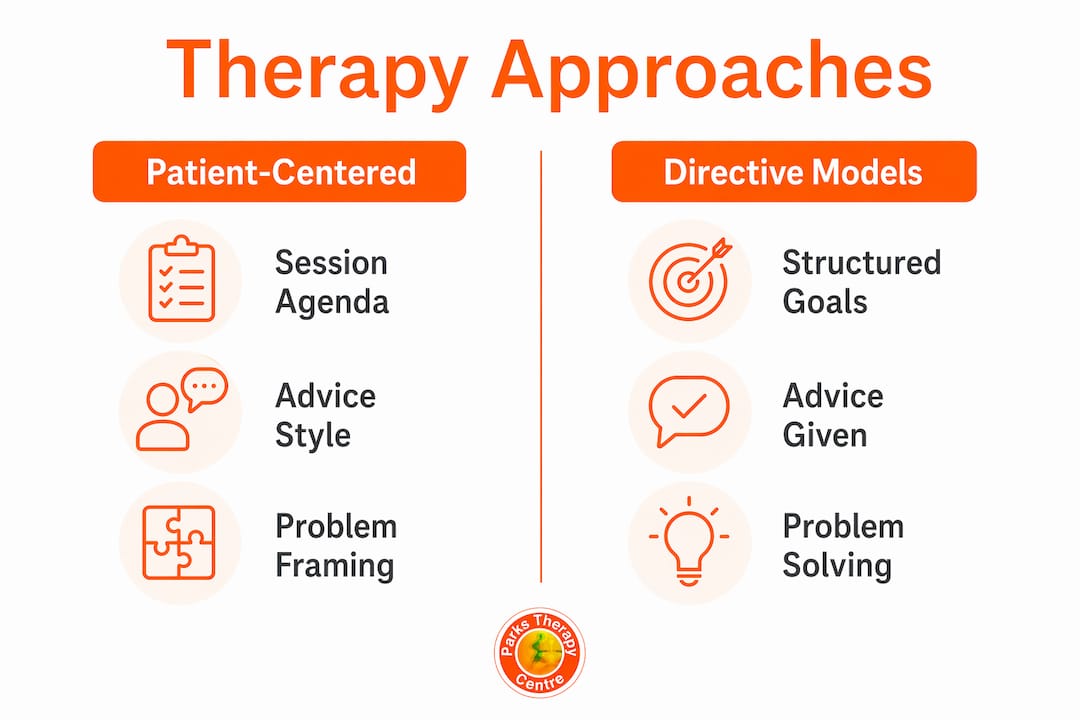
The clearest contrast is with directive models such as Cognitive Behavioural Therapy (CBT). CBT is structured, goal-focused, and therapist-guided. The therapist sets exercises, challenges thought patterns, and tracks progress against defined targets. Patient-centered therapy inverts this entirely. The patient sets the agenda, and the therapist follows.
Feature | Patient-centered therapy | Directive models (e.g. CBT) |
Session agenda | Set by the patient | Set by the therapist |
Therapist role | Facilitator and witness | Adviser and instructor |
Goal structure | Emergent and patient-led | Predefined and measurable |
Advice given | Deliberately avoided | Central to the method |
Pace of progress | Patient-controlled | Structured by programme |
Therapists deliberately avoid giving advice in non-directive models to maintain patient ownership of the process. Early sessions often focus on building trust rather than working through clinical checklists. This can feel slow to patients accustomed to structured healthcare appointments, but that trust-building phase is the foundation of everything that follows.
The difference also shows up in how problems are framed. Directive models treat presenting issues as problems to solve. Patient-centered therapy treats them as experiences to understand. A patient with anxiety in CBT learns techniques to manage anxious thoughts. The same patient in person-centered therapy explores what the anxiety means, where it comes from, and what it says about their values and needs.
This is not a competition between superior and inferior methods. Different presentations call for different approaches. The distinction matters because patients who expect advice and structure from a non-directive therapist often misread the silence as indifference, when it is actually skilled, purposeful attention.
Pro Tip: If early sessions feel unstructured or slow, that is normal in patient-centered therapy. The therapist is building the safety that makes deeper work possible later.
What are the benefits of patient-centered therapy for patients?
The benefits of patient-centered therapy extend well beyond symptom relief. The therapeutic alliance quality is the most reliable predictor of success, and breakthroughs often occur when patients feel safe to exist and be heard without performance pressure. That safety is the mechanism, not a pleasant side effect.
Key benefits patients report include:
Reduced pressure to perform. Person-centred counselling often surprises patients with the realisation that they do not need to be “fixed.” Removing that expectation frees up significant emotional energy.
Improved self-trust. When patients lead their own sessions, they practise making decisions about their inner life. Over time, this builds genuine confidence in their own judgement.
Clarity of values. Exploring experience without a therapist directing the narrative helps patients identify what actually matters to them, rather than what they think should matter.
Resilience. The self-understanding developed in patient-centered therapy tends to be durable. Patients carry the insights with them rather than depending on a therapist to apply a technique.
Flexibility. The approach applies across a wide range of concerns, from anxiety and depression to relationship difficulties, grief, and identity questions.
“Breakthroughs often occur not when a problem is solved, but when a patient feels genuinely safe to be heard without any pressure to perform or improve.”
The importance of patient-centered therapy also shows up in treatment adherence. Patient-centred care combats the historical paternalistic healthcare model by ensuring care is relevant to the patient’s actual life. When patients feel heard and involved, they are far more likely to follow through with treatment. That is a measurable, practical benefit, not just a philosophical preference.
How is patient-centered therapy applied in physiotherapy?
Patient-centered care in physiotherapy represents a significant shift from the traditional practitioner-led model. Historically, a physiotherapist would assess, diagnose, and prescribe a treatment plan with limited input from the patient. The shift to patient-centred care moves away from that paternalism, placing the patient as an active partner in their own recovery.
By 2025–2026, patient-centred care has become a core professional standard in physiotherapy across many jurisdictions. This means shared decision-making is now an expectation, not an optional extra. A physiotherapist working to this standard explains the reasoning behind each treatment choice, invites the patient’s preferences, and adjusts the plan accordingly.
The practical application looks like this in a physiotherapy context:
Element | Traditional model | Patient-centered model |
Treatment planning | Clinician decides | Shared decision-making |
Goal setting | Clinician-defined | Aligned with patient’s life goals |
Patient education | Information delivered | Collaborative, two-way dialogue |
Progress review | Clinical measures only | Patient experience included |
Adherence strategy | Instructions given | Patient ownership built in |
Functional goals are central to this model. Rather than setting a target of “reduce pain by 50%,” a patient-centered physiotherapist asks: “What do you want to be able to do that you cannot do now?” The answer shapes the entire treatment plan. A patient who wants to return to playing football has different priorities from one who wants to carry their grandchildren. Both may have the same diagnosis, but their care plans should look different.
Patient education also changes character in this model. It becomes a dynamic, collaborative process rather than a one-way transfer of clinical information. The physiotherapist explains, the patient questions, and the plan evolves through genuine dialogue. Parkstherapycentre’s approach across its Bedfordshire and Buckinghamshire locations reflects these current professional standards, integrating patient values and preferences into every stage of treatment.
The distinction between patient-centered and person-centered care matters here. In physiotherapy, the focus is on functional health outcomes: what the patient can do, how they move, and how their condition affects daily life. In psychotherapy, person-centered care extends to the whole person, their identity, relationships, and sense of meaning. Understanding this difference helps patients know what to expect from each type of care.
Key takeaways
Patient-centered therapy works because the therapeutic alliance, built on empathy, unconditional positive regard, and congruence, is the strongest predictor of positive outcomes across all treatment settings.
Point | Details |
Core conditions | Unconditional positive regard, empathy, and congruence define patient-centered therapy. |
Non-directive is active | Avoiding advice is a skilled technique that builds patient ownership and emotional safety. |
Therapeutic alliance | The quality of the patient-therapist relationship predicts outcomes more reliably than any technique. |
Physiotherapy application | Shared decision-making and functional goal-setting are now professional standards in patient-centred physiotherapy. |
Key patient benefit | Patients develop self-trust and resilience that outlast the therapy itself. |
Why the therapeutic alliance matters more than the method
The conversation about patient-centered therapy often gets stuck on technique. Practitioners debate non-directiveness, the precise meaning of congruence, and whether unconditional positive regard is achievable in practice. In my experience, that debate misses the point.
What actually changes a patient’s life is whether they feel genuinely safe in the room. Not comfortable, not entertained, but safe enough to say the thing they have never said out loud. That safety is the product of the therapeutic alliance, and the alliance is built through the three core conditions Rogers identified. The method is the vehicle. The relationship is the destination.
I have also noticed that patients new to non-directive care often interpret the therapist’s silence as a lack of expertise. They expect advice, a plan, a set of tools. When none arrives, they assume something is wrong. The opposite is true. A therapist who resists the urge to fix, advise, or redirect is doing something far harder than prescribing a technique.
The confusion between patient-centered and person-centered care is worth addressing directly. In physiotherapy, the patient-centered model focuses on functional outcomes and shared decision-making. In counselling, the person-centered model addresses the whole person. Both are valid. Both are grounded in the same respect for patient autonomy. Patients benefit from knowing which model applies to their setting, so they can engage with it fully rather than waiting for something that will not come.
The future of patient-centered approaches lies in multidisciplinary therapy models that carry these principles across every discipline involved in a patient’s care. When a physiotherapist, a counsellor, and a podiatrist all share the same commitment to patient autonomy and shared decision-making, the effect compounds. That is where the real gains are.
— Ivan
Patient-centered care at Parkstherapycentre
Parkstherapycentre has built its practice around the principles described in this article since 1986. Every patient who comes through the door in Bedfordshire or Buckinghamshire is treated as an active participant in their own recovery, not a passive recipient of clinical decisions.
The centre’s multidisciplinary team, covering physiotherapy, sports injury treatment, acupuncture, and podiatry, applies shared decision-making and functional goal-setting as standard. Treatment plans are built around what matters to you, not just what a diagnosis suggests. If you are ready to experience patient-focused physiotherapy that takes your values and goals seriously, Parkstherapycentre offers online booking and accepts most insurance providers. Your recovery starts with being heard.
FAQ
What is the patient-centered care definition in simple terms?
Patient-centered care is a model where the patient’s values, preferences, and goals actively shape their treatment plan. The clinician acts as a partner rather than a sole decision-maker.
How does patient-centered therapy work in practice?
The therapist creates emotional safety through empathy, unconditional acceptance, and genuine presence, then follows the patient’s lead on what to explore. Sessions are non-directive, meaning the patient sets the agenda.
What is the difference between patient-centered and person-centered therapy?
Patient-centered care focuses on functional health outcomes in medical settings, while person-centered therapy addresses the whole person, including identity, relationships, and meaning. The terms are related but not interchangeable.
What are the main benefits of patient-centered therapy?
The core benefits include reduced performance pressure, improved self-trust, greater clarity of personal values, and stronger treatment adherence. The therapeutic alliance built through this approach is the most reliable predictor of positive outcomes.
Is patient-centered care used in physiotherapy?
Patient-centred care is now a professional standard in physiotherapy across many jurisdictions. It involves shared decision-making, functional goal-setting aligned with the patient’s life, and collaborative patient education throughout treatment.
Recommended