
Why choose acupuncture for neck pain: 2026 guide

TL;DR:
Acupuncture effectively reduces neck pain by modulating pain signals and addressing root causes through structured courses. It has a strong evidence base, a low risk profile, and benefits are enhanced when combined with body assessments and lifestyle modifications. Consistent treatment over several weeks, along with holistic care, yields the most durable relief.
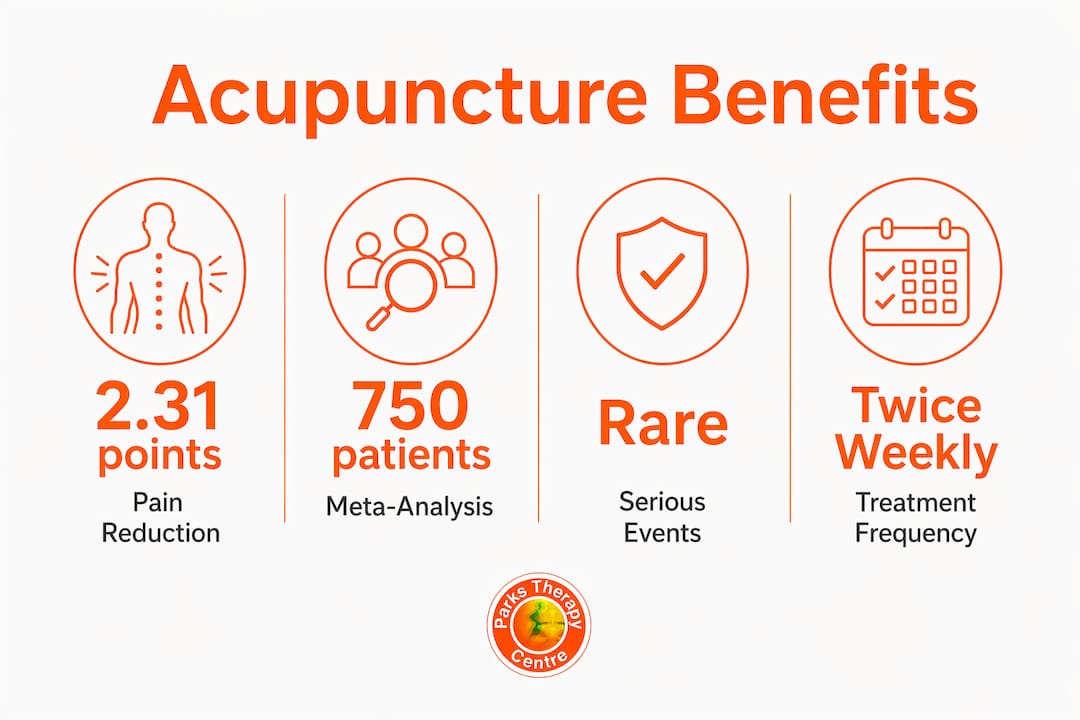
Acupuncture is a clinically supported treatment for neck pain that reduces both pain intensity and muscle tension without medication. A meta-analysis of 17 randomised controlled trials found it lowered pain scores by 2.31 points on average, with results reaching high statistical significance. If you are asking why choose acupuncture for neck pain over other options, the answer lies in its evidence base, its low risk profile, and its ability to address the root causes of discomfort rather than masking symptoms. Parkstherapycentre has delivered acupuncture care since 1986, and this guide draws on current research to help you make an informed decision.
Why choose acupuncture for neck pain: what the evidence shows
Acupuncture produces measurable, clinically meaningful pain relief for neck pain. The meta-analysis covering 750 patients reported a VAS score reduction of 2.31 points, a threshold widely regarded as clinically significant. That figure means patients do not just feel slightly better. They report a genuine, noticeable shift in daily comfort and function.
Comparative studies reinforce this picture. Acupuncture outperformed ultrasound therapy in treating myofascial pain of the upper trapezius, with post-treatment pain scores significantly lower in the acupuncture group. Ultrasound therapy is a standard physiotherapy modality, so beating it on pain outcomes is a meaningful benchmark.
International clinical guidelines now recommend acupuncture as a safe, non-pharmacological option for chronic pain management, particularly where conventional treatments produce limited results or unwanted side effects. That endorsement reflects decades of accumulated trial data, not a single promising study.
The safety profile is equally compelling. Serious adverse events from acupuncture are rare when treatment is delivered by a qualified practitioner. For patients who want to avoid long-term reliance on anti-inflammatory medication or muscle relaxants, acupuncture offers a credible, lower-risk path.
Measure | Acupuncture result |
Average VAS pain reduction | 2.31 points (p < 0.00001) |
Myofascial pain score change | 7.13 to 3.43 after 4 weeks |
Comparative efficacy | Superior to ultrasound therapy (p = 0.046) |
Guideline status | Recommended by multiple international bodies |
How does acupuncture work to relieve neck pain?
Acupuncture works through two complementary frameworks: traditional Chinese medicine and modern neuroscience. Both explain why fine needles placed at specific points reduce pain, but the neuroscience account is now backed by neuroimaging.

From a traditional perspective, acupuncture regulates the flow of Qi through meridian pathways. Points along the Gallbladder, Bladder, and Small Intestine meridians are commonly used for neck and shoulder tension. The practitioner aims to restore balance and remove obstruction in these channels. Many patients find this framework intuitive, even if they have no prior knowledge of Chinese medicine.
The neurobiological explanation is equally persuasive. Neuroimaging studies show that acupuncture modulates activity in the anterior cingulate cortex and thalamus, two brain regions central to pain processing. This is not a placebo response. It is a measurable change in how the brain registers and amplifies pain signals.
Acupuncture also modulates the neuroendocrine immune network. This means it influences the release of endorphins, reduces local inflammation, and calms the nervous system’s heightened pain response. Understanding how acupuncture relieves pain at this level helps explain why its effects often outlast the session itself.
A key concept in treatment is the deqi sensation: a dull ache, warmth, or heaviness felt when a needle reaches the correct depth and location. Practitioners regard deqi as a sign of effective needle stimulation. Both local points near the neck and distal points on the hands, feet, or lower limbs may be used, depending on the pattern of pain.
Local points (e.g., GB 21, BL 10, SI 3): target muscle tension and restricted movement directly in the neck and shoulder region
Distal points (e.g., LI 4, GB 34): influence pain pathways through the nervous system from a distance, often producing rapid relief
Trigger point needling: targets tight muscle bands within the trapezius, levator scapulae, and suboccipital muscles to release chronic guarding
Pro Tip: If you feel a dull, spreading sensation during needling, tell your practitioner. That deqi response is a positive sign, not a reason for concern.
What should patients expect during an acupuncture course?
A single acupuncture session rarely resolves chronic neck pain. Structured courses over four weeks or more enable the physiological shifts that underpin sustained relief. Patients who commit to a full course consistently report better outcomes than those who attend one or two sessions and stop.
A typical course for neck pain follows this structure:
Initial assessment: the practitioner takes a full history, assesses posture, range of movement, and identifies contributing factors such as stress or sleep quality.
First 1–2 sessions: gentle needling to gauge your response, with shorter needle retention times if you are new to treatment.
Sessions 3–8: needle retention of 20–30 minutes per session, twice weekly where possible, with progressive reassessment of pain scores and function.
Adjunct modalities: gua sha, cupping, or electroacupuncture may be introduced to break chronic pain cycles and accelerate recovery.
Maintenance phase: once pain is well managed, monthly or bi-monthly sessions help prevent recurrence.
Frequency matters. Patients treated twice weekly for four weeks showed pain scores dropping from 7.13 to 3.43, a reduction of more than half. Spreading sessions too far apart slows this accumulation of benefit.
Realistic expectations are part of good care. Some patients feel significant relief after two or three sessions. Others need six or more before noticing a clear shift. Your practitioner should reassess your progress at regular intervals and adjust the approach accordingly.
Pro Tip: Keep a brief pain diary between sessions. Note your pain score each morning and evening. This gives your practitioner concrete data to guide treatment decisions and helps you see progress that can be easy to overlook day to day.
Reading about your first acupuncture session before you attend can reduce anxiety and help you get more from the experience.
Why does treating the whole body matter for neck pain?
Neck pain rarely originates in the neck alone. Restrictions in the hips, back, or jaw frequently drive compensatory tension that accumulates in the cervical spine and upper trapezius. Treating only the neck in these cases produces temporary relief at best.
Orthopaedic acupuncture addresses the full kinetic chain. This means assessing how the pelvis tilts, how the thoracic spine moves, and whether jaw tension is feeding into suboccipital tightness. When these patterns are identified and treated, the neck often releases more fully than it would from local needling alone.
Treating the neck in isolation is like fixing a leak by mopping the floor. Effective acupuncture for neck pain means following the tension back to its source, whether that is a stiff hip, a tight jaw, or a thoracic spine that stopped rotating months ago.
Posture and stress are equally significant contributors. Prolonged screen use loads the cervical spine with forces far beyond its resting weight. Psychological stress raises cortisol and keeps the nervous system in a state of heightened alertness, which directly increases muscle tone and pain sensitivity. Acupuncture addresses both the physical and the neurological dimensions of this pattern.
Combining acupuncture with ergonomic adjustments and stress management produces better long-term results than needling alone. Practical steps include:
Adjusting screen height so the top of the monitor sits at eye level
Taking a two-minute movement break every 45 minutes of desk work
Practising diaphragmatic breathing to reduce resting muscle tension
Addressing sleep position, as forward-head posture during sleep perpetuates daytime tension
Acupuncture benefits for muscle tension extend well beyond the session itself when patients make these supporting changes.
Who is most likely to benefit from acupuncture for neck pain?
Acupuncture works best for specific types of neck pain. Knowing whether your condition fits the profile helps you set realistic expectations before starting treatment.
Conditions that respond well include:
Myofascial neck pain: tight, tender muscle bands in the trapezius, levator scapulae, or sternocleidomastoid
Tension-type neck pain: diffuse aching linked to stress, poor posture, or prolonged static loading
Postural neck pain: discomfort driven by forward-head posture, often called “tech neck”
Chronic neck pain: persistent pain lasting more than 12 weeks, particularly where medication has provided limited relief
Acupuncture is less suited to acute traumatic injury, serious neurological symptoms such as progressive arm weakness or loss of bladder control, or conditions requiring urgent surgical assessment. A qualified practitioner will screen for these red flags at your first appointment.
Acupuncture is best approached as a conservative treatment that complements rather than replaces other care. Combining it with physiotherapy, exercise, and ergonomic changes produces the most durable outcomes. Patients who treat it as a standalone fix and make no lifestyle changes tend to see benefits fade more quickly.
Consulting a practitioner with specific experience in musculoskeletal acupuncture is the most important step. Technique, point selection, and clinical reasoning vary considerably between practitioners, and these differences affect outcomes.
Key takeaways
Acupuncture reduces neck pain through measurable neurobiological mechanisms, and structured courses of four weeks or more produce the most durable results.
Point | Details |
Strong clinical evidence | A meta-analysis of 750 patients found acupuncture reduces neck pain VAS scores by 2.31 points. |
Neurobiological mechanism | Acupuncture modulates the anterior cingulate cortex and thalamus, changing how the brain processes pain. |
Course length matters | Twice-weekly sessions over four or more weeks produce significantly better outcomes than one-off treatment. |
Whole-body assessment | Treating hips, back, and jaw alongside the neck addresses root causes and reduces recurrence. |
Best-fit conditions | Myofascial, tension-type, and postural neck pain respond most reliably to acupuncture treatment. |
What I have learned treating neck pain with acupuncture
The patients who get the most from acupuncture are rarely the ones in the most pain. They are the ones who show up consistently, communicate openly, and make the small daily changes their practitioner recommends. I have seen patients with severe, years-long neck tension recover well, and patients with mild discomfort plateau, and the difference almost always comes down to engagement with the process.
The biggest misconception I encounter is that acupuncture is a passive treatment. You lie down, needles go in, pain goes away. That is not how it works. The needling creates a window of neurological change. What you do in that window, how you move, how you manage stress, how you sit at your desk, determines whether the change sticks.
I also find that patients who understand the whole-body picture respond better. When someone realises their neck pain is partly driven by a stiff thoracic spine or a jaw they clench at night, they stop expecting the neck to fix itself in isolation. That shift in understanding is often the turning point.
Acupuncture is not a miracle treatment, and I would not describe it as one. It is a well-evidenced, low-risk option that works best when it is part of a broader plan. The practitioners who deliver the best outcomes are the ones who assess the full picture, adjust the approach as treatment progresses, and are honest when a different intervention is needed.
— Ivan
Acupuncture for neck pain at Parkstherapycentre
Parkstherapycentre has provided acupuncture care across Bedfordshire and Buckinghamshire since 1986. The team includes practitioners experienced in musculoskeletal acupuncture, orthopaedic assessment, and the integration of adjunct modalities such as gua sha and cupping.

Every patient receives an individual assessment before treatment begins. Practitioners identify contributing factors across the full kinetic chain, not just the neck, and build a course of treatment around your specific pattern of pain. Parkstherapycentre accepts insurance cover and offers online booking for convenience. If you are ready to take a structured, evidence-based approach to neck pain relief, visit the acupuncture services page to book your initial consultation.
FAQ
Is acupuncture effective for neck pain?
Yes. A meta-analysis of 17 randomised controlled trials found acupuncture significantly reduces neck pain, with an average VAS score reduction of 2.31 points. International clinical guidelines recommend it as a safe, non-pharmacological option for chronic pain.
How many acupuncture sessions are needed for neck pain?
Most patients need a structured course of at least four weeks, with sessions twice weekly. Research shows pain scores can drop from 7.13 to 3.43 over this period, but individual response varies and ongoing reassessment guides the total number of sessions.
Does acupuncture hurt?
Most patients feel minimal discomfort during needling. The deqi sensation, a dull ache or warmth at the needle site, is a normal and expected part of effective treatment, not a sign that something is wrong.
Can acupuncture help with tension headaches linked to neck pain?
Yes. Acupuncture targeting the upper trapezius, suboccipital muscles, and cervical trigger points frequently reduces both neck pain and associated tension headaches, as these conditions share overlapping muscular and neurological pathways.
Should I combine acupuncture with physiotherapy for neck pain?
Combining acupuncture with physiotherapy, exercise, and ergonomic changes produces more durable outcomes than either treatment alone. Acupuncture is best used as part of a broader care plan rather than as a standalone intervention.
Recommended