
Benefits of physiotherapy for foot pain: 7 key gains
TL;DR:
Physiotherapy offers lasting relief for foot pain by combining manual therapy and targeted exercises that address the root mechanical causes. It enhances pain reduction, improves foot and ankle mobility, and retrains muscle function, supported by personalized home programmes for sustained results. Consistent adherence to prescribed exercises is essential for optimal recovery and long-term pain prevention.
Physiotherapy is the most clinically supported treatment for foot pain, delivering measurable improvements in pain levels, mobility, and function through targeted manual therapy, structured exercise, and adjunct modalities. The benefits of physiotherapy for foot pain extend well beyond temporary relief. Recent 2026 systematic reviews and randomised controlled trials confirm that combining in-clinic techniques with home exercise programmes produces outcomes that neither approach achieves alone. Whether you are managing plantar fasciitis, flexible flatfoot, or general heel pain, physiotherapy addresses the root mechanical cause rather than masking symptoms.
1. Significant pain relief through targeted clinical techniques
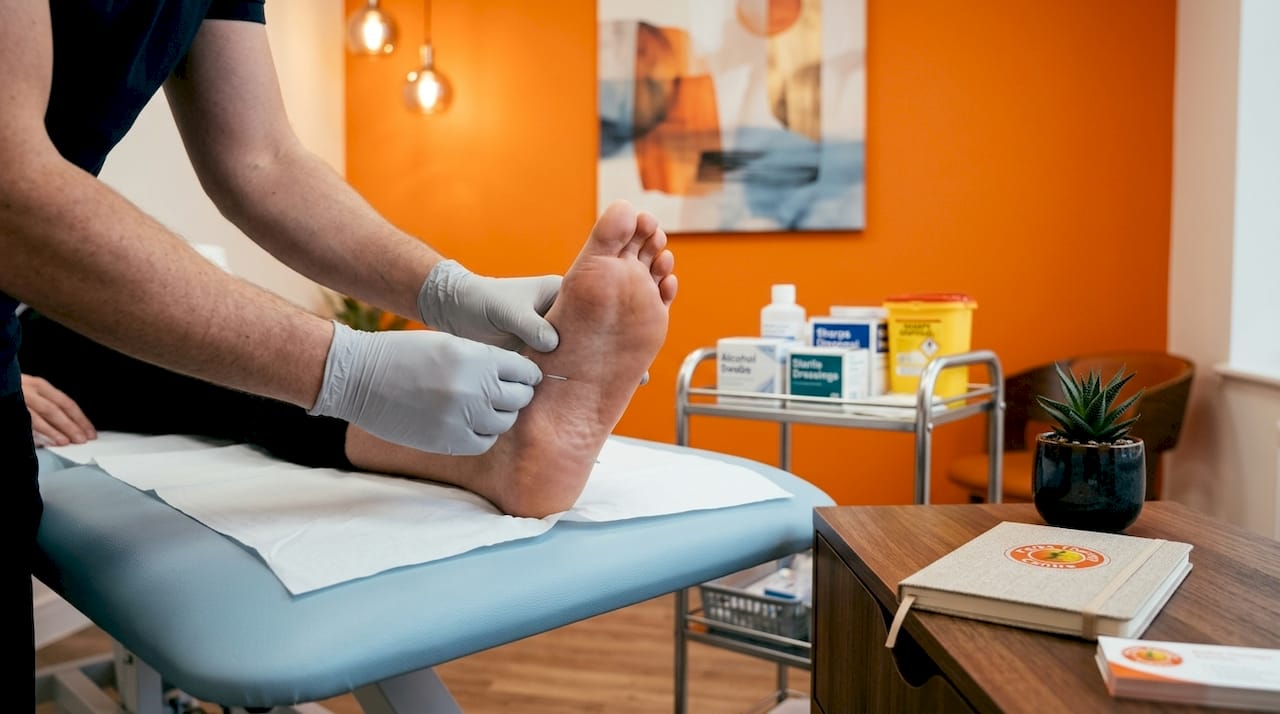
Pain reduction is the most immediate and measurable benefit physiotherapy delivers for foot conditions. Dry needling, low-level laser therapy, and manual therapy combined with home exercise produce standardised mean difference improvements of SMD −1.26 to −1.54 in short-term plantar fasciitis pain. That range represents a clinically significant reduction, meaning most patients notice a real difference in daily comfort within weeks. Dry needling effects are also sustained into the medium term, typically between six and twelve weeks, which distinguishes it from purely symptomatic treatments.
The evidence-based pain relief methods used in physiotherapy work by disrupting pain signalling, reducing local tissue irritability, and restoring normal movement patterns that reduce mechanical load on painful structures.
2. Improved ankle and foot mobility
Restricted ankle dorsiflexion is one of the most common mechanical contributors to foot pain, particularly in plantar fasciitis and Achilles-related conditions. Physiotherapy addresses this directly through joint mobilisation techniques that restore normal joint mechanics and increase range of motion. Joint-oriented manual therapy improves ankle dorsiflexion range of motion in ways that soft-tissue techniques alone do not replicate. Greater dorsiflexion reduces strain on the plantar fascia during walking and running, which breaks the cycle of re-injury.
Improved mobility also translates to better gait mechanics. When your ankle moves freely, your knee, hip, and lower back are no longer compensating for restricted foot movement, reducing pain higher up the kinetic chain.
3. Restoration of foot biomechanics through muscle training
Physiotherapy goes beyond symptom relief to retrain the way your foot functions. Intrinsic foot muscle strengthening, particularly through short foot exercises, is a key component of managing arch-related pain such as flexible flatfoot. These small muscles control arch height and foot stiffness during weight-bearing, and when they are weak or poorly coordinated, the arch collapses under load.
Short foot exercises require you to shorten the foot by drawing the ball of the foot towards the heel without curling the toes. This isolates the intrinsic muscles effectively and, when practised consistently, produces measurable improvements in arch height, balance, and pain levels. Physiotherapists at Parkstherapycentre prescribe these exercises as part of a progressive loading programme tailored to your specific foot type.
Pro Tip: Practise short foot exercises in a seated position first, then progress to standing and single-leg variations as strength improves. This gradual loading approach reduces the risk of overloading a weakened arch too quickly.
4. Reduction of inflammation and soft-tissue stiffness
Soft-tissue-oriented manual therapy modulates muscle tone, elasticity, and local tissue stiffness in ways that joint mobilisation does not. Soft-tissue therapy reduces muscle stiffness and improves elasticity in the lower limb, which is particularly relevant when tight calf muscles or restricted plantar fascia tissue are driving pain. Understanding the role of soft tissue therapy in managing these mechanical contributors helps explain why hands-on treatment produces faster relief than exercise alone in the early stages.
Adjunct modalities such as low-level laser therapy and therapeutic ultrasound further reduce local inflammation and promote tissue healing. These are not standalone treatments but work best when integrated into a broader physiotherapy plan that includes exercise and load management.
5. Enhanced balance and fall prevention
Foot pain disrupts proprioception, the body’s ability to sense position and movement. When the plantar surface of the foot is painful or mechanically compromised, the sensory signals it sends to the brain become unreliable, reducing balance and increasing fall risk. Physiotherapy addresses this through targeted balance and neuromuscular training, which restores proprioceptive accuracy alongside strength and mobility gains.
Short foot exercises and physiotherapy interventions for flexible flatfoot consistently show improvements in balance outcomes, not just pain scores. This matters particularly for older adults, where a foot pain-related fall can have serious consequences. Parkstherapycentre’s physiotherapists incorporate balance retraining into foot pain programmes as standard, rather than treating it as an optional add-on.
6. Faster return to daily activities and exercise
Functional recovery, meaning the ability to walk, stand, climb stairs, and exercise without pain, is the practical goal most patients prioritise. Physiotherapy accelerates this by addressing the specific mechanical impairments that limit function rather than simply advising rest. Education, load management, stretching, and strengthening combined form the practical physiotherapy framework for foot pain management, and this combination consistently outperforms passive approaches such as rest alone.
Load management is particularly important. Rather than stopping all activity, physiotherapy teaches you how much load your foot can tolerate at each stage of recovery and how to progress that load safely. This approach keeps you active, maintains cardiovascular fitness, and prevents the deconditioning that often follows prolonged rest.
7. Personalised home exercise programmes that sustain results
The benefits gained in clinic are only preserved if you continue working on the underlying impairments between sessions. ICT-based home exercise programmes deliver real-time feedback and multimedia support, producing clinically meaningful improvements and higher recovery rates than paper handout programmes in heel pain syndrome. This finding reflects a broader truth: the quality and consistency of your home exercise programme determines how much of your in-clinic progress you retain.
Physiotherapy benefits require adherence to repeated loading and mobility work over weeks, with research prescribing three daily exercise sessions over twelve weeks for heel pain syndrome. That frequency sounds demanding, but each session typically takes under ten minutes once you know the exercises. The top physiotherapy home exercises for foot recovery include plantar fascia-specific stretching, eccentric Achilles loading, and short foot exercises, all of which can be performed at home without equipment.
Pro Tip: Set three daily phone reminders for your foot exercises rather than relying on memory. Consistency over twelve weeks matters far more than the intensity of any single session.
How manual therapy techniques differ for foot pain relief
Not all manual therapy is the same, and the distinction matters for treatment outcomes. Joint-oriented and soft-tissue-oriented techniques target different structures and produce different immediate effects, which is why mechanism-specific manual therapy selection is central to effective physiotherapy for foot pain.
Here is how the two approaches compare:
Technique type | Primary target | Immediate effect | Best suited for |
Joint mobilisation | Ankle and subtalar joints | Improved dorsiflexion range | Mobility restrictions, stiff joints |
Soft-tissue therapy | Muscles, fascia, tendons | Reduced tone and stiffness | Tight calves, plantar fascia tightness |
Combined approach | Joint and soft tissue | Mechanical and symptomatic gains | Complex or chronic foot pain |
The clinical implication is that a physiotherapist who applies only one technique type will achieve partial results. Combining manual treatments with exercise converts the immediate mobility gains from manual therapy into lasting functional improvement, which is why the two are always prescribed together at Parkstherapycentre.
Pro Tip: Ask your physiotherapist to explain which technique they are using and why. Understanding the rationale improves your engagement with the treatment and helps you report the right feedback at your next session.
Why home exercise programmes are non-negotiable for lasting results
The most common reason physiotherapy fails to produce lasting foot pain relief is not the quality of in-clinic treatment. It is poor adherence to home exercise. Adults with foot pain often underestimate exercise dosage and consistency, yet research is clear that recovery from heel pain syndrome requires three daily sessions over twelve weeks to achieve consistent symptom improvements.
The specific exercises prescribed depend on your diagnosis. For plantar fasciitis, plantar fascia-specific stretching and eccentric Achilles loading are the evidence-based choices. For flexible flatfoot, short foot exercises and progressive intrinsic muscle loading are prioritised. Adding targeted in-clinic techniques to home exercise programmes enhances pain and functional outcomes beyond what either approach achieves alone, which is why the combination is the standard of care rather than an optional upgrade.
Digital delivery of home programmes, through apps or ICT platforms, improves adherence by providing video demonstrations, reminders, and progress tracking. Patients who receive digital programmes report higher recovery rates than those given paper handouts, a finding that reflects how much delivery format influences real-world exercise behaviour.
How physiotherapy treats plantar fasciitis and flexible flatfoot
Matching physiotherapy interventions to foot pain drivers is the defining principle of effective treatment. Two of the most common conditions physiotherapists manage are plantar fasciitis and flexible flatfoot, and each requires a distinct emphasis.
For plantar fasciitis, the physiotherapy approach centres on:
Manual therapy to reduce plantar fascia and calf tissue stiffness
Dry needling to address trigger points in the intrinsic foot muscles and gastrocnemius
Plantar fascia-specific stretching performed before the first steps of the morning
Eccentric Achilles loading to reduce tendon strain during walking
Taping and orthotic support as short-term adjuncts to offload the fascia
For flexible flatfoot, the focus shifts to:
Short foot exercises to strengthen intrinsic muscles and restore arch control
Neuromuscular electrical stimulation to activate weakened foot muscles
Progressive balance and proprioception training
Supportive footwear and orthotics to manage load during the strengthening phase
Gait retraining to reduce excessive pronation under load
The structured exercise approach for flexible flatfoot consistently improves arch height, pain scores, and balance outcomes. Parkstherapycentre’s physiotherapists assess your specific foot mechanics before prescribing treatment, which is why outcomes are more predictable than generic exercise programmes found online.
Key takeaways
Physiotherapy produces lasting foot pain relief by combining targeted manual therapy with structured, condition-specific exercise programmes that address the root mechanical cause of pain.
Point | Details |
Pain relief is immediate and sustained | Dry needling and manual therapy produce significant short-term pain reduction, with effects lasting six to twelve weeks. |
Mobility gains require the right technique | Joint mobilisation improves dorsiflexion; soft-tissue therapy reduces stiffness. Both are needed for full recovery. |
Home exercise determines long-term outcomes | Three daily sessions over twelve weeks is the evidence-based dose for heel pain syndrome. |
Treatment must match the diagnosis | Plantar fasciitis and flexible flatfoot require different exercise and manual therapy emphases for optimal results. |
Digital programme delivery improves adherence | ICT-based home programmes outperform paper handouts in recovery rates and patient-reported outcomes. |
What I have learned about foot pain recovery after years in practice
The single biggest predictor of a good outcome is not which technique a physiotherapist uses. It is whether the patient genuinely commits to their home programme between sessions. I have seen patients with severe plantar fasciitis recover fully in ten weeks and others with mild heel pain drag on for six months. The difference, almost without exception, is consistency.
There is also a tendency in physiotherapy to over-rely on manual therapy because patients feel better immediately after a session. That short-term relief is real and useful, but it is not the mechanism of lasting recovery. Manual therapy opens a window of reduced pain and improved mobility. Exercise is what you build through that window. If you leave the clinic feeling better but do nothing until your next appointment, you are essentially starting from scratch each time.
The other thing I would push back on is the idea that foot pain is a simple problem. The foot contains 26 bones, 33 joints, and over 100 muscles, tendons, and ligaments. A thorough assessment that identifies whether your pain is driven by joint stiffness, soft-tissue tightness, muscle weakness, or poor biomechanics changes everything about the treatment plan. Generic advice to stretch your calf and rest misses the point for most patients. Seek a proper assessment early. The longer foot pain is left unaddressed, the more compensatory movement patterns develop, and those take considerably longer to correct.
— Ivan
Get expert foot pain physiotherapy at Parkstherapycentre
If foot pain is limiting your daily life, a professional assessment is the most direct route to lasting relief. Parkstherapycentre has been delivering expert physiotherapy across Bedfordshire and Buckinghamshire since 1986, with a multidisciplinary team experienced in treating plantar fasciitis, flexible flatfoot, Achilles conditions, and a full range of foot and ankle problems.
Every patient receives a thorough biomechanical assessment followed by a personalised treatment plan combining in-clinic manual therapy, adjunct modalities, and a structured home exercise programme. The team accepts most major insurance providers and offers convenient online booking across multiple locations. To take the first step towards pain-free movement, book a consultation with one of Parkstherapycentre’s qualified physiotherapists today.
FAQ
How quickly does physiotherapy relieve foot pain?
Most patients experience meaningful pain reduction within the first two to four weeks of treatment. Dry needling and manual therapy produce clinically significant short-term improvements, with effects from dry needling sustained for six to twelve weeks.
How many physiotherapy sessions are needed for foot pain?
The number of sessions depends on the condition and its severity, but most foot pain programmes involve weekly or fortnightly in-clinic appointments supported by daily home exercise over eight to twelve weeks.
Can physiotherapy help plantar fasciitis specifically?
Physiotherapy is one of the most effective treatments for plantar fasciitis. Combined interventions including dry needling, manual therapy, and plantar fascia-specific exercises produce standardised mean difference improvements of SMD −1.26 to −1.54 in short-term pain scores.
What exercises do physiotherapists prescribe for foot pain?
Common prescriptions include plantar fascia-specific stretching, eccentric Achilles loading, short foot exercises, and circulation-supporting foot movements. The specific selection depends on your diagnosis and the mechanical impairments identified during assessment.
Is physiotherapy better than rest for foot pain?
Rest alone does not address the underlying mechanical causes of foot pain and often leads to deconditioning. Physiotherapy combines load management with active rehabilitation, producing faster functional recovery and lower rates of recurrence than passive approaches.
Recommended