
Why holistic injury care matters for full recovery
- a few seconds ago
- 12 min read

TL;DR:
Whole-person injury care treats physical, psychological, and social factors together, leading to faster recovery and lower costs. It involves evidence-based, person-centered plans that address interconnected health domains and social needs. This coordinated approach outperforms traditional single-modality treatment by reducing re-injury risk and improving long-term outcomes.
Whole-person injury care improves outcomes by treating the physical, psychological, and social drivers of injury together, rather than addressing damaged tissue in isolation. An estimated 2.4 billion people worldwide live with conditions that could benefit from rehabilitation, yet fragmented, single-modality care remains the norm in many settings. The practical gains for patients who receive coordinated, whole-person care are clear: faster functional recovery, fewer repeat injuries, better mental health during rehabilitation, and lower long-term healthcare costs.
At a glance:
Treating physical, psychological, and social factors together reduces the risk of chronic disability.
Integrated models report lower admissions, fewer procedures, and reduced drug costs compared with conventional care alone.
Patients who set functional goals with their clinical team show stronger adherence and more meaningful recovery.
Table of Contents
Why whole-person care produces better outcomes for prevention and recovery
What does a whole-person injury care plan look like in practice?
What does the evidence show about whole-person rehabilitation?
How do you choose a provider and what questions should you ask?
Simple steps you can take now to support recovery and prevent re-injury
Parkstherapycentre: multidisciplinary care you can book today
What does whole-person injury care actually mean?
The term “whole-person care” is sometimes conflated with alternative medicine, but leading practitioners define it as evidence-based, person-centred care that intentionally integrates clinically supported therapies. It is not a rejection of conventional medicine. It is a structured approach that places the patient, not the diagnosis, at the centre of the plan.
In practice, a whole-person injury care plan addresses several interconnected domains:
Physical rehabilitation: restoring movement, strength, and function through physiotherapy, exercise therapy, and manual treatment.
Pain management: using evidence-based interventions, including medication where appropriate, alongside non-pharmacological approaches.
Psychosocial support: identifying fear-avoidance, anxiety, workplace stress, and social isolation that slow recovery.
Vocational and functional goals: planning a realistic return to work, sport, or daily tasks.
Lifestyle factors: nutrition, sleep, stress management, and activity levels that directly affect tissue healing and resilience.
The Nursing and Midwifery Council (NMC) frames holistic assessment as a professional expectation for registered nurses, requiring practitioners to consider the full context of a patient’s life rather than presenting symptoms alone. Physiotherapists registered with the Health and Care Professions Council (HCPC) are held to equivalent standards of person-centred practice.
Pro Tip: If a clinician’s assessment focuses only on the site of pain and does not ask about your sleep, mood, work, or daily activities, that is a sign the plan may be missing important recovery drivers. A thorough initial assessment should take 45–60 minutes and cover all these areas.
Why whole-person care produces better outcomes for prevention and recovery
The benefits of treating injury in its full context are measurable across clinical, psychological, and economic dimensions.
Physical recovery and re-injury prevention
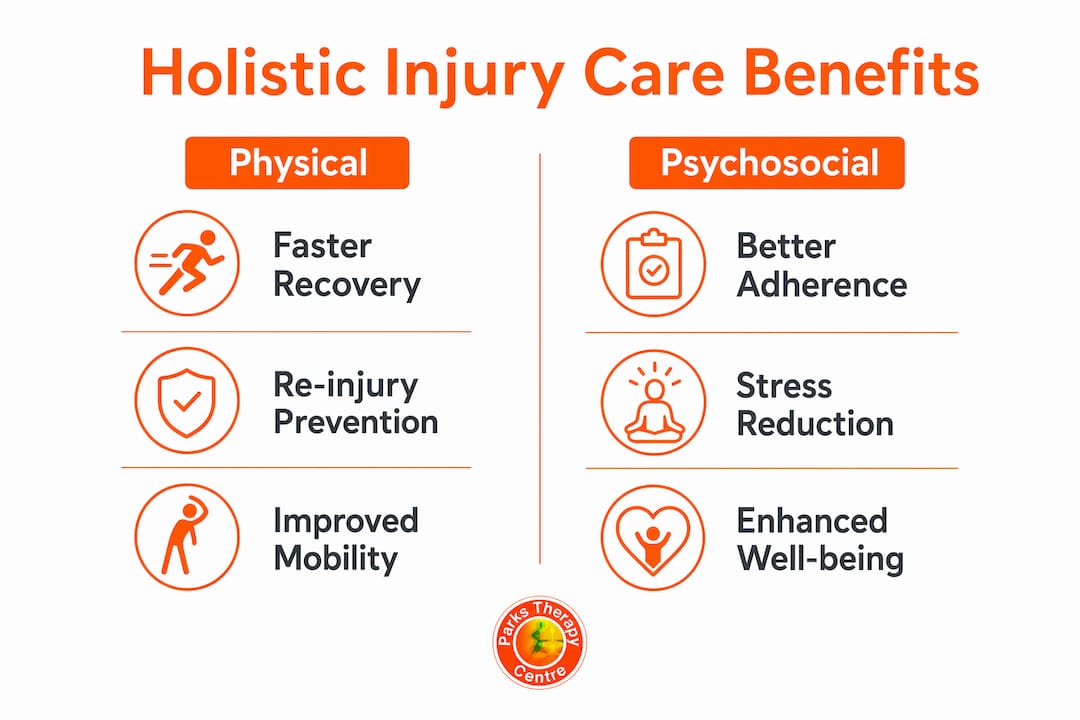
Patients who receive coordinated rehabilitation regain functional movement faster and are less likely to sustain repeat injuries. This is partly because whole-person care addresses the biomechanical and neuromuscular contributors to injury, not just the acute tissue damage. Podiatry, for example, corrects lower-limb loading patterns that would otherwise predispose a patient to recurrence.

Psychological and adherence benefits
Psychosocial factors such as fear-avoidance and workplace stress are stronger predictors of prolonged recovery than minor structural pathology in many cases. Patients who receive psychological support alongside physical treatment show reduced anxiety and depression, better pain coping, and higher adherence to their rehabilitation programme. Early identification of these barriers prevents escalation into chronic disability.
Social and vocational outcomes
A coordinated care plan that includes return-to-work milestones and functional goal setting helps patients re-engage with employment and social roles more quickly. Measuring progress against real-life tasks, rather than pain scores alone, produces more meaningful and sustained recovery.
Economic benefits
Narrative reviews of whole-person integrative care models consistently report lower hospital admissions, fewer procedures, and reduced drug costs in comparative analyses. Programmes that address social needs alongside medical treatment show measurable reductions in medical costs in the year following support. Source: The Case for Whole-Person Integrative Care, MDPI
Consider a working adult who sustains a rotator cuff injury and receives physiotherapy alone. If unaddressed anxiety about re-injury leads to persistent avoidance of shoulder movement, the physical recovery stalls. A whole-person plan would identify that fear early, add psychological support and graded activity, and produce a faster, more complete return to function. The role of multidisciplinary teams in back rehabilitation illustrates exactly this pattern: coordinated team care consistently outperforms single-discipline treatment for complex presentations.
Which therapies are used in whole-person injury care?
A well-designed rehabilitation plan draws on several therapeutic disciplines, each with a specific clinical role. The combination chosen depends on the injury, the patient’s goals, and the findings of the initial assessment.
Physiotherapy and exercise therapy: the foundation of most injury rehabilitation. Physiotherapy restores movement, strength, and motor control through structured exercise, manual techniques, and patient education. It is the most extensively evidenced intervention for musculoskeletal injury.
Manual therapy and massage: reduce pain, improve joint mobility, and address soft-tissue restrictions. Particularly useful in the early and subacute phases when pain limits active exercise.
Acupuncture and dry needling: evidence-based options for selected pain presentations, including chronic musculoskeletal pain and myofascial trigger points. Typically considered when standard physiotherapy alone has not achieved adequate pain control.
Podiatry and orthotics: correct biomechanical loading in the foot, ankle, and lower limb. Indicated for lower-limb injuries where gait abnormalities or structural factors contribute to the problem.
Psychological support and cognitive behavioural approaches: address fear-avoidance, catastrophising, and low mood that impede recovery. Considered when psychosocial screening identifies these barriers at assessment.
Pilates, graded activity, and functional retraining: structured re-conditioning that progressively loads the injured area and rebuilds confidence in movement. Particularly effective in the later rehabilitation phase before return to full activity.
Hypnotherapy and mind-body approaches: clinically indicated for pain management, anxiety reduction, and habit change where a patient has not responded adequately to other psychological interventions.
Understanding how these therapies combine is clearest when you see examples of multidisciplinary therapy approaches applied to real clinical presentations.
Pro Tip: Ask your provider which therapies are included in your plan and why each has been chosen for your specific presentation. A good clinician will give a clear, evidence-referenced rationale for every component, not a standard package.
How does whole-person care fit with NHS pathways in the UK?
Whole-person rehabilitation complements NHS care; it does not replace it. Where surgery, imaging, or urgent medical management is needed, those interventions take priority. Coordinated rehabilitation then builds on the medical foundation.
Within the NHS, patients may access physiotherapy through GP referral, community rehabilitation services, or self-referral in many areas. NHS pathways increasingly incorporate psychosocial screening and return-to-work planning, particularly for musculoskeletal and occupational injuries. However, waiting times and session limits within NHS provision mean that many patients benefit from supplementing NHS care with private treatment.
Nursing and multidisciplinary coordination are central to delivering continuity across these pathways. NMC-registered nurses and HCPC-registered physiotherapists are the regulated professionals most commonly leading holistic assessment in UK clinical settings. Chartered physiotherapists, denoted by membership of the Chartered Society of Physiotherapy (CSP), hold additional professional recognition of their training and standards.
Parkstherapycentre works with NHS referrals and accepts most major health insurance policies, allowing patients to access multidisciplinary care without navigating the full private-pay route independently. The clinic’s team coordinates with referring GPs and consultants to avoid duplication and ensure the care plan reflects any ongoing medical management.
Pro Tip: When moving between NHS and private care, bring a written summary of your diagnosis, any imaging reports, and your current medication list to your first private appointment. This prevents duplication of assessments and speeds up the planning process considerably.
What does a whole-person injury care plan look like in practice?
A structured rehabilitation plan typically moves through four phases, each with specific goals and review points.
Initial assessment (Week 1): A comprehensive review covering medical history, imaging and investigation results, functional movement assessment, psychosocial screening (mood, fear-avoidance, work situation, social support), and collaborative goal setting. The lead clinician, usually a chartered physiotherapist, coordinates input from other disciplines as needed.
Acute phase (Weeks 1–3): Pain management, protection of healing tissue, and early graded movement. Goals focus on reducing pain and preventing deconditioning. Review at the end of this phase determines readiness to progress.
Subacute and rehabilitation phase (Weeks 3–12): Progressive loading, strength and mobility work, and introduction of functional tasks. Psychosocial support and vocational planning run in parallel. Goals are measured against functional milestones, such as returning to driving, climbing stairs, or specific work tasks.
Return-to-function phase (Weeks 8–16 and beyond, depending on injury severity): Sport- or work-specific conditioning, confidence building, and discharge planning. A safe and effective post-injury training plan is agreed before discharge to reduce re-injury risk.
Goals are co-produced with the patient at every stage. Involving patients in goal setting builds resilience and ownership, which are reliable predictors of sustained outcomes.
Plan component | Details |
Initial assessment | Medical review, functional testing, psychosocial screening, goal setting |
Lead clinician | HCPC-registered, chartered physiotherapist |
Common interventions | Physiotherapy, manual therapy, acupuncture, podiatry, Pilates, psychological support |
Review points | End of acute phase, mid-rehabilitation, pre-discharge |
Typical timeline | 8–16 weeks for most musculoskeletal injuries; longer for complex or surgical cases |
Costs and access: NHS physiotherapy is available via GP referral or self-referral, though session numbers are often limited. Private physiotherapy in the UK generally involves a fee per session, with many health insurers covering some sessions annually. Parkstherapycentre accepts most major insurers; confirming your policy’s terms before booking is advisable.
What does the evidence show about whole-person rehabilitation?
The research base for integrated, whole-person rehabilitation is substantial, though the heterogeneity of models means direct comparisons between studies require care.
Globally, 2.4 billion people live with conditions that could benefit from rehabilitation, with access gaps most severe in low- and middle-income countries. In the UK, the picture is better, but fragmented care remains a recognised problem even within well-resourced systems.
Narrative reviews of whole-person integrative care models, including the MDPI review on whole-person care, report consistent patterns: lower hospital admissions, fewer procedures, and reduced drug costs in programmes that address biological, psychological, and social needs together. Programmes that specifically addressed social needs showed measurable medical cost reductions in the year after support was provided.
Outcome area | Finding | Source |
Hospital admissions | Lower in integrated whole-person models | MDPI |
Drug costs | Reduced in comparative analyses of whole-person programmes | MDPI |
Psychosocial barriers | Fear-avoidance and workplace stress are major predictors of delayed recovery | Workers’ Compensation analysis |
Rehabilitation access | 2.4 billion people globally could benefit from rehabilitation | Psychology Town / WHO data |
Care coordination | Nursing continuity and multidisciplinary coordination reduce fragmentation | PMC |
The evidence is strongest for musculoskeletal and occupational injuries, where the biopsychosocial model has been studied extensively. Evidence for specific complementary therapies such as acupuncture and hypnotherapy is more variable; both are supported for selected indications rather than as universal components of every plan.
The honest limitation: most studies compare whole-person models against usual care rather than against each other, making it difficult to identify which specific combination of therapies drives the best outcomes. What the evidence does consistently support is the principle: treating the whole person produces better results than treating the injury alone.
How do you choose a provider and what questions should you ask?
Choosing a provider for whole-person injury care requires checking credentials, assessing how the team coordinates, and identifying red flags before committing to a plan.
Credentials to verify
HCPC registration: all physiotherapists, podiatrists, and occupational therapists practising in the UK must be registered with the Health and Care Professions Council. Check the HCPC register directly.
Chartered physiotherapist status: membership of the Chartered Society of Physiotherapy indicates additional professional standards and ongoing continuing professional development.
NMC registration: where nurses are part of the team, NMC registration confirms regulatory compliance.
Postgraduate training: for specialist areas such as acupuncture, sports rehabilitation, or pain management, ask about relevant postgraduate qualifications.
Questions to ask at first contact
Who will lead my care, and which other disciplines will be involved?
How do you measure progress, and what outcome tools do you use?
How do clinicians communicate with each other about my case?
What is the discharge plan, and how will re-injury risk be managed?
Red flags
A single-modality promise (“we only do physiotherapy, nothing else is needed”) for a complex presentation.
No objective outcome measurement beyond pain scores.
Poor communication between clinicians, or no named care coordinator.
Pressure to commit to a large block of sessions before assessment.
Parkstherapycentre has operated since 1986 across multiple locations in Bedfordshire and Buckinghamshire. Its multidisciplinary team includes HCPC-registered physiotherapists, chartered physiotherapists, podiatrists, and acupuncturists, with outcome tracking built into the care pathway. The step-by-step injury prevention guide on the clinic’s site gives a practical sense of how prevention and rehabilitation planning are integrated.
Pro Tip: Ask any prospective provider how they handle a case where your progress stalls. A good multidisciplinary team will have a clear process for reviewing the plan, seeking a second clinical opinion, or adding a new discipline rather than simply continuing the same treatment.
Simple steps you can take now to support recovery and prevent re-injury
Clinical care produces the best results when patients actively support their own recovery between sessions. These steps are safe for most adults and complement professional treatment.
Graded activity: avoid complete rest unless a clinician has specifically advised it. Gentle, progressive movement within pain limits maintains circulation, prevents deconditioning, and supports tissue healing. A post-injury training plan agreed with your physiotherapist gives you a structured framework for this.
Sleep: tissue repair is most active during sleep. Aim for 7–9 hours per night and address any pain that disrupts sleep with your clinical team rather than tolerating it.
Nutrition: adequate protein supports muscle repair; anti-inflammatory foods (oily fish, vegetables, nuts) may reduce systemic inflammation. Discuss specific dietary adjustments with your clinician if you have relevant health conditions.

Stress management: chronic stress elevates cortisol, which impairs tissue healing and amplifies pain perception. Simple techniques such as paced breathing, short walks, and social connection have measurable physiological effects.
Pacing and load management: doing too much too soon is one of the most common causes of setbacks. Follow the load progression your physiotherapist sets, and communicate any increase in symptoms promptly rather than pushing through.
When to seek help urgently: seek immediate medical attention if you experience severe or worsening neurological symptoms (numbness, weakness, loss of bladder or bowel control), unexplained fever alongside pain, or significant swelling after trauma. These are red flag symptoms that require medical assessment before rehabilitation continues.
Pro Tip: Habit formation research consistently shows that attaching a new rehabilitation exercise to an existing daily routine, such as doing your exercises immediately after brushing your teeth, significantly improves adherence over the first four weeks.
Key takeaways
Whole-person injury care produces better clinical, psychological, and economic outcomes than single-modality treatment because it addresses the full range of factors that drive recovery and re-injury.
Point | Details |
Treat the whole person | Addressing physical, psychological, and social factors together reduces chronic disability risk. |
Check credentials carefully | Verify HCPC registration, chartered physiotherapist status, and postgraduate training before committing. |
Set functional goals | Measuring progress against real-life tasks improves adherence and produces more meaningful recovery. |
Support your own recovery | Graded activity, adequate sleep, nutrition, and stress management all have direct effects on healing. |
Parkstherapycentre | A multidisciplinary clinic established in 1986, offering physiotherapy, acupuncture, podiatry, Pilates, and hypnotherapy across Bedfordshire and Buckinghamshire. |
Why multidisciplinary care is the standard worth holding to
The most persistent gap in injury rehabilitation is not a lack of effective therapies. It is the failure to connect them. Patients often receive excellent physiotherapy, adequate pain management, and appropriate imaging, yet still end up with prolonged disability because nobody asked about their fear of re-injury, their job demands, or the fact that they have not been sleeping properly for three months.
The biopsychosocial model has been the theoretical consensus in rehabilitation for decades. The practical gap between that consensus and what patients actually receive remains significant. What impresses me about the evidence is not that whole-person care is a new idea; it is that the outcomes data keeps confirming what good clinicians have known for years: you cannot separate the person from the injury and expect the best result.
The clinics that do this well share a few consistent features. They measure functional outcomes, not just pain scores. They have a named coordinator who ensures disciplines communicate. They involve the patient in goal setting from the first appointment. And they plan for discharge from day one, rather than treating indefinitely without a clear endpoint.
Parkstherapycentre’s model, built over nearly four decades of practice in Bedfordshire and Buckinghamshire, reflects these principles. The team tracks patient function and return-to-activity milestones, not just symptom reduction. That focus on real-world outcomes is what separates coordinated rehabilitation from a series of disconnected appointments.
Parkstherapycentre: multidisciplinary care you can book today
Parkstherapycentre offers the full range of therapies described in this article, delivered by a coordinated multidisciplinary team across clinics in Bedfordshire and Buckinghamshire. Services include physiotherapy, sports injury treatment, acupuncture, podiatry, Pilates, hypnotherapy, and massage, all available under one roof with HCPC-registered and chartered practitioners.
For patients who have read this article and want to act on it: book a multidisciplinary assessment, bring any previous imaging reports or clinical letters, and use the checklist questions above at your first appointment. The team accepts most major health insurers and NHS referrals, and online booking is available directly through the website.
Book your assessment at Parkstherapycentre and start your rehabilitation with a team that measures what actually matters.
Selected sources and further reading
Whole Person Health: What It Is and Why It’s Important (NCCIH): The US National Center for Complementary and Integrative Health’s authoritative overview of whole-person health principles, covering biological, behavioural, social, and environmental determinants. Directly relevant to the definition and evidence sections.
The Case for Whole-Person Integrative Care (MDPI, Medicine): A narrative review reporting outcome and cost data from integrated care models. The primary source for economic benefit claims in this article.
Understanding Rehabilitation: A Holistic Approach to Recovery (Psychology Town): Source for the global rehabilitation access figure (2.4 billion people) and a clear overview of rehabilitation principles.
Holistic care and complex needs: unveiling the full potential of modern nursing (PMC): Peer-reviewed article on nursing’s role in holistic, coordinated care delivery; supports the NMC and care coordination arguments.
A holistic person-centred approach to neurorehabilitation (The London Neurocognitive Clinic): Practical clinical guidance on person-centred formulation, collaborative goal setting, and multidisciplinary coordination.
Healing the whole worker: why inclusive holistic care is the future of workers’ compensation (WorkersCompensation.com): Industry analysis of psychosocial barriers to recovery and the economic case for whole-person approaches in occupational injury.
Holistic rehabilitation thinking (Rehabilitation Matters): Practical perspective on functional goal setting, patient empowerment, and adherence in rehabilitation.
The past and future of integrated biopsychosocial whole-health perspectives in psychiatric rehabilitation (PMC): Peer-reviewed analysis of the biopsychosocial model’s clinical and policy implications; supports the evidence and perspective sections.
Team-based integrated mental health care and outcomes (iMind Mental Health Solutions): Review of integrated mental health team models and their effect on patient outcomes and costs; relevant to the psychosocial integration arguments.
Recommended