
Biopsychosocial model in physiotherapy: a clinical guide
- Jun 30
- 7 min read

TL;DR:
The biopsychosocial model treats biological, psychological, and social factors as equally important in pain and recovery. Its evidence shows psychosocial factors predict rehabilitation outcomes, making holistic assessment essential. Training and practice support physiotherapists in applying this approach effectively to improve patient care.
The biopsychosocial model in physiotherapy is defined as a clinical framework that treats biological, psychological, and social factors as equally important drivers of pain and recovery. Endorsed by NICE and the Chartered Society of Physiotherapy, multimodal biopsychosocial approaches outperform single-technique treatments for both pain and function. This matters because patients with chronic musculoskeletal conditions rarely present with tissue damage alone. Anxiety, depression, social isolation, and fear of movement all shape how a patient heals. Understanding this framework is the first step toward delivering genuinely patient-centred physiotherapy.
What evidence supports the biopsychosocial model in physiotherapy?
The evidence is clear: psychosocial factors directly predict rehabilitation outcomes. Anxiety, depression, and pain catastrophising each correlate significantly with poorer functional improvement in rehabilitation settings (p < 0.05). That finding means a patient’s emotional state at the start of treatment is a measurable predictor of how well they will recover physically.
The clinical shift this demands is substantial. Rather than focusing exclusively on tissue pathology, effective physiotherapy now requires understanding the patient’s lived experience, including their psychological state and social context. A patient recovering from a lumbar disc injury who also lives alone, fears re-injury, and has lost their job faces a very different recovery trajectory than one with identical imaging but strong social support and a positive outlook.
Pain is influenced by emotional wellbeing and social support, not just the site of physical injury. This means addressing root causes rather than only symptom location produces better outcomes. Physiotherapists who screen for psychological markers early can adjust their treatment plans before poor adherence or avoidance behaviours take hold.
Training also makes a measurable difference. A structured postgraduate course using experiential learning and home assignments produced a significant shift in physiotherapists’ confidence in applying psychology-informed interventions. Confidence in this area is not a soft skill. It directly affects whether a clinician raises psychosocial concerns with a patient or avoids the conversation entirely.
Pro Tip: When reviewing a patient’s outcome measures, track scores on tools like the STarT Back Screening Tool or the Pain Catastrophising Scale alongside physical function tests. A mismatch between physical progress and psychological scores is a clinical signal, not a documentation detail.
What challenges do physiotherapists face in adopting this approach?
Adoption of the biopsychosocial therapy model is uneven across the profession. UK physiotherapists show a trend toward incorporating psychosocial assessment in musculoskeletal care, but a persistent implementation gap remains despite growing awareness. Knowing the model exists and knowing how to apply it in a 45-minute appointment are two very different things.
The barriers fall into several consistent categories:
Conceptual misunderstanding. Some practitioners conflate the biopsychosocial model with simply asking patients how they feel. The model requires structured assessment and clinical reasoning across all three domains.
Biomedical training bias. Most undergraduate physiotherapy programmes prioritise anatomy, biomechanics, and manual therapy. Psychosocial reasoning receives far less curriculum time.
Workplace culture. Clinics structured around high patient throughput leave little room for the extended conversations that psychosocial assessment requires.
Limited postgraduate support. Without access to supervised practice or peer learning, practitioners struggle to translate theoretical knowledge into clinical habit.
Confidence deficit. Many physiotherapists report feeling underprepared to address psychological factors, fearing they will stray outside their professional scope.
Facilitators that help overcome these barriers include peer learning groups, mentorship from experienced practitioners, and access to validated screening tools that make psychosocial assessment feel structured rather than open-ended.
Pro Tip: If your workplace does not yet support formal psychosocial screening, start small. Introduce one validated questionnaire, such as the PHQ-9 for depression or the GAD-7 for anxiety, into your initial assessment. This creates a repeatable clinical habit without requiring a full service redesign.
How can physiotherapists apply biopsychosocial assessment in practice?
The holistic approach in physiotherapy requires a structured assessment that goes beyond range of motion and pain scores. A full biopsychosocial assessment combines physical evaluation with screening for psychological distress, social circumstances, occupational demands, and the patient’s own beliefs about their condition.

Biomedical vs biopsychosocial assessment: a comparison
Assessment domain | Biomedical approach | Biopsychosocial approach |
Pain evaluation | Location, intensity, mechanism of injury | Location plus emotional response, fear avoidance, catastrophising |
Patient history | Medical and surgical history | Medical history plus occupational, social, and psychological context |
Goal setting | Restore physical function | Restore function aligned with patient values and life roles |
Treatment planning | Modality selection based on diagnosis | Modality selection based on biological, psychological, and social findings |
Outcome measures | Physical function scores | Physical function plus psychological wellbeing and quality of life |
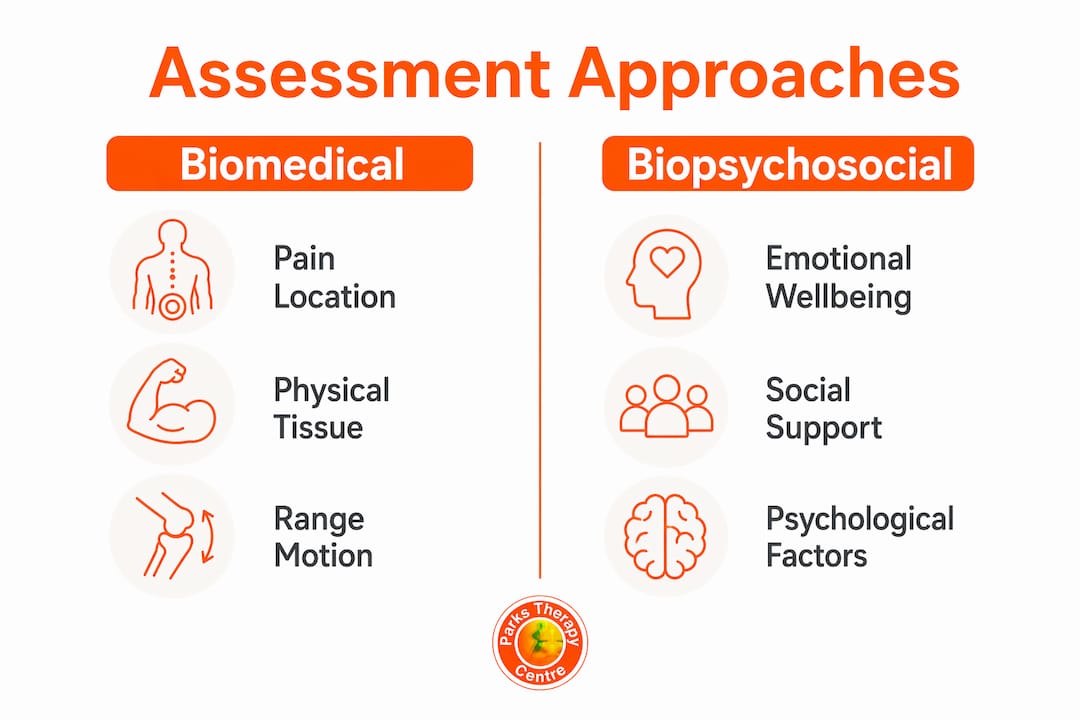
Effective clinical reasoning synthesises biological findings with psychological and social factors to identify the true drivers of a patient’s pain. This is not simply adding a mental health questionnaire to an existing assessment. It means forming a clinical hypothesis that accounts for all three domains before selecting any intervention.
In practice, this changes treatment decisions significantly. A patient presenting with persistent knee pain after surgery may have adequate tissue healing but score highly on fear avoidance measures. The appropriate intervention in that case is graded exposure and education, not further manual therapy. Without the psychosocial assessment, the physiotherapist would likely repeat the same physical techniques and wonder why progress has stalled.
Tailored interventions reflecting this understanding include pain management strategies that combine exercise prescription with cognitive behavioural principles, relaxation techniques, and social reintegration goals. The physical and psychological components are not delivered in parallel. They are integrated into a single, coherent treatment plan.
What training steps build confidence in applying the biopsychosocial model?
Experiential learning with peer engagement is the most effective route to clinical competence in biopsychosocial physiotherapy. Reading about the model builds awareness. Practising it with real patients, then reflecting on those cases with peers, builds the clinical reasoning skills that make it usable.
The following steps provide a practical pathway for physiotherapists at any career stage:
Complete a structured postgraduate course. Look for programmes that include role play, case-based learning, and supervised clinical practice rather than lecture-only formats.
Use validated screening tools from day one. The STarT Back Screening Tool, PHQ-9, and Pain Catastrophising Scale each provide structured entry points into psychosocial assessment without requiring specialist training.
Join or form a peer learning group. Discussing complex cases with colleagues who are also developing their biopsychosocial reasoning accelerates skill acquisition and normalises the approach within your workplace.
Complete home assignments between training sessions. Applying new frameworks to current patients between formal learning sessions is what converts theoretical knowledge into clinical habit.
Seek workplace facilitation. Advocate for protected time in supervision or team meetings to discuss psychosocial complexity. Clinics that support this formally see faster adoption across their teams.
Review your physiotherapy qualifications pathway. Postgraduate certificates in pain science, cognitive functional therapy, or acceptance and commitment therapy each build directly applicable skills.
The goal is not to become a psychologist. The goal is to become a physiotherapist who can recognise when psychological and social factors are driving a patient’s presentation and respond with appropriate clinical reasoning and referral when needed.
Key takeaways
The biopsychosocial model in physiotherapy produces better outcomes than biomedical treatment alone because it addresses the full range of factors that drive pain and limit recovery.
Point | Details |
Psychosocial factors predict outcomes | Anxiety, depression, and pain catastrophising significantly correlate with poorer functional recovery. |
Assessment must span three domains | Effective biopsychosocial assessment covers biological, psychological, and social factors in every patient. |
Training requires experiential learning | Postgraduate courses with peer support and home assignments build clinical confidence more effectively than theory alone. |
Barriers are real but surmountable | Conceptual gaps, workplace culture, and limited training are the main obstacles to adoption. |
Tailored treatment outperforms single techniques | Integrating psychological and social goals into physical treatment plans improves adherence and function. |
Why the gap between knowing and doing still costs patients
The part of this conversation that rarely gets said plainly is this: most physiotherapists already know the biopsychosocial model exists. The problem is that knowing it and using it are separated by a gap that undergraduate training does not close.
I have seen practitioners who can explain the model fluently in a seminar and then revert entirely to biomechanical reasoning the moment they are in a busy clinic. That is not a knowledge failure. It is a confidence and habit failure. The solution is not more lectures. It is supervised practice, peer challenge, and the willingness to sit with clinical uncertainty long enough to ask a patient about their life, not just their knee.
What strikes me most about the evidence on experiential learning is how clearly it mirrors what good clinical mentorship has always looked like. A three-month course with home assignments and peer reflection produces a measurable shift in confidence. That is not a coincidence. It is what happens when learning is attached to real clinical decisions rather than abstract frameworks.
The future of physiotherapy depends on practitioners who can hold biological and psychological complexity simultaneously. Patients with chronic pain and daily living challenges do not present in neat diagnostic categories. They present as whole people, and they deserve clinicians trained to see them that way.
For students entering the profession now, my advice is straightforward. Seek out the training that makes you uncomfortable. The discomfort of asking a patient about their emotional state is temporary. The clinical skill that follows is permanent.
— Ivan
Physiotherapy at Parkstherapycentre: care that sees the whole patient
Parkstherapycentre has delivered patient-centred physiotherapy across Bedfordshire and Buckinghamshire since 1986. The clinical team applies integrative physiotherapy practices that account for physical, psychological, and social factors in every assessment and treatment plan.

Whether you are a practitioner looking to refer a complex patient or a student seeking a clinical environment that takes the biopsychosocial approach seriously, Parkstherapycentre offers the expertise and multidisciplinary support to make that possible. The team works across musculoskeletal conditions, sports injuries, chronic pain, and rehabilitation, with a consistent focus on understanding what is actually driving each patient’s presentation. Visit Parkstherapycentre to learn more about available services and to book an appointment.
FAQ
What is the biopsychosocial model in physiotherapy?
The biopsychosocial model is a clinical framework that treats biological, psychological, and social factors as equally important in understanding and treating pain and mobility issues. It replaces the purely biomedical view that pain is caused only by tissue damage.
How does psychology affect physiotherapy outcomes?
Psychological factors such as anxiety, depression, and pain catastrophising significantly predict poorer functional improvement in rehabilitation. Addressing these factors alongside physical treatment improves adherence and recovery.
What tools support biopsychosocial assessment in physiotherapy?
Validated tools including the STarT Back Screening Tool, the PHQ-9, and the Pain Catastrophising Scale provide structured ways to assess psychosocial factors during a standard physiotherapy assessment.
Why do physiotherapists struggle to apply the biopsychosocial model?
The main barriers are biomedical training bias, limited postgraduate support, workplace time pressures, and a lack of confidence in addressing psychological factors within a physiotherapy scope of practice.
How can physiotherapists build confidence in this approach?
Structured postgraduate courses that include experiential learning, peer discussion, and home assignments produce the most significant and lasting shift in clinical confidence and competence.
Recommended