
Chronic pain management guides for daily living
- May 22
- 8 min read
TL;DR:
Effective chronic pain management focuses on improving function and quality of life by addressing biological, psychological, and social factors simultaneously. Non-drug strategies like gentle activity, pacing, psychological therapies, sleep optimization, and social support form the core of evidence-based care, reducing reliance on medications such as opioids. Adopting a person-centred, multidisciplinary approach helps individuals live well despite persistent pain, with tailored plans for flare-ups, medication review, and holistic therapies enhancing long-term outcomes.
If you’ve been told to simply “manage” your chronic pain and left to figure out what that means, you are not alone. Good chronic pain management guides go far beyond prescribing painkillers and sending you on your way. They recognise that chronic pain persists beyond three months and affects every corner of your life, from sleep and mood to work and relationships. This article pulls together the best practices for pain management drawn from current 2026 evidence, giving you a practical, honest, and empowering framework to work from.
Table of Contents
Key takeaways
Point | Details |
Reframe your goal | Focus on improving function and quality of life, not achieving complete pain relief. |
Non-drug strategies come first | Physical activity, psychological therapies, and sleep hygiene are central to evidence-based care. |
Pacing prevents flare-ups | An activity diary and pacing plan help you avoid the boom-bust cycle that worsens symptoms. |
Opioids carry real risks | Long-term opioid use has limited benefit and increasing harms; review with your clinician regularly. |
Professional support matters | Physiotherapy, acupuncture, and multidisciplinary teams offer proven, personalised approaches. |
Understanding chronic pain: the biopsychosocial approach
Most people expect pain to follow a simple rule: injury occurs, healing happens, pain goes. Chronic pain breaks that rule entirely. Defined as pain lasting beyond three months, it affects 38% of Scottish adults and is one of the most common reasons people seek healthcare across the UK. Yet it remains widely misunderstood.
The old model of pain management treated the body like a broken machine. Fix the damaged part, the thinking went, and the pain disappears. For chronic pain, this approach falls short. Pain signals can persist long after tissues have healed, shaped by factors that have nothing to do with physical damage.
The biopsychosocial model offers a far more useful framework. It recognises that your pain experience is shaped by three overlapping dimensions:
Biological factors: The original injury or condition, nerve sensitisation, inflammation, and physical function.
Psychological factors: Anxiety, depression, catastrophising, fear of movement, and beliefs about what pain means.
Social factors: Work pressures, relationship strain, isolation, financial stress, and access to support.
What this means in practice is that treating only one dimension rarely produces lasting results. A person who receives excellent physiotherapy but has no support for depression, for instance, will likely continue to struggle. Effective chronic pain treatment options address all three dimensions together.
“The goal of chronic pain management is not necessarily to eliminate pain completely, but to support people in living well, with improved function and quality of life as the primary measure of success.” — Scottish Quality Prescribing Guide 2026
This shift in thinking, from cure to quality of life, is not a lowering of ambition. It is a more honest and ultimately more helpful way to approach what is chronic pain management in the real world.
Non-drug strategies that actually work
This is where the most significant gains are made, and yet it is also where most people receive the least guidance. The 2026 Scottish prescribing guidelines give a strong recommendation for non-pharmacological approaches as the backbone of chronic pain care. These include physical, psychological, and lifestyle-based strategies.
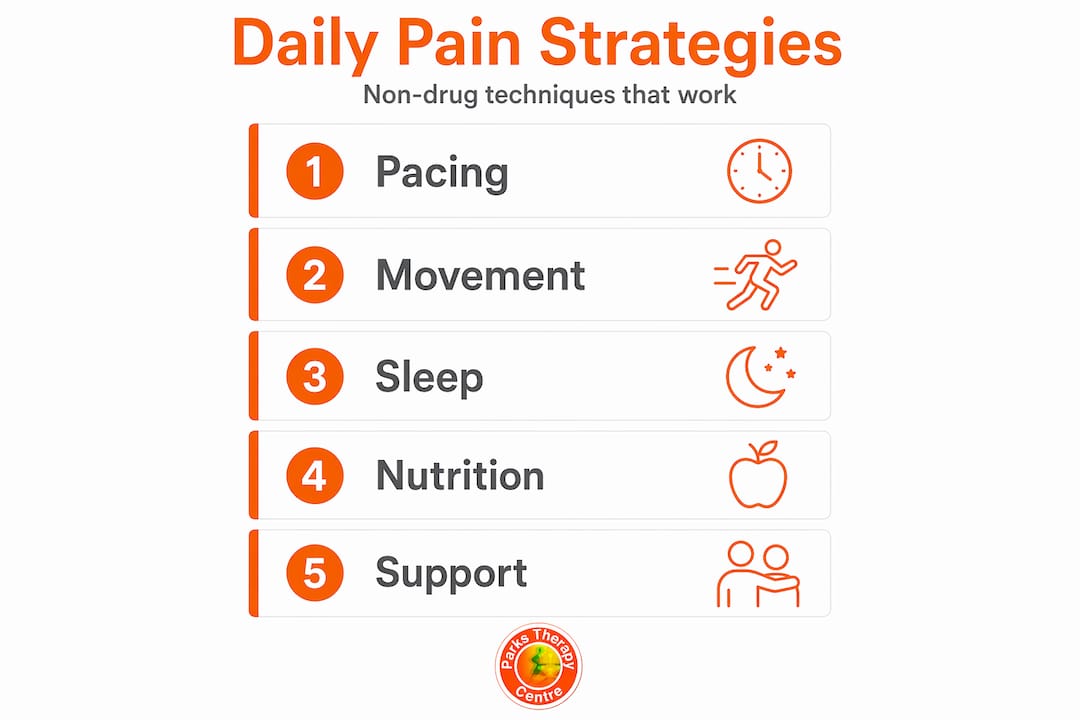
Physical activity and pacing
Movement feels counterintuitive when you are in pain. But staying still worsens deconditioning, increases sensitivity, and creates a cycle that is hard to escape. The key is not how much you do. It is how consistently you do it. Gentle, graded activity builds tolerance over time without triggering flare-ups.
Pacing means splitting activity into manageable portions with planned rest periods, rather than doing as much as possible on a good day and then collapsing for two days afterwards. This boom-bust pattern, where you push through on good days and pay for it later, is one of the most common traps in chronic pain management.
Psychological therapies
Cognitive Behavioural Therapy (CBT) and Acceptance and Commitment Therapy (ACT) are two of the most evidence-backed options for chronic pain. CBT and ACT should be tailored to patient preference and delivered by trained professionals. CBT helps you identify and challenge unhelpful thoughts about pain, whilst ACT works on accepting pain as part of your experience without letting it control your choices.
Neither therapy claims to remove pain. Both have strong track records in helping people function better and feel less controlled by their symptoms.
Sleep, nutrition, and social connection
Poor sleep directly worsens pain and reduces your body’s ability to cope with discomfort. Prioritising consistent sleep and wake times, reducing screen exposure before bed, and limiting caffeine are all worth taking seriously as pain relief strategies, not just general health advice.

Nutrition matters too. Anti-inflammatory foods, steady blood sugar, and hydration all influence how your nervous system processes pain. Social connection and peer support reduce the psychological burden of chronic pain and protect against the isolation that can quietly make everything feel worse.
Pro Tip: Keep a simple diary tracking your sleep quality, mood, activity, and pain levels each day. Patterns often emerge within two weeks that reveal your most powerful triggers and most effective coping tools.
Managing flare-ups with a clear plan
A flare-up is not a sign that you are failing. It is a normal part of living with chronic pain, and flare-ups are best treated as signals to adjust your approach, not evidence that nothing is working. Having a pre-planned response makes a significant difference to how quickly and calmly you recover.
Here is a practical step-by-step approach to building your flare-up plan:
Identify your triggers. Common culprits include overdoing activity, high stress, poor sleep, or changes in weather and routine. Reviewing your activity diary helps spot these patterns before they spiral.
Reduce activity temporarily but keep moving gently. Complete rest rarely helps. Short, gentle walks or stretching can maintain function without aggravating sensitised tissues.
Apply relaxation and soothing measures. Heat packs, warm baths, mindfulness meditation, or breathing exercises can calm the nervous system’s stress response during a flare. NHS guidance from 2026 specifically recommends prioritising tasks and using mindfulness during these periods.
Adjust medication cautiously and in consultation. If you take prescribed medication, speak with your clinician about short-term dose adjustments during a severe flare. Never adjust opioids independently.
Review and adapt your plan afterwards. Flares teach you something every time. Iterative behaviour adaptation based on what you observe is central to long-term improvement.
You can also find practical advice on managing post-injury activity at Parkstherapycentre, which applies directly to pacing during flare periods.
Pro Tip: Write your flare-up plan down and keep it somewhere visible. When pain is high, decision-making is harder. A written plan removes the need to think clearly under pressure.
Medication: what the evidence actually says
Medication has a genuine role in chronic pain management. The problem is that it is rarely enough on its own, and for many people it becomes the centrepiece of treatment when the evidence suggests it should be a supporting element.
Medication type | Evidence and considerations |
Paracetamol and NSAIDs | Useful for short-term or mild to moderate pain; limited evidence for long-term chronic pain relief |
Antidepressants (low-dose) | Some evidence for nerve pain and sleep support; not purely for mood |
Anticonvulsants | Used for neuropathic pain; side effects include cognitive blunting and weight gain |
Opioids | Limited benefit long-term; risks increase significantly above 120mg morphine equivalent dose per day |
The opioid picture is particularly worth understanding clearly. Opioids can provide short-term relief for some pain types, but long-term use carries substantial risks including dependency, opioid-induced hyperalgesia (where the medication paradoxically increases pain sensitivity), hormonal disruption, and significant withdrawal challenges.
Shared decision-making with your GP or specialist is the cornerstone of good medication management. This means regular reviews, honest conversations about what is and is not working, and goals framed around function rather than targeting zero pain.
If you are considering reducing opioids, know that deprescribing requires a tailored taper plan with multidisciplinary support, including emotional and psychological input. Mood can temporarily worsen during tapering, which is a known and manageable side effect when properly supported.
Complementary and alternative therapies
Physiotherapy, acupuncture, and manual therapies occupy an important space in holistic pain management techniques. They are not substitutes for psychological or lifestyle work, but they can make a meaningful contribution when applied appropriately and professionally.
Physiotherapy for chronic pain addresses movement patterns, muscle imbalances, joint function, and exercise tolerance. An experienced physiotherapist can help you build a graded activity programme that respects your current limits whilst systematically improving them.
Acupuncture is one of the most studied natural remedies for chronic pain and complementary approaches. Evidence supports its use for musculoskeletal pain, tension headaches, and osteoarthritis, among other conditions. The AMA’s 2026 guidance on pain care endorses a multimodal approach that includes physical therapies alongside psychological treatment. You can read more about how acupuncture targets pain at the tissue and nervous system level.
These therapies work best as part of a coordinated plan. When combined with sleep management, pacing, and psychological support, the cumulative effect can be considerably greater than any single therapy alone.
My perspective on living well with pain
I’ve worked alongside people living with chronic pain for many years, and the single biggest shift I’ve observed is when someone stops asking “how do I get rid of this?” and starts asking “how do I live well despite this?” That reframe is not giving up. It is gaining ground.
What I’ve seen in practice is that the patients who make the most progress are those who take the lifestyle factors seriously, not the ones who simply try more medications. Sleep, pacing, stress reduction, and social connection consistently matter more than people expect them to. They are not glamorous solutions, but they are effective ones.
I’ve also seen how difficult opioid tapering can be, especially for people who have been on high doses for years. The mood changes are real, the anxiety is real, and the process genuinely needs proper support, not just a dose reduction schedule handed over at a GP appointment.
My honest take: if you have been relying heavily on medication without a parallel investment in non-drug strategies, that is the gap most worth closing. The evidence is clear. A multidisciplinary, person-centred approach outperforms any single treatment. And the good news is that making a start, however modest, creates momentum.
— Ivan
How Parkstherapycentre can help you
Living with chronic pain is exhausting, and knowing where to turn for reliable, evidence-based care is not always straightforward. Parkstherapycentre has been providing multidisciplinary therapy since 1986, with a team of experienced physiotherapists, acupuncturists, and specialist clinicians across multiple locations in Bedfordshire and Buckinghamshire. Their approach reflects current best practice, addressing the physical, lifestyle, and functional dimensions of pain together rather than treating them in isolation. Whether you are exploring physiotherapy, acupuncture, or a personalised management plan, the team at Parkstherapycentre can support you in taking a structured first step. Appointments can be booked online, and the centre accepts insurance cover from most major providers.
FAQ
What is chronic pain management?
Chronic pain management is a person-centred approach to reducing the impact of persistent pain on daily life. Rather than focusing solely on pain relief, it combines physical, psychological, and lifestyle strategies to improve function and quality of life.
Which non-drug treatments work best for chronic pain?
Graded physical activity, pacing, CBT, ACT, mindfulness, and sleep hygiene are all strongly recommended in 2026 guidelines. The most effective approach combines several of these according to individual needs and preferences.
When should I be concerned about opioid use for chronic pain?
Long-term opioid use carries significant risks including dependency and hyperalgesia, and evidence suggests limited benefit beyond the short term. Regular reviews with your prescriber and a plan that includes non-drug therapies are strongly advised.
How do I manage a chronic pain flare-up?
Use a pre-planned approach: reduce activity temporarily, apply heat or mindfulness, maintain gentle movement, and avoid complete rest. Reviewing your activity diary after the flare helps identify triggers and prevent the next one.
Can physiotherapy and acupuncture help with chronic pain?
Yes. Physiotherapy improves movement, strength, and exercise tolerance, whilst acupuncture has evidence for musculoskeletal and nerve pain. Both work best as part of a broader, coordinated management plan.
Recommended