
How to improve mobility after injury: step-by-step guide

TL;DR:
Early, guided movement after injury significantly improves recovery outcomes compared to prolonged rest.
Progression should be criteria-based, matching tissue healing stages and avoiding rushing ahead or excessive rest.
Losing the ability to move freely after an injury is frustrating in ways that go well beyond the physical. The stiffness, the cautious shuffle to the bathroom, the uncertainty about whether you’re doing too much or too little — it all compounds the emotional weight of being sidelined. The good news is that early, guided movement often produces significantly better recovery outcomes than prolonged rest, and there is a clear, practical path back to full function that you can start following right now.
Table of Contents
Key Takeaways
Point | Details |
Start early, but safely | Begin gentle movement as soon as pain allows, always within clinical guidance. |
Follow a stepwise plan | Progress from simple range-of-motion to strengthening and functional activities to restore mobility. |
Track functional improvement | Measure recovery by real-life movements—like walking and reaching—not just pain levels. |
Get support for setbacks | Consult your physiotherapist promptly for any new pain, swelling, or persistent loss of movement. |
Understanding mobility after injury: why early movement matters
To put the evidence into context, let’s explore the role of movement right from the early days after injury.
For decades, the default advice after a sprain, strain, or soft-tissue injury was simple: rest, and rest some more. That thinking has changed substantially. Research now shows that early, symptom-guided movement improves recovery and reduces complications such as muscle atrophy, joint stiffness, and poor circulation. The body’s tissues respond well to controlled loading, which helps align healing fibres and maintain the health of surrounding structures.
The critical phrase here is symptom-guided. This does not mean gritting your teeth and pushing through severe pain. It means working within a tolerable range and gradually expanding that range as healing progresses. The NHS recommends starting gentle movement as soon as pain allows after most acute soft-tissue injuries, aiming for short sessions repeated three to four times daily where possible.
Common misconceptions still slow people down:
“Complete rest speeds up healing.” In most soft-tissue injuries, prolonged immobility actually delays recovery.
“Pain means I’m making it worse.” Mild, predictable discomfort during movement is usually safe; sharp or escalating pain is not.
“I need to wait for the swelling to fully go.” Gentle movement can actually help disperse fluid and reduce swelling when done correctly.
“Movement is medicine — but only when the dose is right. Too little delays healing; too much risks re-injury. The skill lies in finding the appropriate middle ground.”
If you are unsure about reading your own symptoms, reviewing physiotherapy tips for beginners can help you understand the basics before you start. It is also worth learning how to approach assessing your injury safely so that you are moving forward with confidence rather than guesswork.
What you need before starting mobility work
Before diving into mobility exercises, ensure you have laid the right groundwork to make every step as effective and as safe as possible.
Preparation is unglamorous but genuinely important. Jumping straight into exercise without the right foundation is one of the most common reasons people plateau early or pick up a secondary problem. Before you begin any structured mobility programme, work through this checklist:
All movement should stay within pain limits and never be forced.
Confirm with a physiotherapist that your injury is stable enough to begin.
Set up a clear, safe space at home for daily exercise (no trip hazards, something sturdy to hold if needed).
Have ice packs and an elevated surface ready for post-exercise management.
Keep your clinic’s contact details accessible in case symptoms change suddenly.
The NHS advises starting exercises as soon as possible after acute soft-tissue injury, using aids such as ice, elevation, and supportive footwear as appropriate to manage symptoms around exercise.
Here is a quick guide to common items you might need at different stages:
Stage of recovery | Useful equipment | Purpose |
Acute (days 1–5) | Ice pack, elevation pillow | Manage swelling and pain |
Early mobility | Resistance bands, chair or rail | Supported range-of-motion work |
Mid-stage | Balance board, resistance bands | Strength and proprioception |
Late-stage | Step platform, light weights | Functional loading |
Understanding which physiotherapy aids support recovery at each stage helps you use them purposefully rather than guessing. It is also worth being clear on using ice correctly — timing, duration, and frequency matter more than most people realise.
Pro Tip: Avoid exercising on a full stomach or when fatigued. Short, focused sessions of 10 to 15 minutes are far more productive than one long, exhausting session that leaves you too sore to move the next day.
Step-by-step: core mobility exercises for safe recovery
With preparation in place, you are ready for a progressive plan. Let’s break down each step of mobility recovery so you know what to do — and when.
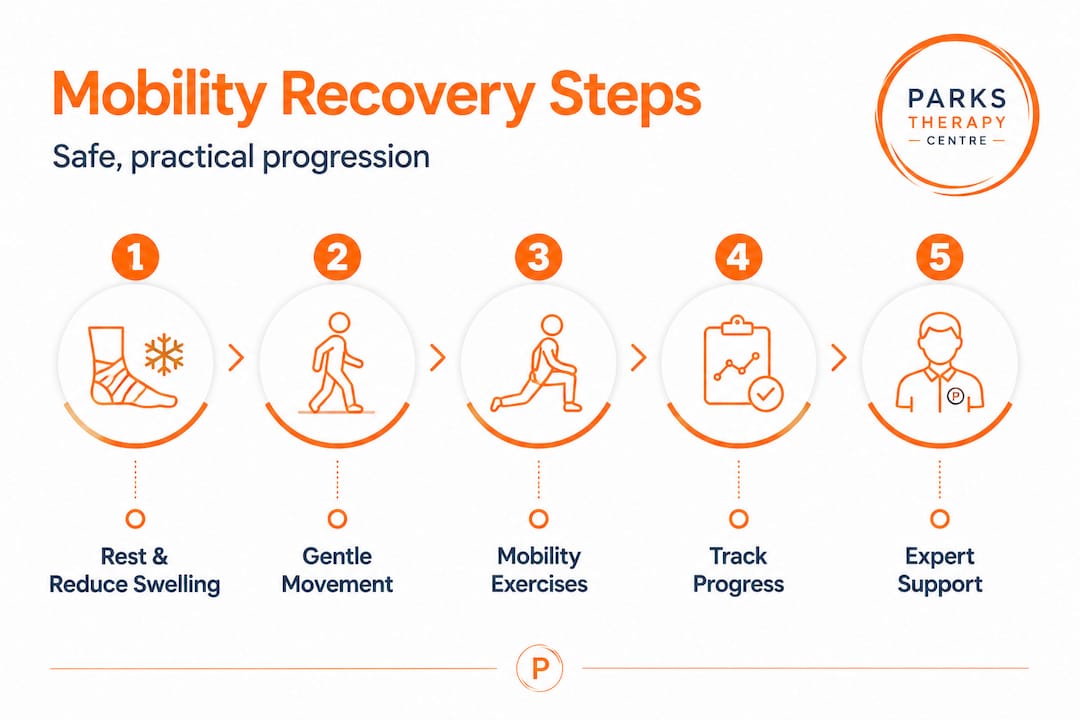
The foundation of any good mobility programme is a clear sequence. Skipping stages or rushing from one phase to the next is where most injuries stall or worsen. Follow these steps in order, spending enough time at each phase before advancing:
Range-of-motion exercises. Begin with gentle, unresisted joint movement. For an ankle, this might be slow circles and alphabet-tracing with your foot. For a shoulder, pendulum swings and supported lifts. Do these within a comfortable range and gradually increase as pain decreases.
Mobility with support. If you are using crutches, a boot, or a support bandage, continue using them as prescribed while gently practising walking or weight-bearing tasks. Rushing out of aids before you are ready often causes compensatory movement patterns.
Light strengthening. Once range of motion is improving, introduce resistance. Begin with gravity-only movements such as calf raises or shoulder shrugs, then progress to light resistance bands. Focus on smooth, controlled technique rather than the amount of resistance.
Functional movements. Sit-to-stand repetitions, step-ups, and lateral side-steps begin to translate gym-style exercises into everyday activity. These are pivotal for rebuilding confidence as well as physical capacity.
Sport or activity-specific tasks. These come last, introduced only once functional movements are pain-free and strong. Returning to sport prematurely is the single biggest cause of re-injury in recreational athletes.
Research on mobilisation with movement techniques shows they significantly improve range of motion and reduce pain in ankle sprain rehabilitation, which highlights how purposeful, guided movement outperforms passive rest at every stage. Similarly, early mobility exercises after rotator cuff repair are supported by evidence for improving both range of motion and strength following surgery, demonstrating that the principle of early movement applies across a wide range of injury types.
Here is a comparison of passive rest versus active mobility in recovery:
Factor | Prolonged rest | Active mobility programme |
Joint stiffness | Increases | Reduces progressively |
Muscle strength | Declines | Maintained or improved |
Recovery timeline | Often longer | Evidence suggests shorter |
Confidence in movement | Lower | Builds steadily |
Risk of secondary problems | Higher | Lower with correct guidance |
Detailed home exercises for mobility can supplement your physiotherapy sessions and keep momentum going between appointments. And if you need a framework to structure everything together, guidance on building a post-injury plan provides a solid blueprint.
Pro Tip: Record yourself performing an exercise on your phone every two weeks. Visual comparison is one of the most motivating and practical ways to see genuine improvement in movement quality and range — far more reliable than memory alone.
How to track your progress and know you’re improving
Now that you are consistently working on your mobility, you will want to confirm your efforts are paying off.

Tracking recovery is not about obsessive measurement. It is about having objective reference points so you can make informed decisions about when to progress and when to hold back. Without any record-keeping, it is easy to lose sight of how far you have come, particularly when recovery slows during a plateau phase.
Practical tools for tracking your recovery include:
A simple daily diary noting which exercises you completed, pain levels before and after (scored 0 to 10), and any new movements you achieved.
Measuring joint range of motion with a goniometer (a basic angle-measuring tool available cheaply online) or simply by photographing joint position consistently.
Timing functional tasks such as walking a set distance, completing ten sit-to-stands, or climbing a flight of stairs.
Smartphone health apps that track step count or walking speed over time.
Requesting a formal physiotherapy assessment such as the timed up-and-go test, which measures how quickly you rise from a chair, walk three metres, and return — a highly practical benchmark for lower-limb recovery.
Research confirms that benchmarks for mobility improvement should be functionally meaningful and measurable, meaning they should relate directly to what you need to do in everyday life rather than abstract clinical scores.
Tracking method | What it measures | Frequency |
Pain diary | Symptom trends over time | Daily |
Range-of-motion photos | Joint movement improvement | Weekly |
Timed sit-to-stand | Functional lower-limb strength | Fortnightly |
Step count | General activity and endurance | Daily |
Physiotherapy assessment | Objective clinical benchmarks | As directed |
Familiarising yourself with injury recovery terminology can also help you communicate more effectively with your clinician, making your sessions more productive and your goal-setting more precise.
Troubleshooting and when to get expert help
No recovery path is fully smooth — setbacks happen. Here is how to respond constructively when challenges arise.
One of the most disheartening experiences during recovery is a flare-up of pain after a promising few days. Understanding what is normal and what warrants concern makes an enormous difference to how you respond — and whether you recover your momentum quickly or let a small setback spiral.
Normal experiences during recovery:
Mild muscle soreness 24 to 48 hours after a new exercise (similar to the feeling after starting a new training regime).
Occasional minor aches during activity that settle within 30 minutes of finishing.
Temporary increase in awareness around the injured area when activity levels increase.
Warning signs that require you to stop and seek advice:
Sharp, sudden, or escalating pain during or after exercise.
Swelling that increases rather than decreases as recovery progresses.
New bruising appearing after the initial injury phase.
Loss of function — for example, an inability to bear weight that was not present before.
Fever, warmth, or redness around the joint (possible signs of infection or inflammatory flare).
“If pain is worsening rather than improving, that is the body’s signal to pause, not to push. Respect it.” This aligns with NHS guidance which recommends using elevation, ice, and rest as needed, and stopping exercise if pain increases.
Common mistakes that cause unnecessary setbacks include rushing back to sport before functional milestones are met, skipping rest days, and failing to monitor daily symptoms. Having a well-structured effective post-injury plan removes much of the guesswork and gives you clear boundaries to work within.
Pro Tip: The 24-hour rule is a useful guide — if pain the morning after exercise is higher than it was the morning before, you have likely done too much. Scale back by 20% and rebuild gradually.
Why mobility recovery is never one-size-fits-all
With the step-by-step process and troubleshooting understood, let’s reflect on what genuinely makes mobility recovery successful — and where generic advice falls short.
We see it regularly at Parks Therapy Centre. Two patients with almost identical ankle sprains, similar ages and activity levels, who follow the same protocol — and yet one is back playing sport in six weeks while the other is still struggling at twelve. The variables are numerous: tissue quality, sleep, stress levels, nutrition, whether they had a previous injury, how quickly they sought treatment, and how consistently they followed their programme. A standard timeline simply cannot account for all of this.
This is why blindly following a recovery calendar you found online is genuinely risky. It might feel reassuring to have a week-by-week plan, but if your tissue is not ready to progress at the prescribed rate, following the schedule anyway risks damaging the very structures you are trying to heal. Research is clear that early movement must match tissue stage — particularly in post-surgical repairs where boundaries are critical to long-term outcomes.
What works better is criteria-based progression. Rather than advancing because “it’s been three weeks,” you advance when you can perform a set of movements without pain, when swelling has settled to a defined level, or when a strength test meets a specific target. This approach is less intuitive but significantly more reliable. Your physiotherapist can establish those criteria specifically for you and your injury.
Small milestones matter enormously too. Celebrate the first morning you wake up without stiffness. Acknowledge the day you walk to the end of the road without limping. These moments are not trivial — they are evidence of genuine tissue healing and neuromuscular reorganisation. Connecting those wins to your tailored training plans keeps motivation high during the long middle phase of recovery where progress feels slower.
Recovery is not a race. But it does respond brilliantly to consistency, good guidance, and a plan that was made specifically for you.
Expert support for every stage of your recovery journey
Regaining mobility after injury is absolutely achievable with the right approach, but self-directed strategies only go so far. If you are finding progress slow, experiencing recurring setbacks, or simply unsure whether you are doing the right things at the right time, professional input changes everything.
At Parks Therapy Centre, our experienced physiotherapy team works with patients across Bedfordshire and Buckinghamshire to create individually tailored recovery programmes grounded in the latest evidence. From hands-on manual therapy to progressive exercise prescription and ongoing reassessment, we provide the kind of personalised guidance that generic online plans simply cannot replicate. We have been doing this since 1986, and our clinicians are experienced in managing the full spectrum of musculoskeletal and sports injuries. Whether you are recovering from a sprain, a surgical repair, or a longer-standing mobility issue, we are here to help you move forward with confidence. Book your appointment today and take the next step in your recovery.
Frequently asked questions
How soon should I start moving after an injury?
NHS guidance recommends starting gentle exercises as soon as pain allows, but always confirm with a clinician that your specific injury is stable enough to begin movement safely.
Is it safe to exercise if I still have some pain?
Mild discomfort during movement is generally considered normal in the early recovery stages, but stop if pain worsens becomes sharp, or does not settle within 30 minutes of finishing exercise.
What mobility exercises work best for ankle injuries?
Systematic reviews show that mobilisation with movement combined with regular range-of-motion and progressive strengthening exercises reliably improves both pain levels and function in chronic and recovering ankle injuries.
How can I tell if I’m making real progress?
Use measurable markers such as walking distance, joint range, or timed tests; functionally meaningful benchmarks tracked over time give a far more accurate picture of improvement than pain levels alone.
When should I get expert help during recovery?
If you experience sudden severe pain, notice new or increasing swelling, develop bruising after the acute phase, or lose the ability to bear weight or move the joint, seek professional advice without delay.
Recommended